


ISSN : 0976-8920
EISSN : 0976-8939



NARWADE S.S.1*
1Department of Economics, Dr. Babasaheb Ambedkar Marathwada University, Aurangabad- 431004, MS, India.
* Corresponding Author : ssnarwade22@gmail.com
Received : 06-07-2013 Accepted : 18-07-2013 Published : 23-07-2013
Volume : 4 Issue : 1 Pages : 108 - 111
J Crop Sci 4.1 (2013):108-111
DOI : http://dx.doi.org/10.9735/0976-8920.4.1.108-111
Conflict of Interest : None declared
Present paper is an attempt to study the state-wise growth performance of coarse cereals like Jowar, bajra, and maize during the pre- and post- reforms period in India. The coarse cereal crops performance is evaluated on the basis of estimates of compound annual growth rates and coefficients of variation in area, production and yields per hectare of principal crops at all-India and state level. The study showed that Jowar has registered dismal growth performance during period under study at all-India level. It is observed that bajra output growth has accelerated from pre-reform period to post-reform period. Yield per hectare played the major role bajra output growth. Haryana, Karnataka, Madhya Pradesh and Uttar Pradesh registered significant bajra output growth during the post- and later post-reform period. In the state of Maharashtra Bajra output growth has picked up during the period 2001-02 to 2006-07 due to increase in yield per hectare. During the later post-reform period maize recorded significant output growth (4.26%) mainly due to area expansion at all-India level. Andhra Pradesh, Bihar, Karnataka, Maharashtra and Punjab were the states in which output growth in maize has significantly increased during the post-reform period and later post-reform period. In majority of these states area expansion played an important role in maize output growth.
Coarse Cereals Output, Agricultural Growth.
National Commission for Enterprises in the Unorganized Sector (NCEUS) in 2007 reported 77 percent of India’s population lives on consumption level of `20 per day. Another study by Deaton and Dreze [1] showed that India has largest number of malnourished people in the world. Thus the role of the Public Distribution System (PDS) is important in the context of achieving food security in India. The government of India is making huge expenditure on food subsidy so that food is supplied to poor and needy at affordable price. The food subsidy has considerably increased from `6,066 cr. in 1996-97 to `27,800 cr. in 2003-04 to `58242-45 crores during 2009-10 [2] .
The PDS is expected to help large number of the population which is below poverty line to achieve food security. But much inefficiency like leakages, black marketing and high prices of grains in the PDS are observed in its working [3,4] . The introduction of targeting needy families by making a distinction between of BPL and APL categories has exacerbated the problems [5] . These studies showed that the targeted Public Distribution System (TPDS) has failed to deliver food subsidy to poor. It had problems of targeting like unfair exclusion, unjustified inclusion and considerable leakages in PDS. So if this system is made universal, as it is possible shown by Kaustav Bannerjee [6] , it would work efficiently. If Government procure other commodities like millets, course cereals, pulses and edible oils (some states are procuring) the universalisation of PDS can be reality. This would help to give not only food security but also nutritional security to the poor. These crops are generally grown on dry land. Thus it would help the development of dry land agriculture and regions, increasing and stabilizing income of the farmers.
The role of the coarse cereals is important in achieving the food security and nutritional security of the poor as it is their staple food. But the production of the coarse cereals has been neglected in India. At the time of independence India was not self-reliant in foodgrains and depended on imports till 1966-67 [7] . The green revolution technology led to growth in the production of foodgrains enabling the young nations to put an end the frequent visitations of famines marking the history of Indian economy until the middle of last century [8] . But the impact of modern high-yielding varieties technology had mainly on production and productivity of major cereals crops specially wheat. Among cereals the so-called coarse grains, namely, Jowar, Maize and Bajra lost area in the decade starting from 1967-68 [9] . Present paper is an attempt to study the growth performance of coarse cereals during the pre- and post- reforms period in India.
The present study is based on purely secondary data. The secondary data about area, yield and production of coarse cereal crops in majour states by production are collected for the period from 1981-82 to 2006-07. In order to present and analyze the growth and instability, this entire period of thirty years has been divided into three sub-periods viz; 1981-82 to 1990-91, Period I as pre-reform period, 1991-92 to 2000-01, Period II as post-reform period, and 2001-02 to 2006-07, period III as a later post reform period. The purpose of dividing the entire period into three sub-periods is to examine growth and variations after 1991 reforms and compare it with pre-reform period and see what has happened to growth and instability of coarse cereal crops.
The required secondary data are collected from India’s agricultural sector, Centre for Monitoring Indian Economy (CMIE), Mumbai. In the present study state-wise growth performance of coarse cereal crops is analyzed. The coarse cereal crops considered for the analysis are Jowar, Bajra, and Maize. Jowar, Bajra and Maize crops constitute 23.26 million hectare area of the total 28.18 million hectare area under total coarse cereals [10] .
The coarse cereal crops performance is evaluated on the basis of estimates of compound annual growth rates and coefficient of variation in area, production and yields per hectare of principal crops at all-India and state level
Jowar output growth which was stagnant during 1980s registered negative growth in 1990s at all-India level. During the later post-reform period Jowar output growth was stagnant (0.16% per annum), due to opposite trends in yield growth rate (2.94%) and area expansion (-2.71%) at all-India level. Output instability in Jowar declined during post-reform period over pre-reform period [Table-1] .
In case of Jowar, area growth rate has received severe setback during all the sub-periods and yield growth rate has also significantly decelerated during the post-reform period over pre-reform period, at all-India level.
At the disaggregate level, the states of Tamil Nadu and Maharashtra have recorded the significant deceleration in Jowar output growth during the post-reform period as compared to pre-reform period, mainly due to decrease in yield growth rates. During later post-reform period output growth has improved in the state of Tamil Nadu. Output instability in Jowar was observed to be low in the states of Tamil Nadu and Maharashtra, during all the sub-periods. In the states of Madhya Pradesh, Orissa, Haryana and Rajasthan, pace of decline in Jowar output growth has accelerated during the post-reform period as compared to pre-reform period. Output instability in Jowar has increased in these states during the post-reform period as compared to pre-reform period. Both area and yield growth rates have significantly declined in these states during the post-reform period as compared to pre-reform period. During later post-reform, period output growth in Jowar has significantly increased in Orissa (4.56%), Haryana (-5.31%), Rajasthan (11.81%) due to yield increase.
Output instability in Jowar has significantly declined in Haryana, Madhya Pradesh, Orisssa but increased in Rajastha during later post-reform period over post-reform period.
Jowar output growth has registered negative growth rate during all sub-periods due to loss in area in the states of Andhra Pradesh, Gujarat. The state of Karnataka which registered negative output growth in Jowar during pre- and post-reform period, improved its performance during 2001-02 to 2006-07, due to increase in yield growth rate. Output instability was observed low in the state of Karnataka throughout the study period.
Analysis of the bajra output growth and instability shows that bajra output growth has marginally accelerated from 1.35% during the pre-reform period to 1.57% during the post-reform period, it further increased to 3.25% during the later post-reform period at all-India level. Yield per hectare played the major role in this respect. But output instability has decreased from medium (27.65%) during the pre-reform period to low (20.78%) during the post-reform period, at all-India level [Table-2] .
In Andhra Pradesh, Gujarat and Tamil Nadu pace of output decline has slowed down and also the output instability in bajra has decreased during the post-reform period as compared to pre-reform period. These states continued with negative growth rates during the later post-reform period also. In Andhra Pradesh and Tamil Nadu area decline was responsible for the bajra output growth. Andhra Pradesh, Tamil Nadu recorded higher bajra output instability during the later post-reform period over post-reform period
Haryana, Karnataka, Madhya Pradesh and Uttar Pradesh which registered significant bajra output growth during the post-reform period, continued their great performance during the later post-reform period. In the state of Maharashtra Bajra output growth has picked up during the period 2001-02 to 2006-07 due to increase in yield per hectare.
The states of Andhra Pradesh, Tamil Nadu and Karnataka have registered increase in bajra output instability during the later post-reform period as compared post-reform period.
Maize output growth has increased from 2.59% during the pre-reform period to 3.69% during the post-reform period, at all-India level.
Area expansion was solely responsible for this output growth, as yield per hectare growth declined marginally, during the post-reform period as compared to pre-reform period, at all-India level. Output instability in maize has decreased from 15.85% during the pre-reform period to 11.82% during the post-reform period, at all-India level. During the later post-reform period maize recorded significant output growth (4.26%) mainly due to area expansion at all-India level [Table-3] .
Himachal Pradesh, Jammu and Kashmir, Madhya Pradesh, Rajasthan, were the states which registered deceleration in output growth of maize and also the output instability in maize decreased in these states during the post-reform period as compared to pre-reform period. In almost all these states, performance of both area and yield per hectare has deteriorated during the post-reform period as compared to pre-reform period. Decrease in output instability was significant in the state of Rajasthan during the post-reform period over pre-reform period. All these states have registered negative maize output growth except Bihar (2.14%) during the post reform period over pre-reform period.
Andhra Pradesh, Bihar, Karnataka, Maharashtra and Punjab were the states in which output growth in maize has significantly increased during the post-reform period over pre-reform period. These states continued their positive growth performance in maize output during the later post-reform period as well. In majority of these states area expansion played an important role in maize output growth. All the states except Karnataka and Rajasthan registered low output instability in maize during period 2001-02 to 2006-07.
The study showed that Jowar has registered dismal growth performance during period under study at all-India level. Jowar yield growth rate has significantly decelerated during post-reform period at all-India level. During later post-reform, period output growth in Jowar has significantly increased in Orissa, Haryana, Rajasthan due to yield increase. It is observed that bajra output growth has accelerated from pre-reform period to post-reform period. Yield per hectare played the major role bajra output growth. Output instability has decreased from pre-reform period to post-reform period, at all-India level. Haryana, Karnataka, Madhya Pradesh and Uttar Pradesh which registered significant bajra output growth during the post- and later post-reform period. In the state of Maharashtra Bajra output growth has picked up during the period 2001-02 to 2006-07 due to increase in yield per hectare.
During the later post-reform period maize recorded significant output growth (4.26%) mainly due to area expansion at all-India level. Andhra Pradesh, Bihar, Karnataka, Maharashtra and Punjab were the states in which output growth in maize has significantly increased during the post-reform period and later post-reform period. In majority of these states area expansion played an important role in maize output growth.
[1] Deaton A. and Drèze J. (2009) Economic and Political Weekly, 42-65.
» CrossRef » Google Scholar » PubMed » DOAJ » CAS » Scopus
[2] Government of India (2010) Economic Survey of India, 2009-10, Ministry of Finance, New Delhi, India.
» CrossRef » Google Scholar » PubMed » DOAJ » CAS » Scopus
[3] Swaminathan M. and Misra N. (2001) Economic and Political Weekly, 2447-2454.
» CrossRef » Google Scholar » PubMed » DOAJ » CAS » Scopus
[4] Hirway I. (2003) Economic and Political Weekly, 38(45).
» CrossRef » Google Scholar » PubMed » DOAJ » CAS » Scopus
[5] Krishnaraj M. (2005) Economic and Political Weekly, 2508-2512.
» CrossRef » Google Scholar » PubMed » DOAJ » CAS » Scopus
[6] Kaustav Bannerjee (2011) Economic and Political Weekly, XLVI(52), 19-22.
» CrossRef » Google Scholar » PubMed » DOAJ » CAS » Scopus
[7] Ahmed R. (1999) Agriculture Situation in India, LVI(1), 9-14.
» CrossRef » Google Scholar » PubMed » DOAJ » CAS » Scopus
[8] Rao V.M. and Deshpande R.S. (1987) The Development Process of Indian Economy, Himalaya Publishing House, Mumbai, 220-227.
» CrossRef » Google Scholar » PubMed » DOAJ » CAS » Scopus
[9] Srinivasan T.N. (1979) Economic and Political Weekly, XIV (30 & 32).
» CrossRef » Google Scholar » PubMed » DOAJ » CAS » Scopus
[10] Government of India (2012) Handbook of Agricultural Statistics, Department of Agriculture and Cooperation, Ministry of Agriculture, New Delhi, India.
» CrossRef » Google Scholar » PubMed » DOAJ » CAS » Scopus
[11] Centre for Monitoring Indian Economy (2005-2009) Growth Rates and Coefficients of Variation are estimated on the basis of data collected from ‘India’s Agricultural Sector, Mumbai, India.
» CrossRef » Google Scholar » PubMed » DOAJ » CAS » Scopus
[12] Chadha R.S. (1967) Agricultural Situation in India, XXI(X), 841-848.
» CrossRef » Google Scholar » PubMed » DOAJ » CAS » Scopus
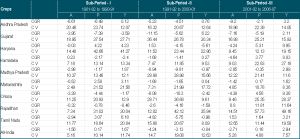 | Table 1- Compound Annual Growth Rates and Coefficients of Variation in Area, Production and yield of Jowar Crop CGR = Compound Growth Rate; CV =Coefficient of Variation; Source: CMIE [11]. |
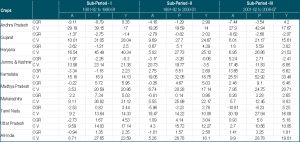 | Table 2- Compound Annual Growth Rates and Coefficients of Variation in Area, Production and yield of Bajra CGR = Compound Growth Rate; CV =Coefficient of Variation; Source: CMIE [11]. |
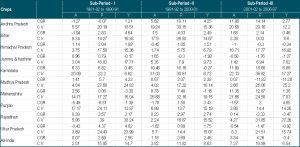 | Table 3- Compound Annual Growth Rates and Coefficients of Variation in Area, Production and yield of Maize CGR = Compound Growth Rate; CV =Coefficient of Variation; Source: CMIE [11]. |