


ISSN : 2231-6833
EISSN : 2231-6841



AKINOLA M.O.1, OJENIYI S.O.2, AMUSAN O.A.3*
1Federal Polytechnic Ado-Ekiti, Nigeria.
2Department of Crop Soil and Pest Management, Federal University of Technology, Akure, Nigeria.
3Department of Agricultural Production and Management Science, Tai Solarin University of Education, Ijebu-ode.
* Corresponding Author : oamusan56@gmail.com
Received : 26-01-2013 Accepted : 04-03-2013 Published : 01-07-2013
Volume : 2 Issue : 1 Pages : 25 - 28
J Soil Sci 2.1 (2013):25-28
DOI : http://dx.doi.org/10.9735/2231-6833.2.1.25-28
A field experiment was conducted for three years (2008-2010) at two sites in Ado-Ekiti Local Government Area of Ekiti State, Southwest Nigeria to develop a soil management package for enhanced productivity of soybean (Glycine max) in the rain forest zone. Ten tillage cum wood ash manure treatments were applied and replicated three times at the two sites. The treatments were manual clearing (MC), manual clearing + ash (MCA), zero tillage (ZT), zero tillage + ash (ZTA), ploughing (PL), ploughing + ash (PLA), ploughing + harrowing (PLH), ploughing + harrowing + ash (PLHA), ploughing + two passes of harrowing (PLHH), ploughing + two passes of harrow + ash (PLHHA). Soil chemical properties and grain yield were evaluated. Significant effects of tillage method on soil N,P and Ca were recorded in the third year with PLHH having least values. Generally ash increased significantly the soil pH, organic matter (OM), N, P, K, Ca and Mg. The effects reflected better in the second and third years of cropping irrespective of tillage treatment. The ZTA and PLHA respectively had highest values of seed yield in the three cropping seasons. The most suitable tillage plus ash combination is ZTA. Ash increased mean grain yield by 93%.
Soybean, Wood ash, Ploughing, Harrowing, Zero tillage, Grain yield.
Soybean is a more recent food crop in Nigeria compared with other legumes. The shortage of edible oil and protein contributes to economic importance of soybean. However, study is scanty on aspect of soil management for the enhanced performance of the crop particularly the role of organic manure and tillage.
Nigeria is the largest producer of soybean in west and central Africa. However soybean yield in the southern rainforest zone declines yearly even with use of chemical fertilizers. This is attributable to degradation in soil physical, chemical and biological properties, negative nutrients balance, loss of organic matter and soil acidity [24] . In southern Nigeria, P, Ca and soil acidity are nutritional factors limiting the yield of soybean. The low Ca status and high soil acidity of soils are attributed to high rainfall and leaching. Hence Ca supply or liming is an integrated part of soil management package for legume production, soybean inclusive [25] . Osodeke and ojeniyi [20] reported significant correlations between yield of soybean and soil P, N, exchangeable K and organic carbon in southeast Nigeria. According to Singh et al [24] , the most important factor affecting soybean is soil acidity.
Like other legumes, tillage is expected to influence positively the soil physical properties, growth and yield of soybean. However, research information is scanty on suitable tillage method for soybean in the rainforest ecology. In the guinea savanna zone, a study was conducted on suitable tillage - fertilizer package for soybean [24] Ridging and heaping gave highest yield but combination of manual clearing plus single superphosphate, conventional tillage plus superphosphate respectively gave highest grain yield.
There is need to develop suitable, adoptable and sustainable tillage-manure package for soybean cultivation in the rain forest ecology. Wood ash is a cheap, easily available fertilizing and liming material for crops [1,5,10,16] . Ash derived from plants is a source of macro and micro nutrients including P and Ca that are important in soybean cultivation. Wood ash serves to furnish K and Ca with small amounts of other nutrients, hence many farmers use it on coconut palms. In most oil palm plantations, ash derived from bunch wastes is used as fertilizer. In their study, Ezekiel et al [11,12] found that oil palm bunch ash increased nutrients availability and yield of cassava in southeast Nigeria. The analysis of wood ash by Ewulo et al [10] showed that it had high level of K, Ca, Mg and trace values of N and P.
This study, carried out over a period three years, investigated the effect of tillage methods and tillage - ash combinations on soil nutrients composition and yield of soybean in southwest Nigeria.
Field experiment was conducted in three consecutive seasons (2008, 2009 and 2010) at two sites in Ado Ekiti Local Government Area of Ekiti State, Southwest Nigeria. Ado-Ekiti (Latitude 7º371N, longitude 5º141E) is located in the rainforest zone and is characterized by sandy-loam soil that belongs to Okemesi series and classified as oxic Tropuldalf (USDA). It is derived from quartz, gneiss and schist. The two sites were Federal polytechnic Ado-Ekiti (FPA) and Ago Aduloju village (AGO) which had been under fallow for at least 5years. The rainfalls in the three years of experience were 1156, 1476 and 804mm respectively for 2008, 2009 and 2010. Ten tillage cum ash treatments were applied to soybean after initial manual clearing. They were (a) manual clearing with cutlass, (b) manual clearing + ash (MCA), (c) zero tillage (ZT) paraquat treated, (d) zero tillage + ash (ZTA), (e) ploughing (PL), (f) ploughing + ash (PLA), (g) ploughing + harrowing (PLH), (h) ploughing + harrowing + ash (PLHA), (i) ploughing followed by two passes of harrow (PLHH) and (j) ploughing followed by two passes of harrow + ash (PLHHA). Treatments were allocated in a randomised complete block design (RCBD) and replicated three times.
Each plot measured 5m x 5m with 2m wide discards area between blocks and 1m between plots. Four soybean (TGX 1829-1E) seeds were planted per stand on 15th July, 2008 at 30x30cm. Seedlings were thinned to one plant per stand two weeks after planting to give 50 plants per plot. Weeding was manually done 6 weeks after planting. Experiment was repeated using the same sites and plots in 2009 and 2010.
At harvest of each crop ten plants were selected for determination of seed weight.
Before commencement of experiment in 2008, surface (0 to 10cm depth) soil samples were collected using core sampler over each site for chemical analysis. At harvest of each crop, samples were collected over each treatment plot and bulked for each replicate each year. Samples were air-dried and sieved using 2mm sieve before routine analysis was carried out as described by Faithful [13] . Organic matter (OM) was determined by wet dichromate method; Total N was determined by micro-kjeldahl digestion method; available P by Bray-1 extraction followed by molybdenum blue colorimetry. Exchangeable K, Ca and Mg were extracted using ammonium acetate; K was determined on flame photometer and Ca and Mg by EDTA titration. Soil pH in soil-water 1:2 medium was determined.
The test wood ash collected from a bakery was analysed as done for soil before the first experiment.
Soil and crop data were subjected to analysis of variance and the means were compared using Duncan Multiple Range Test at 0.05 level.
Data on initial soil and wood ash analysis are shown in [Table-1] . The test soils are low in OM and available P. Test wood ash is very high in pH, K, Ca and Mg relative to soil. Therefore it is suitable as a liming material. Relative to K and Mg, the ash Ca content is very high, about five times higher than Mg and twelve times higher than K. The N concentration of ash is 100% higher than soil N concentration. Ash is therefore expected to release N, K, Ca and Mg to the soil. Available P concentration in soil and ash are comparable.
Generally, tillage method did not influence soil chemical properties significantly in the first and second cropping of soybean at the two sites of study [Table-2] , [Table-3] , [Table-4] , [Table-5] , [Table-6] , [Table-7] . Values of nutrients contents were similar among the five tillage treatments. However in the third cropping season, the PLHH gave the least values of available soil P, K, OM and N in site 1 (Table 6) and least Ca, P, OM and N in site 2 [Table-7] . At sites 1 and 2, the effect of tillage method was significant on soil P and it was significant on soil N and Ca in site 2.
Analysis of test wood ash in 2008 gave the following data. Total N (4.8 g kg-1); available P (8.8 mg kg-1); exchangeable Ca (64 cmol kg-1); Mg (12 cmol kg-1); K (5.2 cmol kg-1) and pH in water (11.1). Ash increased soil pH, Ca, Mg, OM, N and P in the first cropping season at sites 1 and 2 especially in ZT (zero tillage) and PL (ploughed) soils. Similar observation was made in respect of the nutrients in site 1 when ash was added to PLH at site 1 and in respect of pH, Ca, Mg and K at site 2. Ash increased soil K and OM in the first season at site 1 as well as at site 2.
Unlike in the first cropping season when there were exceptions, addition of ash to tilled and untilled soils increased soil pH, Ca, Mg, K, OM, N, and P in the second and third seasons and at both sites of study. The effect of ash addition on soil chemical properties was often statistically significant. It appeared the effect of ash in improving soil pH, OM and nutrients reflected better after the first year of its addition to soil. It had cumulative effect. Thus, ash served as a liming and fertilizing material.
The PLH had highest values of seed weight at sites 1 and 2 and its effect was significant in the first crop season. It had similar values with ZT in the second and third seasons. The PLHH and MC respectively had least seed yields. The overall mean values for MC, ZT, PL, PLH and PLHH were 77, 109, 87, 165 and 83 gm per 10 plants respectively [Table-8] . The initial positive effect of PLH on yield is attributable to relatively lower bulk density and higher porosity recorded for its soil, which should have favoured root growth and nodulation [2] .
The relatively high seed yield recorded for ZT is attributable to accumulation of OM and nutrients especially cations in surface soil on long term basis. It could be seen that ZTA recorded the highest or relatively high soil OM in the second cropping season at site 2 [Table-5] and in the third season at site 1 [Table-6] . It had highest soil concentrations of soil N and K at site 1 in the third season and highest soil N, K and Mg at site 2. Experiments conducted on alfisols of West Africa indicated beneficial effect of reduced and zero tillage on soil physical, chemical and biological properties in the long term [18,19] . High soil OM content and associated increased availability of nutrients and favourable structure and moisture status enhance crop yield on long term basis. Whereas excessive mechanised tillage involving repeated secondary tillage such as in case of PLHH in the present study adversely affects crop yield and soil quality, it could be seen that PLHH tended to have least soil nutrients and OM concentrations in the second and third cropping seasons. This can be adduced to its least seed yield. In the second season, the mean seed yield for MC, ZT, PL, PLH, and PLHH were 55, 69, 59, 70, and 52 gm per 10 plants respectively. In the third season, the values were 61, 70, 70, 62 and 50 gm. Therefore in the long term, zero tillage sustained relatively high soil OM and fertility status and as a result higher crop yield.
The ZTA and PLHA respectively had highest values of seed yield in the first, second and third cropping seasons irrespective of site among the ten tillage cum ash treatment packages. The ZTA clearly had the highest and significantly different values. The least values were consistently recorded by MC and PLHH with mean yield (per 10 plants) of 83 and 77gm respectively. These compared with mean seed yield of 329 and 228 gm for ZTA and PLHA respectively. Thus non-tillage and excess mechanical tillage adversely affected soybean yield while ash clearly improved yield. The values recorded for ZTA and PLHA were respectively significantly higher than yield for other treatments. Hence the ZTA combination is most suitable under the rainforest ecology of study.
The least yield recorded for untilled MC and excessively tilled PLHH soils among the five tillage treatments can be associated with the compactness of their soils. In the study of the physical properties of the soils, the MC, ZT and PLHH soils had higher bulk density, which is disadvantageous to root growth and nutrients uptake especially in case of legumes.
The highest yield recorded for the package ZTA can be adduced to the fact that on long term basis ZT is known to accumulate organic matter and nutrients in tropical soils. For example in the third year of the present study, at site 1, ZT recorded the highest value of soil OM, K and CEC among the five tillage treatments. At site 2, it had relatively high soil N, K and Mg. Aside from accumulating nutrients and OM, addition of ash to ZT soil should have further enhanced nutrients accumulation thus significantly enhancing uptake of nutrients by soybean especially P and Ca which are known to dictate yield of soybean. The present work shows that soil pH, OM and macro-nutrients were increased significantly by ash addition to soil. This led to significant increases in seed weight. Irrespective of cropping season and site, addition of ash to MC soil increased mean seed yield by 91%. In case of ZT the increase was 202%; for PL, the increase was 82%; 38% in case of PLH and 53%in case of PLHH. These gave overall mean increase of 93%.
The results of this study revealed that ash generally increased significantly the soil pH, organic matter, N, P, K, Ca and Mg especially in the second and third years of cropping irrespective of tillage treatment. The zero tillage plus ash treatment (ZTA) produced the highest soybean grain yield in the three cropping seasons and is therefore concluded to be the best treatment for sustainable soybean production in southwest Nigeria.
[1] Adeleye E.O., Adeleye A.A. and Ojeniyi S.O. (2004) The Nigerian Journal of Research and Production, 5(5), 76-82.
» CrossRef » Google Scholar » PubMed » DOAJ » CAS » Scopus
[2] Awodun M.A. and Ojeniyi S.O. (2005) Nigerian Agricultural Journal, 36, 80-87.
» CrossRef » Google Scholar » PubMed » DOAJ » CAS » Scopus
[3] Awodun M.A. and Ojeniyi S.O. (2005) Nigerian Agricultural Journal, 36, 80-87.
» CrossRef » Google Scholar » PubMed » DOAJ » CAS » Scopus
[4] Awodun M.A., Otaru M.S. and Ojeniyi S.O. (2007) Asian Journal of Agricultural Research, 1, 27-30.
» CrossRef » Google Scholar » PubMed » DOAJ » CAS » Scopus
[5] Awodun M.A., Ojeniyi S.O., Adesoye A. and Odedina S.A. (2007) American Eurasian Journal of Sustainable Agriculture, 1, 50-54.
» CrossRef » Google Scholar » PubMed » DOAJ » CAS » Scopus
[6] Ayeni L.S., Ayeni O.M., Oso O.P. and Ojeniyi S.O. (2008) Agricultural Journal, 3(5), 323-326.
» CrossRef » Google Scholar » PubMed » DOAJ » CAS » Scopus
[7] Ayeni L.S., Adetunji, M.T and Ojeniyi,S.O.2008. Nigerian journal of soil science 18, 114-123.
» CrossRef » Google Scholar » PubMed » DOAJ » CAS » Scopus
[8] Ayeni L.S., Adetunji M.T., Ojeniyi S.O., Ewulo B.S. and Adeyemo A.J. (2008) American Eurasian Journal of Sustainable Agriculture, 2(1), 92-97.
» CrossRef » Google Scholar » PubMed » DOAJ » CAS » Scopus
[9] Ayeni L.S., Adetunji M.T. and Ojeniyi S.O. (2009) International Journal of Pure and Applied Sciences, 2(2), 34-41.
» CrossRef » Google Scholar » PubMed » DOAJ » CAS » Scopus
[10] Ewulo B.S., Babadele D.O. and Ojeniyi S.O. (2009) American Eurasian Journal of Sustainable Agriculture, 3(1),88-92.
» CrossRef » Google Scholar » PubMed » DOAJ » CAS » Scopus
[11] Ezekiel P.O., Ojeniyi S.O., Asawalam D.O. and Ano A.O. (2009) Nigeria Journal of Soil Science, 19(1), 1-5.
» CrossRef » Google Scholar » PubMed » DOAJ » CAS » Scopus
[12] Ezekiel P.O., Ojeniyi S.O., Asawalam D.O. and Ano A.O. (2009) Nigeria Journal of Soil Science, 19(1), 6-10.
» CrossRef » Google Scholar » PubMed » DOAJ » CAS » Scopus
[13] Faithful N.T. (2002) A Practical Handbook, CABI Publishing, 206.
» CrossRef » Google Scholar » PubMed » DOAJ » CAS » Scopus
[14] Kayode B.O., Ojeniyi S.O. and Odedina S.A. (2010) Nigerian Journal of Soil Science, 22(1), 186-189.
» CrossRef » Google Scholar » PubMed » DOAJ » CAS » Scopus
[15] Nottidge D.O., Ojeniyi S.O., Asawalam D.O. (2007) Nigerian Journal of Soil Science, 17, 98-103.
» CrossRef » Google Scholar » PubMed » DOAJ » CAS » Scopus
[16] Odedina S.A., Odedina J.N., Ayeni S.O., Arowojulu S.A., Adeyeye S.D. and Ojeniyi S.O. (2003) Nigerian Journal of Soil Science, 13, 55-60.
» CrossRef » Google Scholar » PubMed » DOAJ » CAS » Scopus
[17] Ojeniyi S.O., Awanlemhen B.E. and Adejoro S.A. (2010) Journal of American Science, 6(12), 456-480.
» CrossRef » Google Scholar » PubMed » DOAJ » CAS » Scopus
[18] Ojeniyi S.O. and Agoola A.A. (1995) Africa Soils, 28, 255-256.
» CrossRef » Google Scholar » PubMed » DOAJ » CAS » Scopus
[19] Ojeniyi S.O. (2011) Proceedings Nigerian Branch of International Soil Tillage Research Organisation, Ilorin, 49-54.
» CrossRef » Google Scholar » PubMed » DOAJ » CAS » Scopus
[20] Osodeke V.E. and Ojeniyi S.O. (2005) Nigerian Journal of Soil Science, 15, 129-132.
» CrossRef » Google Scholar » PubMed » DOAJ » CAS » Scopus
[21] Osodeke V.E. and Ojeniyi S.O. (2003) Nigerian Journal of Soil Science, 13, 1-6.
» CrossRef » Google Scholar » PubMed » DOAJ » CAS » Scopus
[22] Owolabi O., Adeleye A., Oladejo B.T. and Ojeniyi S.O. (2003) Nigerian Journal of Soil Science, 13, 55-60.
» CrossRef » Google Scholar » PubMed » DOAJ » CAS » Scopus
[23] Owolabi O., Ojeniyi S.O., Amodu A.O. and Hazzan K. (2005) Moor Journal of Agricultural Research, 4(2), 178-182.
» CrossRef » Google Scholar » PubMed » DOAJ » CAS » Scopus
[24] Singh A., Carsky R.J., Lucas E.O., Dashell K. and Adeoye G.O. (2000) Nigerian Journal of Soil Science, 12, 81-87.
» CrossRef » Google Scholar » PubMed » DOAJ » CAS » Scopus
[25] Singh S.R., Rachie K.O. and Dashell K.E. (1987) Soybean for the Tropics: Research, Production and Utilization, John wiley & sons ltd, NY, 230.
» CrossRef » Google Scholar » PubMed » DOAJ » CAS » Scopus
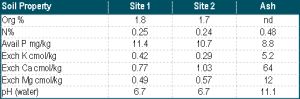 | Table 1- Pre-trial Soil and Ash analysis data |
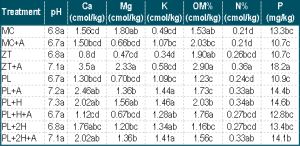 | Table 2- Effect of tillage and wood ash on soil chemical properties -crop 1 site 1 A = ash, ZT = zero tillage, MC = Manual clearing, PL = Ploughing, H= Harrowing |
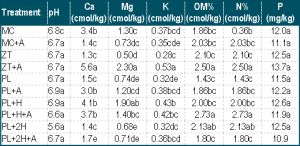 | Table 3- Effect of tillage and wood ash on soil chemical properties- crop 1 site 2 A = ash, ZT = zero tillage, MC = Manual clearing, PL = Ploughing, H= Harrowing |
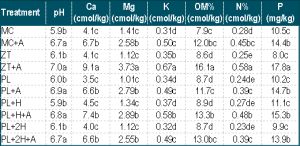 | Table 4- Effect of tillage and wood ash on soil chemical properties- crop 2 site 1 A = ash, ZT = zero tillage, MC = Manual clearing, PL = Ploughing, H= Harrowing |
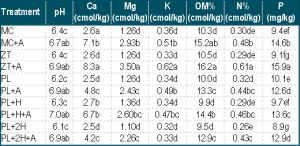 | Table 5- Effect of tillage and wood ash on soil chemical properties- crop 2 site 2 A = ash, ZT = zero tillage, MC = Manual clearing, PL = Ploughing, H= Harrowing |
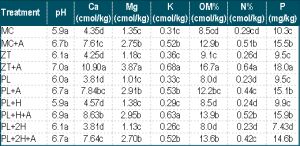 | Table 6- Effect of tillage and wood ash on soil chemical properties- crop 3 site 1 |
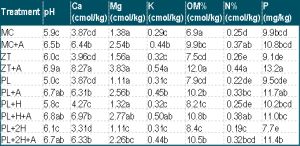 | Table 7- Effect of tillage and wood ash on soil chemical properties – crop 3 site 2 A = ash, ZT = zero tillage, MC = Manual clearing, PL = Ploughing, H= Harrowing |
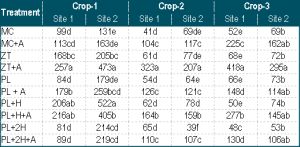 | Table 8- Effect of tillage and wood ash on seed weight of soybean A = ash, ZT = zero tillage, MC = Manual clearing, PL = Ploughing, H= Harrowing |