


ISSN : 0976-9943
EISSN : 0976-9951



MISRA S.1*, MANDAL T.2, VANLALRUATI3, DAS S.K.4
1Department of Floriculture & Landscaping, BCKV, Nadia-741 252, West Bengal, India.
2Department of Floriculture & Landscaping, BCKV, Nadia-741 252, West Bengal, India.
3Department of Floriculture & Landscaping, BCKV, Nadia-741 252, West Bengal, India.
4Department of Floriculture & Landscaping, BCKV, Nadia-741 252, West Bengal, India.
* Corresponding Author : tmbckv@gmail.com
Received : 09-01-2013 Accepted : 21-01-2013 Published : 02-09-2013
Volume : 3 Issue : 1 Pages : 14 - 16
J Hortic Lett 3.1 (2013):14-16
DOI : http://dx.doi.org/10.9735/0976-9943.3.1.14-16
Twenty five germplasm of spray chrysanthemum were evaluated to determine correlation and path coefficient among seven different parameters to differentiate the contribution made by each parameter in the final flower yield. Number of primary branches per plant had the highest correlation (0.998) followed by number of secondary branches per plant (0.997) and number of leaves per plant (0.997). Path coefficient analysis revealed that Number of primary branches per plant had the highest direct effect on flower yield (0.6010) followed by number of secondary branches per plant (0.2452) and number of leaves per plant (0.1631). All these three characters showed a negative indirect effect via plant height at full bloom stage, self-life and flower diameter. The important characters effecting flower yield in this study were number of primary branches per plant, number of secondary branches per plant and number of leaves per plant.
spray chrysanthemum, correlation, path analysis, flower yield, yield components.
Chrysanthemum is commonly known as Gul-e-Daudi or Autumn Queen. It belongs to the family Compositae (Asteraceae). It has about 275 different varieties grown in the different parts of the world for the beautification and decoration purposes. Apart from ornamental values, the flowers of 52 varieties of Chrysanthemum moifolium are edible [3] . So many works have been done on the evaluation of best chrysanthemum cultivars in India and still there are a lot of researches going on to select the best cultivars suitable for particular soil and climatic conditions. The wide range of groups and varieties of this flower made the workers research more complex. Its flower yield is a complex character and is the result of interrelationship of various components. Therefore, information on direct and indirect effect of these components is of great importance. Study of such yield components may provide a solid ground for a successful varietal development programme. Path coefficient analysis and its contribution to vertical development have been reported by many workers [2,6] . Vegetative parameters, different flowering parameters and floral characters are the important characters which need to be recorded as they help in determining the criteria for the selection of suitable varieties. Keeping all these in views, the following experiment was undertaken to find out the type of association between flower yield and yield attributes to judge the direct and indirect influences of these on flower yield through path coefficient analysis in some germplasm of spray chrysanthemum for maximizing quality cut flower production in the plains of West Bengal.
The experiments were conducted at the Horticulture Research Station, Mondouri, Bidhan Chandra Krishi Viswavidyalaya, Nadia, West Bengal 2011-12 to evaluate the performance of some chrysanthemum germplasm under new alluvial zone of West Bengal. The experiment was laid out according to Randomized Block Design with three replications. The treatments in this experiment were of twenty five cultivars. The field was divided into three blocks; each block was further divided into twenty five plots i.e. one plot for each treatment. The total number of plots in the experiment was seventy five. The rooted cuttings were planted on 10-15 cm raised beds. The size of each bed was 2 × 1.5 m, with 30 cm wide channel and path for irrigation. The treatments were allotted randomly in each plot. Healthy, well-rooted cuttings of more or less uniform growth were planted at a spacing of 40 × 30 cm on the 5th November’ 2011 in open field. The plants were allowed to grow naturally without pinching, de-shooting or disbudding, to study its natural growth and flowering behavior. Twenty one characters including Vegetative parameters (i.e. plant height, number of leaves per plant, individual leaf area and number of primary and secondary branches per plant), different flowering parameters (including number of days to flower bud emergence from planting, days to bud break, days to full bloom and days to senescence from full bloom), floral characters (number of flower per plant, individual flower diameter, individual flower weight) and the vase-life parameters (such as days to opening of fifty percent of the flowers in the stalk, days to reach full bloom stage, days to get senescence, amount of water uptake by the plant and weight loss of the stalk) were recorded. The data collected from the germplasm of spray chrysanthemum on different parameters were subjected to statistical analysis following Panse and Sukhatme [5] . The level of significance considered for the ‘F’ and ‘t’ test was 5% (p=0.05). Software SPSS 16.0 was used to calculate the correlation coefficients among different parameters. Path coefficient analysis was performed according to the procedure adopted by Dewey and Lu [2] .
The variability parameters showing PCV (Phenotypic Coefficient of Variability) as well as GCV (Genotypic Coefficient of Variability) as percentage over mean along with their mean values and range are presented in [Table-1] .
The data in the table revealed that among the characters numbers of leaves/plant exhibited highest range (93.33 to 299.56) with a mean of 186.50. The magnitude of range was between 8.54 to 39.03 cm for plant height at bud initiation stage, 17.75 to 49.64 cm for plant height at full bloom stage, 6.56 to 16.08 for number of primary branches/plant and 30.56 to 58.00 for number of secondary branches/plant. The range of 24.28 to 32.44 days, 5.2 to 9.21cm and 71.00 to 115.33 was observed for self-life of flowers, flower diameter and number of flowers/plant respectively. The difference between the PCV and GCV showed a minimum difference among the characters. Among these parameters plant height at bud initiation stage showed maximum phenotypic and genotypic variation of 47.04% and 45.87% respectively followed by numbers of leaves/plant with 35.43% and 33.60% respectively and plant height at full bloom stage 33.12% and 31.83% respectively.
Correlation among the seven parameters studied showed that number of primary branches per plant had the highest and positively significant correlation with flower yield (number of flowers per plant). Number of leaves per plant and number of secondary branches per plant both ranked second with high and positively significant correlation with the flower yield, while plant height at bud initiation stage and plant height at full bloom stage also showed high and positively significant correlation with the flower yield [Table-2] . However, flower diameter showed highest negative correlation (-0.114) (though non significant) and self-life (field-life) of flowers showed second highest negative correlation (-0.065) (non significant) with the flower yield. This indicated that number of primary branches per plant, number of leaves per plant and number of secondary branches per plant were strongly associated with flower yield. The correlation of characters among themselves revealed that plant height at bud initiation stage, plant height at full bloom stage, number of leaves per plant, number of primary branches per plant and number of secondary branches per plant had very high, positive and significant correlation with each other. On the other hand, self-life of flowers and flower diameter showed very low, negative and non significant correlation with the rest of the parameters as well as among themselves. Correlation analysis [Table-2] revealed that the traits most important in flower yield were number of primary branches per plant, number of secondary branches per plant and number of leaves per plant. However, simple correlation should not be interpreted as having casual relationship between two variables [4] . Path coefficient technique presents a better idea of cause and effect relationship among different characters. A path coefficient is simply a standardized partial regression coefficient [2] and hence permits us to identify direct and indirect effects of different characters on flower yield. It is obvious from the data that number of primary branches per plant had the highest direct effect on flower yield followed by number of secondary branches per plant and number of leaves per plant [Table-3] . It is, therefore, concluded that these three parameters had very high, positive and significant correlation as well as high direct effects on flower yield. Perusal of indirect effects of number of primary branches per plant revealed that it also had a high indirect effect via number of secondary branches per plant and number of leaves per plant.
Similarly number of secondary branches per plant and number of leaves per plant both had the highest positive indirect effect through number of primary branches per plant. High direct effect of a character on yield indicates that it was controlled by additive type of gene action [1] . Moreover, plant height at bud initiation stage and plant height at full bloom stage also showed high and positive indirect on yield via these three characters although plant height at full bloom stage revealed a negative direct effect on flower yield. A perusal of data showed that high direct and indirect effects of a character on flower yield also revealed high correlations. The exception was plant height at full bloom stage which had negative direct effect on flower yield. This indicated that these characters were under genotypic control. However the negative effects of number of primary branches per plant, number of secondary branches per plant and number of leaves per plant through the remaining characters has to be considered. For instance, number of primary branches per plant had the negative indirect effect on flower yield through plant height at full bloom stage, self-life of flowers and flower diameter. Similarly both number of secondary branches per plant and number of leaves per plant had the negative indirect effect on flower yield via those three characters as well. It meant that if increase number of primary branches per plant, number of secondary branches per plant and number of leaves per plant, other characters like plant height at full bloom stage, self-life of flowers and flower diameter will be negatively affected.
Thus the study indicated that number of primary branches per plant, number of secondary branches per plant and number of leaves per plant be improved in any selection scheme aiming at increasing flower yield. However, the effect of the negative indirect effect of those characters via plant height at full bloom stage, self-life of flowers and flower diameter must be considered.
With privilege, it is my immense pleasure to express the gratitude towards the researchers, workers, labours and all the other stuffs associated with A.I.C.R.P. [All India Co-ordinate Research Project (Floriculture)], Bidhan Chandra Krishi Viswavidyalay, Mohanpur, Nadia, West Bengal, India for their continuous support, needful help and necessary suggestion in bringing out my work.
[1] Aslam M., Khan N.A., Mirza M.S. and Khan A.R. (1992) Pakistan J. Agric. Res., 13, 20-25.
» CrossRef » Google Scholar » PubMed » DOAJ » CAS » Scopus
[2] Dewey D.R. and Lu K.H. (1959) Agron. J., 51, 515-518.
» CrossRef » Google Scholar » PubMed » DOAJ » CAS » Scopus
[3] Endo M. and Iwasa S. (1982) Journal of the Japanese Society for Horticultural Sciences, 51(2), 177-186.
» CrossRef » Google Scholar » PubMed » DOAJ » CAS » Scopus
[4] Gomez K.A. and Gomez A.A. (1984) Statistical Procedure for Agri. Res., 2nd ed., John Willey & Sons, 680.
» CrossRef » Google Scholar » PubMed » DOAJ » CAS » Scopus
[5] Panse V.C. and Sukhatme P.V. (1995) Statistical Methods for Agricultural Workers., ICAR, New Delhi, 199-210.
» CrossRef » Google Scholar » PubMed » DOAJ » CAS » Scopus
[6] Srivastava J.P., Singh H.N. and Singh S.O. (1975) Progressive Hort., 7, 5-9.
» CrossRef » Google Scholar » PubMed » DOAJ » CAS » Scopus
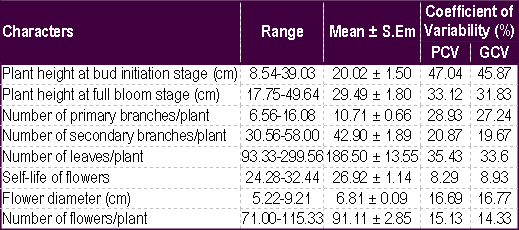 | <i>Table 1- Mean, Range and Estimates of Genetic Variability of twenty five spray chrysanthemum germplasm.</i> |
 | <i>Table 2- Correlations among six traits of the spray chrysanthemum germplasm **. Correlation is significant at the 0.01 (P<0.1%) level (2-tailed).</i> |
 | <i>Table 3- Path coefficient analysis showing direct (diagonal) and indirect effects among seven traits of the spray chrysanthemum germplasm Residual effect= 0.9968</i> |