


ISSN : 0976-9943
EISSN : 0976-9951



SHEKARA B.G.1, SOWMYALATHA B.S.2*, BARATKUMAR C.3
1AICRP on Forage Crops, ZARS, V.C. Farm, Mandya- 571 405, Karnataka, India
2AICRP on Forage Crops, ZARS, V.C. Farm, Mandya- 571 405, Karnataka, India
3AICRP on Forage Crops, ZARS, V.C. Farm, Mandya- 571 405, Karnataka, India
* Corresponding Author : sowmyalatha.vinu@gmail.com
Received : 08-03-2012 Accepted : 22-11-2012 Published : 26-11-2012
Volume : 2 Issue : 1 Pages : 12 - 13
J Hortic Lett 2.1 (2012):12-13
DOI : http://dx.doi.org/10.9735/0976-9943.2.1.12-13
A field experiment was conducted at Zonal Agricultural Research Station, V.C. Farm, Mandya (Karnataka) during kharif 2011, to study the response of fodder cowpea genotypes (MFC 08-14, IL-117, UPC 5286, Bundel Lobia-1 and UPC 9202) to varied levels of phosphorus (30, 60 and 90 kg P2O5 ha-1). The experiment was laid out in factorial randomized design with three replications. The result revealed that among genotypes MFC o8-14 recorded significantly higher green forage yield (267.44 q ha-1), dry matter yield (43.40 q ha-1) and crude protein yield (6.41 q ha-1). Application of 90 kg P2O5 ha-1 recorded significantly higher green fodder (242.80 q ha-1), dry matter (39.01 q ha-1) and crude protein yield (5.88 q ha-1) .
Genotypes, Phosphorus levels, Crude protein, Dry matter yield, Green forage yield.
Cowpea (Vigna unguiculata L.) is a grain legume belonging to the family leguminosae. Its value lies in its high protein content and ability to tolerate drought. Cowpea is an important food, fodder and cover crop. It also possesses the ability to fix atmospheric nitrogen through its nodules and thereby grows well in poor soils. It has been identified as one of the keys to crop-livestock. Phosphorus is important for cowpea production and is inherently low in many tropical soils. Next to nitrogen phosphorus is yield limiting nutrient. Selection of cowpea genotypes that produce good yield under low soil P or those with high P response efficiency can be a low input approach in solving this problem. In addition, cowpea is considered less prone to drought and has a high yield potential especially when P fertilizers are applied. Keeping these things in view, the present study was under taken to optimize the phosphorus level for sustaining yield in fodder cowpea under rainfed situation.
The present investigation was carried out at Zonal Agricultural Research Station, V.C. Farm, Mandya, University of Agricultural Sciences, Bangalore, Karnataka, under All India Co-ordinated Research Project on Forage crops during kharif seasons of 2011 under rainfed situation. The experiment was laid out in factorial randomized complete block design with three replications. The experiment consisted of 15 treatments, including five cowpea genotypes (MFC 08-14, IL-117, UPC 5286, Bundel Lobia-1 and UPC 9202) and three phosphorus levels (30, 60 and 90 kg P2O2 ha-1). The texture of the soil is red sandy loam having pH 6.9, available nitrogen (220 kg ha-1), phosphorus (30.32 kg ha-1) and potassium (160.19 kg ha-1). The crop was sown in June at row spacing of 30 cm apart. The recommended dose of nitrogen (25 kg ha-1) and potassium (25 kg ha-1) were applied in the form of urea and muriate of potash respectively. Phosphrus was applied using single super phosphate as per treatments at the time of sowing. The cultural operation was applied and other production practices were followed as per local recommendation. Observations on growth parameters were recorded at 50 percent flowering. The data was analysed statistically for the interpretation of the results.
Genotypes were significantly influenced by phosphorus levels with respect to Green fodder, dry matter, crude protein yield, plant height and number of branches per plant. Genotype MFC 08-14 recorded significantly higher plant height, number of branches and leaf stem ratio (50.55 cm, 5.51 and 0.50), followed by UPC 9202 (50.02 cm, 5.35 and 0.45 respectively) over check Bundel lobia-1 (46.46 cm, 5.20 and 0.44). Application of 90 kg P2O5/ha recorded significantly higher plant height, number of branches per plant and leaf stem ratio (48.96 cm, 5.53 and 0.46) which was on par with 60 kg P2O5/ha(48.65 cm, 5.22 and 0.44). The increased plant height at higher level of nutrients may be due to increased intermodal length. These results are in conformity with the work of Ezedinma (1965). Singh et al. (1968) also reported that phosphous promotes branches length and width of leaves intern increased plant height. According to Malik et al. (1972) phosphorus at higher level promotes more number of branches which might have enhanced the metabolic activity and intern plant growth. Among different cowpea genotypes MFC 08-14 recorded significantly higher green fodder yield (267.44 q ha-1), dry matter yield (43.40 q ha-1), crude protein yield (6.41 q ha-1), followed by UPC 9202 (227.15 q, 36.97 q and 5.51 q ha-1 respectively) over check Bundel lobia-1 (216.07 q, 34.48 q and 5.24 q ha-1). This increase in herbage yield could be attributed to maximum plant height and more number of branches with MFC 08-14 than the other varieties [Table-1] . Application of 90 kg P2O5 ha-1 recorded significantly higher green fodder yield (242.80 q ha-1), dry matter yield (39.01 q ha-1), crude protein yield (5.88 q ha-1), which was on par with 60 kg P2O5 ha-1 (235.15, 37.68 and 5.66 q ha-1 respectively) but superior over 30 kg P2O5 ha-1 [Table-2] . Data further indicated that every incremental dose of phosphorus increased green fodder, dry matter and crude protein yield significantly upto 90 kg P2O5 ha-1 which was on par with 60 kg P2O5 ha-1. The increase in green forage yield with higher level of phosphorus might be due to effective utilization of nutrients through extensive root system developed by phosphorus application. The interaction between genotypes and phosphorus levels found non-significant. The results of the present investigation are in line with the reports of Tripathi et al. (1997), Kumar and Sangwan (2006).
[1] Ezedinma F.O.C. (1965) Nigerian Agricultural Journal, 2, 75-79.
» CrossRef » Google Scholar » PubMed » DOAJ » CAS » Scopus
[2] Kumar D. and Sangwan V.P. (2006) Forage Res., 32, 59-60.
» CrossRef » Google Scholar » PubMed » DOAJ » CAS » Scopus
[3] Malik B.S., Arora N.D. and Lodhi G.P. (1972) Haryana Agricultural University Journal Research, 2, 114-118.
» CrossRef » Google Scholar » PubMed » DOAJ » CAS » Scopus
[4] Singh R., Singh N. and Sidhu G.S. (1968) Journal Research, 1, 88-94.
» CrossRef » Google Scholar » PubMed » DOAJ » CAS » Scopus
[5] Tripathi H.P., Gill P.S. and Kapoor M.L. (1997) Forage Res., 3, (1 and 2), 121-126.
» CrossRef » Google Scholar » PubMed » DOAJ » CAS » Scopus
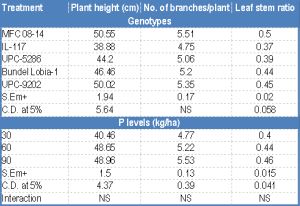 | Table 1- Plant height (cm), Number of branches per plant and leaf stem ratio of fodder cowpea genotypes as influenced by phosphorus levels |
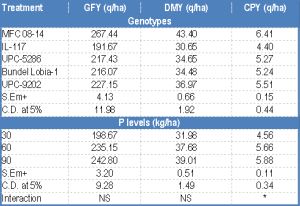 | Table 2- Green forage, Dry matter and Crude protein yield (q ha-1) of fodder cowpea genotypes as influenced by phosphorus levels |