


ISSN : 0976-8920
EISSN : 0976-8939



KANDIL A.A.1, SHARIEF A.E.2*, ABIDO W.A.E.3, IBRAHIM M.M.O.4
1Department of Agronomy, Faculty of Agriculture, Mansoura University, Egypt.
2Department of Agronomy, Faculty of Agriculture, Mansoura University, Egypt.
3Department of Agronomy, Faculty of Agriculture, Mansoura University, Egypt.
4Central Administration for Seed Certification (CASC), Seed Testing Station, Beni-Suef, Ministry of Agriculture, Egypt.
* Corresponding Author : shariefali42@gmail.com
Received : 19-12-2012 Accepted : 27-12-2012 Published : 28-12-2012
Volume : 3 Issue : 3 Pages : 95 - 103
J Crop Sci 3.3 (2012):95-103
DOI : http://dx.doi.org/10.9735/0976-8920.3.3.95-103
Conflict of Interest : None declared
A laboratorial experiment was carried out at Bani-Sueif Seed Testing Laboratory during the period of October and November 2011 to investigate the effect of NaCl priming on seed germination and seedling growth of some canola cultivars i.e. Serw 4, Serw 10, Pactol and Line 51-El Serw. Canola seeds were primed with 1% NaCl solution for 24 hours, at 20°C. Then primed and non-primed seeds were irrigated with seven different saline solutions consisted of 0, 0.25, 0.50, 0.75, 1.00, 1.25 and 1.50% concentrations of NaCl. Results showed a significant effect of studied canola cultivars on means of final germination percentage (FGP %), germination index (GI), seedling vigor index (SVI), plumula length (cm), radical length (cm), seedling fresh weight (g), seedling dry weight (g), and seedling height reduction (SHR %). Line 51-El-serw significantly exceeded other studied cultivars in (FGP, GI, SVI, plumula length, radical length and seedling dry weight). While, Serw 4 and Serw 10 cultivars significantly exceeded the other studied cultivars in seedling fresh weight and seedling height reduction %. Results showed a significant effect due to seed priming on averages of FGP, GI, SVI, plumula length, radical length, seedling fresh weight, seedling dry weight, RDW and SHR% comparing with non-seed priming. Increasing salinity concentrations from 0 to 1.75% NaCl significantly decreased all studied characters except SHR was increased with increasing salinity concentrations. It could be concluded that priming line 51-El-serw seed with 1% NaCl and increasing salinity concentration up to 0.75% NaCl maximizing seed germination parameters and seedling characters. It is very important to use line 51-El Serw and pactol cultivar in breeding program for enhancing canola production in saline soil in Egypt.
Canola cultivars, germination and seedling characters, salinity concentrations, seed priming.
In order to reduce the gap between oil production and its consumption which reach 10% from our production only. Canola (Brassica napus L.) is a Canadian trademark for varieties of rapeseed with low content of two undesirable constituents namely, erucic acid in the seed and glycosinolate in the meal. It is one of the most important annual oil and protein crops in temperate climates. Seed provides oil both for industrial and culinary drives to production margarine, or serves as source to produce bio-diesel fuel [1] . The cultivated area of canola in Egypt is relatively small due to the strong competition between canola and other strategic winter season crops on the limited arable land in Nile Valley and Delta. Cultivation of canola in Egypt may provide an opportunity to overcome some of the local deficit of vegetable edible oil production, particularly it could be successfully grown during winter season in newly reclaimed land outside the Nile valley soils to get around the competition with other crops engaged the old cultivated area [2] . Ghassemi and Ponr [3] found that the germination percentage and dry weight of seedling were significantly affected by canola cultivars (Talayeh and Okapi). Similar conclusions were reported by Bybordi and Tabatabaei [4,5] .
Seed priming is one of the physiological methods which improves seed performance and provides faster and synchronized germination. Seed priming with NaCl could be used as an adaptation method to improve salt tolerance of seeds. Bybordi and Tabatabaei [4] indicated that all priming treatments were effective in improving germination percentage as compared to control. Maximum root and shoot lengths were recorded in hydro primed seeds. Ashraf and Foolad [6] pointed out that priming allows seed hydration to initiate the early events of germination, but not permit radicle, emergence, followed by drying to initiate moisture. Seed priming is one of the physiological methods, which improves seed performance and provides faster and synchronized germination. Farhoudi and Sharifzadeh [7] found that total emergence and dry weight were higher in canola seedlings derived from primed seeds and they emerged earlier than non-primed seeds. Mohammadi [8] and Heshmat, et al. [10] concluded that NaCl priming increased germination percentage, germination index, seedling vigor index shoot and root length and seedling dry weight, as compared with non-primed seeds.
Salinization is one of the most important factors affecting agricultural land in arid and semi-arid regions in the world, that sustainability reduces the yield of major crops by more than 50%. Salinity is one of the most serious factors limiting crops production [11-12] . The major constraint to seed germination and seedling establishment of canola is soil salinity that is a common problem in reclaimed soil in Egypt. Speed germination and seedling growth stages are known to be more sensitive to salinity [13] . Almansouri [14] reported that salt and osmotic stresses are responsible for both inhibition or delayed seed germination and seeding establishment. Under these stresses there is a decrease in water uptake during imbibition's and further more salt stress may cause excessive uptake of ions. Annon [15] and Houle, et al. [16] reported that canola has been classified as moderate tolerant together with wheat and barley, which means that when canola is grown in medium with a root-zone EC of 4-8 dSm-1 it will produce at least 50% of its normal yield. Puppala, et al. [17] found that final germination % were reduce to less 60% when salinity levels of EC 16 dSm-1 and more were used. Both canola and wheat can be classified as highly tolerant to salinity when germination response is used as an indicator. Similar conclusions were reported by [18-19] . Bybordi and Tabatabaei [4] , Mohammadi [8] , Zadeh and Naeni [12] , Baybordi [20] found that the final germination percentage, germination index, seedling vigor index, seedling growth and distance between the root hairs and root tips were decreased by salt solutions, especially by increasing salinity concentration at 12 dSm-1 treatment. However, these parameters were increased by 3 dSm-1 concentration.
Regarding to the interactions effect, Houle, et al. [16] concluded that there is a significant variation in seed germination among canola cultivars grown under salinity condition. Similar conclusions were reported by Mwale, et al. [21] . Saeid, et al. [22] reported that RJ5003 cultivar had the least and opera cultivar the most. RJ5003 and opera cultivars had the highest and the lowest germination rate compared with other three cultivars, respectively. The control seed priming under distil water had the highest root length. Opera cultivar had the highest stem length. Ghassemi, et al. [23] showed that seed priming x cultivar interaction was only significant for seedling dry weight at the 1% level of probability. Analysis of variance of the field experiment data showed that the interaction of salt priming x cultivar was only significant for grains per plant. However, the other interactions of treatments were not significant for any traits. Baybordi [20] and Zamani S., et al [24] found similar results.
This investigation was aimed to evaluate the effect of seed priming with 1% NaCl, salinity stress of some canola cultivars on germination parameters and seedling characters, as well as interaction effects between studied factors.
A laboratory experiment was conducted at Bani-Sueif Seeds Testing Laboratory Station of Central Administration for seeds Certificate (CASC), Ministry of Agriculture, Egypt, during October and November 2011. The aim of this investigation study the effect of salt stress on seed germination and seedling properties under primed and non-primed canola seeds (Brassica napus L.).
The experiment was arranged in factorial experimental with three factor in Randomized Complete Block Design (RCBD) with four replications. The first factor includes priming seeds in 1% NaCl solution and non-priming, where, the same size of canola seeds were primed with 1% Nacl solution for twenty four hours at 20°C. After priming, seeds were put in a wire mesk strainer washed with tap water for 5 minutes and then rinsed with distilled water. Following this, seeds were dried between two filter papers. Non-primed seeds were only, rinsed with distilled water. The second factor includes four spring canola cultivars i.e. Serw 4, Serw 10, Pactol, Line51 El-Serw. Cultivars were collected from EL Serw Research Station, Oil crops Department, Agricultural Research Center, Egypt. The third factor includes eight salinity concentrations of NaCl as follows: 0 (control), 0.25, 0.50, 0.75, 1.00, 1.25, 1.50 and 1.75% NaCl.
Primed and non-primed seeds were transferred in 9 cm glass petri dishes on a layer of filter paper. Twenty five seeds were placed in each petri dish, the petri dishes were wetted with different saline solutions. The dishes were labeled and placed in a germinator at 20±1°C under dark conditions. The papers belong to each dish were replaced every two days to prevent accumulation of salt [25,26] .
Random sample were sown on top filter paper in sterilized Petri-dishes (14-cm diameter). Each Petri-dish contained 25 seeds, and four Petri-dishes kept close together and incubated at 20ºC and 100% relative humidity, then four replications were used to evaluate every seed test done on each treatment as the rules of International Seed Testing Association.
Final Germination Percentage (FGP)- It was measured by the percentage of seed germinating normally after twelve days by the following formula [27,28] :
Germination Index (GI)- It was calculated using the following equation [29] :
Seedling Vigor Index (SVI)- It was calculated using the following equations [30] :
SVI = (Average Plumula Length + Average Radical Length Germination Percentage)
Shoot Length (cm)- It was determined from 10 normal seedlings taken by random per each replicate at the end of standard germination test.
Root Length (cm)- It was determined from 10 normal seedlings taken by random per each replicate at the end of standard germination test.
Seedling Fresh Weight- Shoot and root portions of averages 10 normal seedlings at random per replicate, were determined, expressed as grams.
Seedling Dry Weight- Shoot and root portions of averages 10 normal seedlings at random per replicate, were dried in a forced air oven at 70°C to a constant weight and weights thereafter, dry weight recorded and expressed as grams.
Seedling Height Reduction (SHR)- The seedling height reduction (SHR) was calculated using the following equation [31] :
SHR % =
Relative Dry Weight (RDW)- The relative dry weight (RDW) was calculated according to [31] using the following equation:
RDW % =
All obtained data were statistically analyzed according to the technique of analysis of variance (ANOVA) for the factorial experiment with three factor in randomized complete block design (RCBD) with four replications as published by Gomez and Gomez [32] by using means of “MSTAT-C†computer software package. Least Significant Difference (LSD) method was used to test the differences between treatment means at 5 and 1% level of probability as described [33] .
The results showed a significant effect of studied canola cultivars on the means of FGP, GI, SVI, plumula length, radical length, fresh weight, dry weight, RDW% and SHR% [Table-1] . Results revealed that Line 51 El-Serw significantly exceeded other studied cultivars in FGP. It could be concluded that Line 51 El-Serw is more the best in germination parameters than other studied cultivars. Line 51 El-Serw significantly exceeded other studied cultivars in GI% followed by Pactol and Serw 4 cultivars without significant differences between them. While, Serw 10 produced the lowest GI%. Moreover, Line 51 El-Serw significantly surpassed other studied cultivars in SVI followed by Pactol cultivar. While, Serw 10 cultivar produced the minimum SVI. Line 51 El-Serw significantly exceeded other studied cultivars in plumula length. Plumula length of Line 51 El-Serw surpassed Serw 10 cultivar by 8.6%, Pactol cultivar by 9.3% and Serw 4 by 14.7%. Line 51 El-Serw was recorded longest radical length, whereas Serw 10 cultivar produced the shortest radical. Line 51 El-Serw surpassed Pactol cultivar by 7.6%, Serw 4 cultivar by 9.1% and Serw 10 by 16.4% in radical length. The differences in germination parameters may be due to the genetical factors and heredity variation among studied canola cultivars. Serw 4 cultivar significantly exceeded the other studied cultivars in seedling fresh weight. Serw 4 cultivar surpassed Serw 10 cultivar by 8.5%, Line 51 El-Serw by 9.3% and Pactol cultivar by 16.9% in seedling fresh weight. Line 51 El-Serw exceeded other cultivars in seedling dry weight followed by Pactol cultivar. Whereas, Serw 4 and Serw 10 recorded the lowest weight of seedling dry weight. There were no significant differences in RDW% among all studied canola cultivars. Serw 10 cultivar significantly exceeded other studied cultivars in SHR%, which was 66.8% followed by Serw 4 and Pactol cultivars, which were 65.6 and 64.6%, respectively without significant differences between them. While, Line 51 El-Serw produced the lowest SHR% which was 61.5%. Ghassemi, et al. [23] found that germination percentage and seedling dry weight were significantly affected by canola cultivars. These results are in good accordance with those obtained by Bybordi and Tabatabaei [4] Mohammadi and Amiri [5] .
Regarding to seed priming effects, results clearly showed that a significant effect on the averages of FGP, GI%, SVI, plumula length, radical length, seedling fresh weight, seedling dry weight, RDW% and SHR% [Table-1] . It could be stated that seed priming surpassed non-priming by 17.1, 16.2, 35.9, 31.8, 27.9, 25.8, 14.6, 10.2% in FGP, GI, SVI, plumula length, radical length, seedling fresh weight, seedling dry weight, RDW%, respectively. Highest averages of SHR% was obtained from non-priming canola seeds. Seedling height reduction percentage increased with non-priming canola seeds in NaCl. Ghassemi and Ponr [3] reported that seed priming is a pre-sowing strategy for improving seedling establishment by modulating pre-germination metabolic activity prior to emergence of the radical and generally enhances germination rate and plant performance. During priming, the embryo expands and compresses the endosperm [34] . NaCl priming has a notable beneficial effect on seed performance of canola under salinity condition [8] . Significant improvement in radical length may be attributed to earlier germination induced by primed over non-primed seeds [35] , which resulted in vigorous seedlings with more root length than the seedlings from non-primed seeds. Farhoudi and Sharifzadeh [7] reported that NaCl priming enhanced proline accumulation in canola seedlings and seeds could be used to increase salt tolerance of seedlings. Seed priming improved seedling fresh weight might be due to increased cell division within the apical meristem of seedling roots, which cause an increase in plant growth [36] . These results are in good accordance with results of some researchers [7-10] .
Salt stress declined the germination and also delayed the emergence of canola seeds and significantly affected average of final germination percentage (FGP), germination index % (GI), seedling vigor index (SVI), plumula length (cm), radical length (cm), seedling fresh weight (g), seedling dry weight (g), relative dry weight (RDW%) and seedling height reduction (SHR%) as presented in [Table-1] . Highest average of final germination percentage, germination index, seedling vigor index, plumula length, radical length, seedling seedling fresh weight, seedling dry weight and relative seedling dry weight (%) were produced with the control treatment. Highest salinity concentration i.e. 1.75% NaCl produced the lowest averages of these characters. Results indicated that increasing salinity concentrations from 0 to 1.75% NaCl significantly caused decrease in germination percentage. Highest germination percentage was recorded with the control treatment followed by 0.25, 0.50, 0.75, 1.0, 1.25, 1.5 and 1.75% NaCl concentrations, which recorded 95.9, 91.9, 89.1, 74.6, 59.4, 45.3, 25.5 and 5.6%, respectively. Highest germination index was recorded from the control treatment, which was (100%). Highest salinity concentration i.e. 1.75% NaCl recorded the lowest germination index, which was 5.7%. Increasing salinity concentrations from 0 to 1.75% NaCl gradually decreased seedling vigor index. Highest values of seedling vigor index (1444.1) was recorded with the control treatment. The lowest seedling vigor index was recorded from highest salinity concentration i.e.1.75% NaCl, which was 2.9. Jamil, et al. [37] reported that salinity caused signiï¬cant reduction in germination percentage, germination rate, root and shoot lengths and fresh root and shoot weights. Salt induced inhibition of seed germination could be attributed to osmotic stress or to speciï¬c ion toxicity [38] Germination percentage also signiï¬cantly decreased as the level of salinity of the medium increased [39] . The toxic effect of sodium at high salt levels and physical damage to roots decreased their ability to absorb water and nutrient which caused marked reduction in photosynthesis, enzymatic process and protein synthesis [40] . The longest plumula (5.04 cm) produced from the control treatment. The highest salinity levels i.e. 1.75% NaCl produced the shortest plumula (0.05 cm). It could be stated that increasing salinity levels from 0.25, 0.50, 0.75, 1.00, 1.25, 1.50 and 1.75% NaCl reduced plumule length by 22.5, 42.2, 61.3, 76.2, 86.3 and 92.1%, respectively compared with the control treatment. The results clearly indicated that the longest radical (10.0 cm) produced from the control treatment compared with the other salinity concentrations. Whereas, the highest salinity concentration i.e. 1.75% NaCl produced the shortest radical length (0.31cm). Increasing salinity levels from 0.25, 0.50, 0.75, 1.00, 1.25, 1.50 and 1.75% NaCl reduced radical length by 29.3, 59.0, 77.1, 85.8, 92.5 and 96.9%, respectively compared with the control treatment. The results revealed that increasing salinity concentration from 0 to 1.25% NaCl gradually significantly decreased seedling fresh weight. It could be stated that increasing salinity levels from 0.25, 0.50, 0.75, 1.00, 1.25, 1.50 and 1.75% NaCl reduced seedling fresh weight by 16.1, 33.4, 56.3, 77.2, 88.2 and 100.0%, respectively compared with the control treatment. Increasing salinity stress from 0 to 1.25% NaCl gradually significantly decreased dry weight. It could be concluded that increasing salinity levels from 0.25, 0.50, 0.75, 1.00, 1.25, 1.50 and 1.75% NaCl reduced seedling dry weight by 9.6, 22.9, 49.4, 69.9, 80.7 and 100.0%, respectively compared with the control treatment. The results clearly showed that highest relative dry weight percentage (100%) was obtained from the control treatment compared other salinity concentration. Increasing salinity levels from 0.25, 0.50, 0.75, 1.00, 1.25, and 1.50 NaCl reduced seedling fresh weight by 89.7, 75.5, 49.9, 29.9 and 19.1%, respectively compared with the control treatment. Increasing salinity concentrations at 1.75% NaCl recorded the lowest relative dry weight percentage (0.00%). Increasing salinity levels from 0.25, 0.50, 0.75, 1.00, 1.25, 1.50 and 1.75% NaCl reduced seedling height reduction by 29.1, 44.5, 66.4, 80.6, 88.3,93.6 and 98.0%, respectively compared with the control treatment. The control treatment recorded the lowest percentage of seedling height reduction, which was 16.5%. It could be noticed that seedling height reduction increased with salinity levels. Inhibition of plant growth i.e. root and shoot length, fresh root and shoot weight by salinity may be due to the inhibitory effect of ions. The reduction in root and shoot development may be due to toxic effects of the NaCl used as well as unbalanced nutrient uptake by the seedlings. It may be due to the ability of the root system to control entry of ions to the shoot is of crucial importance to plant survival in the presence of NaCl [41] . Root and shoot lengths are important parameters for salt stress because roots are in direct contact with soil and absorb water from soil and shoot supply it to the rest of the plant. For this reason, root and shoot length provides an important clue to the response of plants to salt stress [42] . Zhu [43] pointed out that adverse effects of salinity on plant growth may also be due to ion cytotoxicity and/or osmotic stress, which cause ionic imbalances, oxidative and osmotic stress and nutritional deficiencies. These results in agreement with those obtained by several researchers [4,8,12,19,20] .
It is clear that all cultivars seed primed under study produced tallest radical than did not primed seed. It could be stated that the tallest radical was obtained from Line 51 El-Serw cultivar with seed priming in NaCl. Shortest radical was recorded from Serw 10 cultivar with non-priming seeds [Fig-1] .
It is clear that all cultivars seed primed under study produced highest seedling fresh weight than did not primed seed. Highest seedling fresh weight was recorded from Line 51 El-Serw and Serw 4 cultivars with seed priming in NaCl solution without significant differences between them. The lowest seedling fresh weight was produced from Pactol cultivar with non-seed priming in NaCl solution [Fig-2] .
It is clear that all cultivars seed primed under study produced highest seedling dry weight than did not primed seed. Highest seedling dry weight was resulted from seed priming of Line 51 El_Serw, Pactol and Serw 4 cultivars with seed priming without significant differences between them. The lowest seedling dry weight was recorded from non-seed priming of Serw 4, Pactol and Serw 10 cultivars in NaCl solution without significant differences between them [Fig-3] . These results in good agreement with those obtained by Saeid, et al. [22] .
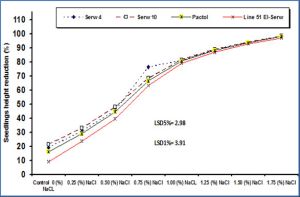
It is clear that under all studied cultivars increasing salinity concentrations significantly decreased seedling vigor index, radical length, seedling fresh weight and increased seedling height reduction. Highest seedling vigor index was resulted from Line 51 El-Serw cultivar at the control treatment. The lowest seedling vigor index was recorded from Serw 10 cultivar at salinity level of 1.75% NaCl [Fig-4] . Tallest radical was recorded from Line 51 El-Serw at the control treatment and the shortest radical was obtained from all studied cultivars at highest salinity levels i.e. 1.75% NaCl, without significant differences between them [Fig-5] . Highest seedling fresh weight was resulted from sown Serw 4 cultivar at the control treatment. Increasing salinity levels to i.e. 1.25% NaCl with sown Pactol, Line 51 El-Serw, Serw 10 and Serw 4 cultivars are recorded the lowest seedling fresh weight without significant differences between them [Fig-6] . The highest salinity level of 1.50 and 1.75% NaCl recorded lowest seedling fresh weight under all studied cultivars. Highest percentage of seedling height reduction was resulted from Serw 10, Serw 4, Pactol and Line 51 El-Serw cultivars with highest salinity levels of 1.75% NaCl treatment without significant differences between them. The lowest percentage of seedling height reduction was resulted from Line 51 El-Serw cultivar with the control treatment [Fig-7] . These results are in good agreement with those obtained by [4,16,20,23] .
The results clearly showed that highest final germination percentage was recorded with seed priming in NaCl at the control treatment, which was (96.8%). The lowest final germination percentage was recorded with non-priming seeds at salinity concentration levels of 1.75% NaCl [Fig-8] . The results clearly showed that highest germination index was obtained from the control treatment with priming and non-priming seeds.
The lowest germination index percentage was recorded with non-priming seeds at salinity level of 1.75% NaCl [Fig-9] .
Results reported the highest seedling vigor index was recorded with priming canola seeds in NaCl at the control treatment. The lowest seedling vigor index was recorded with non-seed priming at salinity level of 1.75% NaCl [Fig-10] .
Tallest plumula was obtained with seed priming in NaCl at the control treatment of salinity stress. The shortest plumula was recorded with non-seed priming with highest level of salinity i.e. 1.75% NaCl [Fig-11] radical was recorded with seed priming canola seeds in 1.0% NaCl solution with the control treatment. Shortest radical was resulted with non-seed priming with highest levels of salinity 1.75% NaCl [Fig-12] .
The highest salinity level i.e.1.50 and 1.75% NaCl recorded the lowest of seedling fresh weight with seed priming and non-priming [Fig-13] .
Highest seedling dry weight was obtained with seed priming and non-priming with the control treatments without significant differences between them. The lowest seedling dry weight was recordrd with highest salinity concentration of 1.25% NaCl with non-seed priming [Fig-14] .
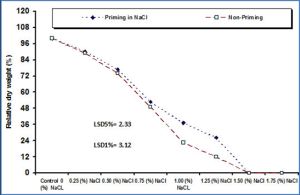
Highest relative dry weight percentage was obtained with the control treatment with both seed priming and non-priming. The lowest relative dry weight percentage was recorded with seed priming and non-priming with highest salinity concentrations i.e. 1.50 and 1.75% NaCl [Fig-15] .
Highest seedling height reduction percentage was obtained from salinity concentration of 1.75% NaCl with non-seed priming. Seed priming of canola with the control treatment was produced the lowest seedling height reduction percentage [Fig-16] . These results are in good harmony with obtained by Mohammadi G.R. [8] .
It is clear that under all studied cultivars with seed priming and decreasing salinity concentrations significantly increased seedling fresh and dry weight and decreased seedling height reduction. It could be stated that highest seedling fresh weight was resulted from Serw 4 and Serw 10 cultivars with seed priming in NaCl with the control treatment without significant differences between them. Increasing salinity concentration up to 1.25% NaCl with all studied cultivars with non-seed priming in NaCl was produced the lowest seedling fresh weight without significant differences between them [Fig-17] . Results clearly showed that highest percentages of seedling height reduction was resulted from all studied canola cultivars with seed priming and non-seed priming at highest salinity level of 1.75% NaCl. The lowest seedling height reduction percentages was obtained from Line 51 El-Serw cultivar with seed priming with the control treatment [Fig-18] . Similar conclusions were reported by [21] .
This study was revealed that for maximizing germination measurements and seedling parameters under salinity stress, it should be priming canola seeds in 1% NaCl solution for twenty four hours at 20°C, using Line 51 El-Serw with increasing salinity concentration up to 1.25% NaCl. Tolerance ranking cultivars was Line 51 El-Serw > Pactol > Serw 4 > Serw 10. It is important to use these cultivars in breading program for enhancing canola production in Egypt.
[1] Smart J. and Simmonds N. (1995) Evolution of crop plants., (Ed) John Wiley & Sons Inc, N-York.
» CrossRef » Google Scholar » PubMed » DOAJ » CAS » Scopus
[2] Ghallab K.H. and Sharaan A.N. (2002) Egypt. J. Plant Breeding, 6 (2), 15-30.
» CrossRef » Google Scholar » PubMed » DOAJ » CAS » Scopus
[3] Ghassemi G.K. and Ponr E. (2008) Not Bot. Hort. Agrobot. Cluj-Napoca, 36, 67-70.
» CrossRef » Google Scholar » PubMed » DOAJ » CAS » Scopus
[4] Bybordi A. and Tabatabaei S.J. (2009) Natulae Botanicae Hort., Agrobotanici Cluj-Napoca, 37(1), 71-76.
» CrossRef » Google Scholar » PubMed » DOAJ » CAS » Scopus
[5] Mohammadi R.G. and Amiri F. (2010) American Eurasion J. Agric. & Environ. Sci., 9(2), 202-207.
» CrossRef » Google Scholar » PubMed » DOAJ » CAS » Scopus
[6] Ashraf M. and Foolad M.R. (2005) Adv. Agron., 88, 223-271.
» CrossRef » Google Scholar » PubMed » DOAJ » CAS » Scopus
[7] Farhoudi R. and Sharifzadeh F. (2006) Indian J. of Crop Sci., 1 (1-2), 74-78.
» CrossRef » Google Scholar » PubMed » DOAJ » CAS » Scopus
[8] Mohammadi G.R. (2009) American Eurasion J. of Agric. and Environ. Sci., 5(5), 696-700.
» CrossRef » Google Scholar » PubMed » DOAJ » CAS » Scopus
[9] Salehi M., Tamaskani F., Ehsani M., Arefi M. (2010) Journal of Plant Science Researcher, 16 (4), 52-57.
» CrossRef » Google Scholar » PubMed » DOAJ » CAS » Scopus
[10] Heshmat O., Saeed H.A., Fardin K. (2011) J. of Agric. Tech., 7 (3), 611-622.
» CrossRef » Google Scholar » PubMed » DOAJ » CAS » Scopus
[11] Munnus R. (2002) Plant Cell Environ., 25, 239-250.
» CrossRef » Google Scholar » PubMed » DOAJ » CAS » Scopus
[12] Zadeh H.M. and Naeni M.B. (2007) J. of Agron., 6 (3), 409-414.
» CrossRef » Google Scholar » PubMed » DOAJ » CAS » Scopus
[13] Cuttero J., Bolarine M.C., Asins M.J., Moreno V. (2006) J. Exp. Bot., 57(5), 1045-1058.
» CrossRef » Google Scholar » PubMed » DOAJ » CAS » Scopus
[14] Almansouri M., Kinet J.M., Lutts S. (2001) Plant and Soil, 231(2), 243-254.
» CrossRef » Google Scholar » PubMed » DOAJ » CAS » Scopus
[15] Annon A. (2001) Manitoba Soil Fertility Guide (Ed.), Canada.
» CrossRef » Google Scholar » PubMed » DOAJ » CAS » Scopus
[16] Houle G., Morel L., Reyonlds C.E., Siegel J. (2001) American J. of Botany, 88: 62-67.
» CrossRef » Google Scholar » PubMed » DOAJ » CAS » Scopus
[17] Puppala N., Fowlr J.L., Poindexter L., Bhardwaj H.L. (2001) Evaluation of salinity tolerance of canola germination. 25-253.
» CrossRef » Google Scholar » PubMed » DOAJ » CAS » Scopus
[18] Ayaz F.A., Kadioglu A., Urgut R.T. (2002) Canadian. J. Plant Sci., 80, 373-378.
» CrossRef » Google Scholar » PubMed » DOAJ » CAS » Scopus
[19] Jamil M., Lee C.C., Rehman S.U., Lee D.B., Ashraf M., Rha E.S. (2005) EJEAF Che., 4(4), 970-976.
» CrossRef » Google Scholar » PubMed » DOAJ » CAS » Scopus
[20] Baybordi A. (2010) Not. Bot. Hort. Agobot. Cluj-Napoca, 38 (1), 128-133.
» CrossRef » Google Scholar » PubMed » DOAJ » CAS » Scopus
[21] Mwale S.S., Hamusimbi C., Mwansa K. (2003) Seed Sci. Tech., 31(1), 199-206.
» CrossRef » Google Scholar » PubMed » DOAJ » CAS » Scopus
[22] Saeid M.R., Abdolghium A., Hassanzadeh M., Rouhi A., Nikzad P. (2008) Journal of Food, Agriculture & Enviroment., 6 (2), 188-191.
» CrossRef » Google Scholar » PubMed » DOAJ » CAS » Scopus
[23] Ghassemi G.K., Jabbarpour S., Zehtab-Salmasi S., Mohammadi A. (2010) African J. of Agric. Res., 5 (10), 1089-1094.
» CrossRef » Google Scholar » PubMed » DOAJ » CAS » Scopus
[24] Zamani S., Nezami M.T., Habibi D., Khorshidi M.B. (2010) Advances in Environmental Biology, 4(3), 422-427.
» CrossRef » Google Scholar » PubMed » DOAJ » CAS » Scopus
[25] Rehman S., Harris P.J., Bourne W.F., Wilkin J. (1996) Seed Sci. Tech., 25(1), 45-57.
» CrossRef » Google Scholar » PubMed » DOAJ » CAS » Scopus
[26] Rehman S., Harris P.J., Bourne W.F. (1998) J. plant Nutrition, 21(2), 277-285.
» CrossRef » Google Scholar » PubMed » DOAJ » CAS » Scopus
[27] Ellis R.H. and Roberts E.H. (1981) Seed Sci. Technol., 9, 373-409.
» CrossRef » Google Scholar » PubMed » DOAJ » CAS » Scopus
[28] Ruan S., Xue Q., Thlkowska K. (2002) Seed sci. Technol., 30, 451-458.
» CrossRef » Google Scholar » PubMed » DOAJ » CAS » Scopus
[29] Karim M.A., Utsunomiya N., Shigenaga S. (1992) Japanese J. of Crop Sci., 61, 279-284.
» CrossRef » Google Scholar » PubMed » DOAJ » CAS » Scopus
[30] Abdul-Baki A.A. and Anderson J.D. (1970) Crop Sci., 10, 31-34.
» CrossRef » Google Scholar » PubMed » DOAJ » CAS » Scopus
[31] Islam M.M. and. Karim M.A. (2010) The agriculturists, 8(2), 57-65.
» CrossRef » Google Scholar » PubMed » DOAJ » CAS » Scopus
[32] Gomez K.A. and Gomez A.A. (1984) Statistical Procedures in Agricultural Research. New York 2nd Ed. Wiley, 680.
» CrossRef » Google Scholar » PubMed » DOAJ » CAS » Scopus
[33] Snedecor G.W. and Cochran W.G. (1980) Statistical Methods. 7<sup>th</sup> Ed. Iowa State University Press, Iowa, USA.
» CrossRef » Google Scholar » PubMed » DOAJ » CAS » Scopus
[34] Liptay A. and Zariffa N. (1993) Hort. Science, 28, 881-883.
» CrossRef » Google Scholar » PubMed » DOAJ » CAS » Scopus
[35] Farooq M., Basra S.M.A., Saleem B.A., Nafees M., Chishti S.A. (2005) Pakistan J. Agric. Sci., 42, 36-41.
» CrossRef » Google Scholar » PubMed » DOAJ » CAS » Scopus
[36] Farooq M., Basra S.M.A., Rehman H., Hussain M. and Amanat Y. (2007) Pakistan J. Agric. Sci., 44, 1-8.
» CrossRef » Google Scholar » PubMed » DOAJ » CAS » Scopus
[37] Jamil M., Lee D. B., Jung K.Y., Ashraf M., Lee S.C., Rha E.S. (2006) Journal of Central European Agriculture, 7(2), 273-282.
» CrossRef » Google Scholar » PubMed » DOAJ » CAS » Scopus
[38] Huang J. and Redmann R.E. (1995) Can. J. Plant Sci. (1995) 75, 815-819.
» CrossRef » Google Scholar » PubMed » DOAJ » CAS » Scopus
[39] Gulzar S., Khan M.A., Ungar I.A. (2001) Seed Sci. Technol., 29, 21-29.
» CrossRef » Google Scholar » PubMed » DOAJ » CAS » Scopus
[40] Tester M. and Davenport R. (2003) Ann. Bot., 9, 503-527.
» CrossRef » Google Scholar » PubMed » DOAJ » CAS » Scopus
[41] Hajibagheri M.A., Yeo A.R., Flowers T.J., Collins J.C. (1989) Plant, Cell and Envir., 12, 753-757.
» CrossRef » Google Scholar » PubMed » DOAJ » CAS » Scopus
[42] Jamil M. and Rha E.S. (2004) Korean J. Plant Res., 7, 226-232.
» CrossRef » Google Scholar » PubMed » DOAJ » CAS » Scopus
[43] Zhu J.K. (2002) Plants. Annul. Rev. Plant Biol., 53, 247-273.
» CrossRef » Google Scholar » PubMed » DOAJ » CAS » Scopus
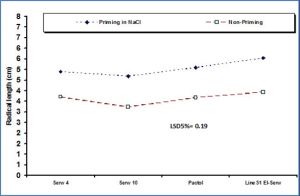 | Fig. 1- Radical length (cm) as affected by the interaction between seed priming in 1% NaCl and canola cultivars. |
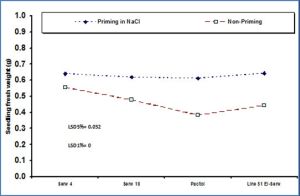 | Fig. 2- Seedling fresh weight (g) as affected by interaction between canola cultivars and seed priming in 1% NaCl. |
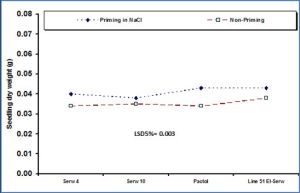 | Fig. 3- Seedling dry weight (g) as affected by the interaction between seed priming in 1% NaCl and canola cultivars. |
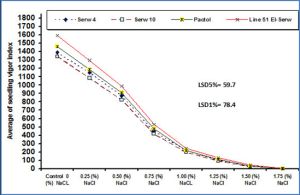 | Fig. 4- Average of seedling vigor index as affected by the interaction between canola cultivars and salinity concentrations. |
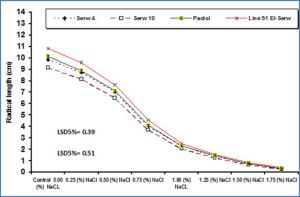 | Fig. 5- Radical length (cm) as affected by the interaction between canola cultivars and salinity concentrations. |
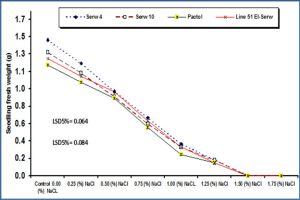 | Fig. 6- Seedling fresh weight (g) as affected by the interaction between canola cultivars and salinity concentrations. |
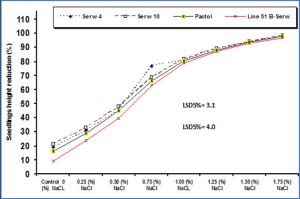 | Fig. 7- Average of seedlings height reduction (%) as affected by the interaction between canola cultivars and salinity concentrations |
 | Fig. 8- Germination percentage(%) as affected by the interaction between seed priming in 1% NaCl % and salinity concentrations. |
 | Fig. 9- Germination index (%) as affected by the interaction between seed priming in 1% NaCl and salinity concentrations. |
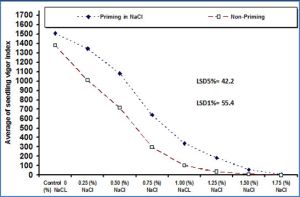 | Fig. 10- Average of seedling vigor index as affected by the interaction between seed priming in 1% NaCl and salinity concentrations. |
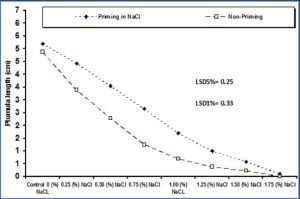 | Fig. 11- Plumula length (cm) as affected by the interaction between seed priming in 1% NaCl and salinity concentrations. |
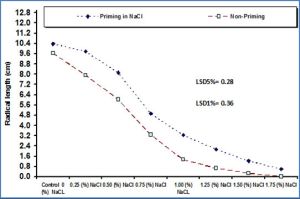 | Fig. 12- Radical length (cm) as affected by the interaction between seed priming in 1% NaCl and salinity concentrations. |
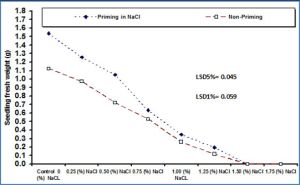 | Fig. 13- Seedling fresh weight (g) as affected by interaction between seed priming in 1% NaCl and salinity concentrations. |
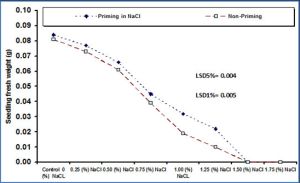 | Fig. 14- Seedling dry weight (g) as affected by the interaction between seed priming in 1% NaCl and salinity concentrations. |
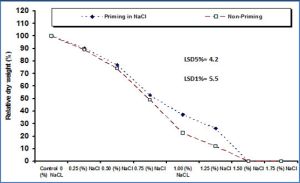 | Fig. 15- Relative dry weight (%) as affected by the interaction between seed priming in 1% NaCl and salinity concentrations. |
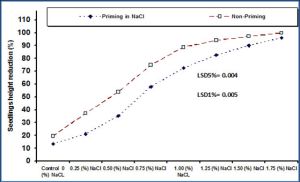 | Fig. 16- Average of seedlings height reduction (%) as affected by the interaction between seed priming in 1% NaCl and salinity concentrations. |
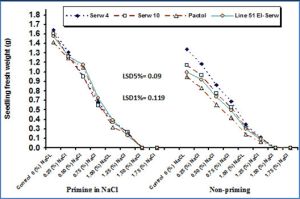 | Fig. 17- Seedling fresh weight (g) as affected by the interaction between seed priming in 1% NaCl canola cultivars and salinity concentrations. |
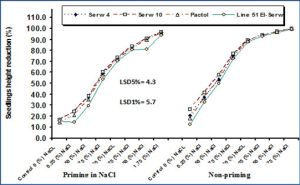 | Fig. 18- Average of seedlings height reduction (%) as affected by the interaction between seed priming in 1% NaCl, canola cultivars and salinity concentrations. |
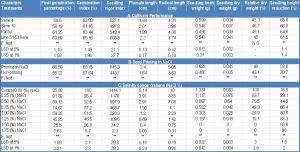 | Table 1- Averages of final germination percentage (%), germination index, vigor index, plumula length, radical length, seedling fresh weight, seedling dry weight, seedling height reduction and relative dry weight as affected by canola studied cultivars. |