


ISSN : 2320-3404
EISSN : 2320-5644



NIRMALA B.1*, VASUDEVII N.2, SUHASINI K.3
1Scientist, Directorate of Rice Research, Hyderabad- 500030, AP, India.
2Professor and Head, Department of Agricultural Economics, College of Agriculture, ANGRAU, Hyderabad- 500030, AP, India
3Professor, Department of Agricultural Economics, College of Agriculture, ANGRAU, Hyderabad- 500030, AP, India
* Corresponding Author : bnirmaladrr@gmail.com
Received : 12-07-2012 Accepted : 25-10-2012 Published : 30-10-2012
Volume : 1 Issue : 1 Pages : 7 - 10
World Res J Agron 1.1 (2012):7-10
The present study was conducted in Ambedkar nagar district of Uttar Pradesh in an attempt to throw light on the economic potential of hybrid rice technology with a view to make suggestions for transfer of hybrid rice technology to the farmers on a large scale. The net benefit cost ratio was more for hybrid rice cultivation than the HYV rice cultivation. The gini coefficient was 0.12 in case of HYV rice cultivation, which got reduced to 0.07 for hybrid rice cultivation. The inequalities in income distribution were comparatively less in hybrid rice cultivation than the HYV rice cultivation. It was found that the hybrid rice fetched comparatively lower price than HYV rice. Hence efforts need to be made to improve quality of rice hybrids as per the region specific requirements of the consumers, millers and market.
High yielding variety (HYV) rice, hybrid rice, income distribution, lorenz curves, gini coefficient.
Rice being the staple food for the majority of the Indians, demand for rice in the future is bound to increase with the growing population. Considering the annual decline of 0.05 % in population growth rate, India’s population is projected to be 1.301 and 1.378 billion by 2020 and 2030, respectively (Goyal and Singh 2002). It is estimated that there will be a demand of 136 and 146 Mt of rice (taken as 50 % of total cereals) for the year 2020 and 2030, respectively. To meet the growing demand, a rapid increase in paddy production is needed. Among the various options available to increase the rice yields, hybrid rice technology is the most feasible and readily adoptable one as has been amply demonstrated in China. The rigorous efforts of hybrid rice research and development in India since 1990’s has resulted in release of forty six hybrids, 29 from public sector and 17 from private sector for commercial cultivation. During the year 2010, hybrid rice was planted in an area of 1.3 m ha and additional rice production of 1.5 to 2.5 m t was added to our food basket through this technology (Hariprasad et al. 2011).
More than 80 % of the total hybrid rice area is in eastern Indian states like Uttar Pradesh, Jharkhand, Bihar, Chhattisgarh, with some little area in states like Madhya Pradesh, Assam, Punjab and Haryana. As rice is a key source of livelihood in eastern India, a considerable increase in yield through this technology will have a major impact on household food and nutritional security, income generation, besides an economic impact in the region. There is a rapid expansion of area under hybrid rice in eastern Uttar Pradesh in the recent years; hence the present study was conducted with an objective to compare the economic potential of HYV vs. hybrid rice cultivation in Ambedkar nagar district of Uttar Pradesh.
From Ambedkar nagar district of Uttar Pradesh two villages viz., Hajipur and Mohammedpur of Jalalpur block were selected purposively. From each of these villages 25 farmers who cultivated both hybrid and HYV rice on their farms were selected. Thus 50 farmers from 2 villages were selected to assess the impact of hybrid rice technology. A purposive sampling technique was followed in the selection of the sample farmers in consultation with the local stakeholders from both the public and private sector. Only those farmers who cultivated hybrid rice along with a HYV rice variety were included in the sample. The data pertains to kharif 2010.
Lorenz curves are used to compare the distribution on income generated from hybrid as well as HYV rice cultivation among the sample respondents. These curves relate to the cumulative percentage of aggregate benefits to the cumulative percentage of population receiving these benefits. If every member of the population receives the same benefit lorenz curve will coincide with the diagonal line sometimes referred to as egalitarian line. If not the lorenz curve will fall below the diagonal line. More the concentration of the distribution of benefit the farther would be placement of the lorenz curve from the diagonal line.
Although the Lorenz curve is useful for determining the degree of inequlaity it does not give a precise value that can be used for comparison. The gini coefficient on the other hand has this convenient property.
Gini coefficient is a very popular tool for studying income distribution. The Gini coefficient is a measure of statistical dispersion developed by the Italian statistician and sociologist Corrado Gini and published in his 1912 paper "Variability and Mutability". The Gini coefficient is a measure of the inequality of a distribution, a value of 0 expressing total equality and a value of 1 maximal inequality.
GC = [∑j=1nPj(Qj+Qj-1)] = Gini coefficient
Pj = Proportion of household in j th group
Qj = Cumulative proportion of income in j th group
Qj = Cumulative proportion of income in (j-1) group
N = Total number of groups
The average yield of HYV and hybrid rice cultivation in tonnes per hectare are presented in [Table-1] . It can be observed that the average yield of hybrid rice were higher than the HYV rice. The average yield of HYV rice was 4.73 t/ha, while that of hybrid rice cultivation was 5.80 t/ha. There was a yield increase of 22.73 per cent in case of hybrid rice cultivation when compared to HYV rice. The price fetched by the hybrid rice was slightly lower (8.58 per cent) than the HYV rice. Market price which is an indicator of grain quality shows that HYV rice has good grain quality compared to hybrid rice, and hence fetched higher price than the HYV rice. The total returns obtained per hectare were Rs. 46204 for HYV rice cultivation whereas it was Rs.52055 for hybrid rice cultivation which was 12.66 percent higher than the HYV rice cultivation.
Lin (1994) reported that the hybrid rice has a yield advantage of 15 to 20 % over the conventional inbred varieties in farmer’s fields in China. Janaiah (2002) reported a 16 per cent higher yield than the cultivation of inbred varieties, conventional HYVs of rice.
An important element in the farm business management relates to the manner in which the resources are allocated. A measuring indicator is necessary to provide guide and standard for appraising the use of various resources. To achieve this objective various farm efficiency measures were computed. It was observed that the net income for HYV rice cultivation per hectare was Rs. 22778 [Table-2] . Hybrid rice cultivation resulted in a net income of Rs. 28994.
Farm family labour income for HYV and hybrid rice cultivation was Rs. 28559 and 35201 per hectare respectively. Another crucial farm management efficiency measure is farm business income. The farm business income was Rs. 36170 and Rs. 42812 per hectare for HYV and hybrid rice cultivation respectively. Hybrid rice farmers have obtained a higher income which implies that the income accruing to owned land, owned long term capital and management was profitable for farmers engaged in hybrid rice cultivation.
Farm investment income which is obtained by deducting the imputed value of own family labour from farm business income, was Rs. 32817 and Rs. 37617 per hectare for HYV and hybrid rice cultivation respectively.
The net benefit cost ratio for HYV rice cultivation was 0.85 for the sample farmers, whereas in case of hybrid rice cultivation it was 0.96.
To assess the pattern of distribution of income, the sample farmers were divided into different groups based on the extent of income generated from HYV rice cultivation and hybrid rice cultivation as shown in [Table-3] and [Table-4] .
The pattern of distribution of income generated from HYV rice cultivation is presented in [Table-3] . The lowest income earning families accounted for 2 per cent of the total sample farmers and their share in the total income earned by all the sample farmers was 1.06 per cent. The average income of the lowest income group was Rs. 11937.5. The percentage of households in the highest income group was 14 percent of the total households and their share in the total income earned by all the sample households was 17.49 per cent. About 44 percent of the sample farmers share only 34 per cent of the total income. The average income of the highest income group was Rs. 56321.43.
The farmers were categorised into nine groups based on the income generated by cultivation of hybrid rice. It can be observed from [Table-4] that the lowest income group was those sample farmers who received less than Rs.34000 per hectare from hybrid rice cultivation. The share of the lowest income group in the total income earned by all the sample farmers was 2.55 percent and the lowest income group had accounted for 2 per cent of the total number of sample farmers. The highest income group was those sample farmers who received more than Rs.62000 per hectare income from cultivation of hybrid rice. The average income of the highest income group was Rs.63600 per hectare. The share of highest income group was 4 per cent to the sample farmers and accounted for 4.86 percent of the total income of the sample farmers. Nearly 17 per cent of the total income was received by 18 per cent of the households.
It is clear from the Lorenz curves [Fig-1] and [Fig-2] that there exists inequalities in distribution of income obtained from cultivation of both HYV and hybrid rice in all the four districts. Both the curves fell well below, the egalitarian line. To compare the two curves, the curve which represents the hybrid rice cultivation showed lesser inequality against the other curve which represents the HYV rice cultivation in all the four districts of the study area. This implies that the income generated from hybrid rice cultivation is more equally distributed than the income generated from the HYV rice cultivation in all the four districts.
The distribution of income among the sample farmers, through cultivation of HYV and hybrid rice were quantified with the help of gini concentration ratios presented in [Table-5] . It can be observed from the [Table-5] that the gini coefficient in Ambedkar nagar district of Uttar Pradesh was 0.12 in case of HYV rice cultivation, which got reduced to 0.07 for hybrid rice cultivation. The gini coefficient closer to zero indicates higher inequalities and the ratio nearer to the value one indicates less inequalities in income distribution. It can be concluded from the above findings that there were comparatively lesser inequalities in distribution of income obtained from cultivation of hybrid rice among different categories of farmers when compared with the inequalities in distribution of income obtained from HYV rice cultivation.
The net benefit cost ratio for HYV rice cultivation was 0.85, whereas it was 0.96 in case of hybrid rice cultivation. The gini coefficient was 0.12 in case of HYV rice cultivation, which got reduced to 0.07 for hybrid rice cultivation. The following conclusions can be drawn from the present study:
1. The returns obtained from hybrid rice were comparatively higher for hybrid rice than for HYV rice cultivation.
2. The inequalities in income distribution were comparatively less in hybrid rice cultivation than the HYV rice cultivation.
3. Hybrid rice has the potential to contribute significantly to improve production and food security. Hence, efforts are needed to promote hybrid rice cultivation on a wider scale in suitable conditions to sustain food security.
4. Quality considerations are of paramount importance for popularisation and large scale adoption of hybrid rice. It was found that the hybrid rice fetched comparatively lower price than HYV rice. Hence efforts need to be made to improve quality of rice hybrids as per the region specific requirements of the consumers, millers and market.
[1] Goyal S.K. and Singh J.P. (2002) International Farm Management Congress, Wageningen, Netherlands, 20.
» CrossRef » Google Scholar » PubMed » DOAJ » CAS » Scopus
[2] Hariprasad A.S., Senguttuvel P., Revati P., Kemparaju K.B., Rani S.N. and Viraktamath B.C.V. (2011) Hybrid rice in India. Technical Bulletin 56/2011, ICAR, India.
» CrossRef » Google Scholar » PubMed » DOAJ » CAS » Scopus
[3] Janaiah (2002) Economic and Political Weekly, 42(37), 4328.
» CrossRef » Google Scholar » PubMed » DOAJ » CAS » Scopus
[4] Lin J.Y. (1994) Agricultural Economics, 10 153-164.
» CrossRef » Google Scholar » PubMed » DOAJ » CAS » Scopus
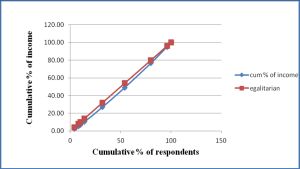 | Fig. 1- Distribution of income in HYV rice cultivation |
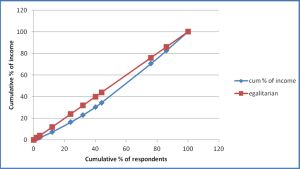 | Fig. 2- Distribution of income in Hybrid rice cultivation |
 | Table 1- Comparison of returns from HYV and hybrid rice cultivation in Ambedkar nagar district of Uttar Pradesh (Figures in parenthesis indicate yield advantage of hybrid rice over HYV rice cultivation) (Rupees per hectare) |
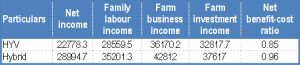 | Table 2- Farm income measures for HYV and hybrid rice cultivation in Ambedkar nagar district of Uttar Pradesh (Rupees per hectare) |
 | Table 3- Comparison of Gini coefficient for HYV and hybrid rice cultivation among sample farmers in Ambedkar nagar district of Uttar Pradesh |
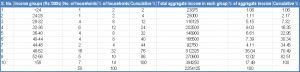 | Table 4- Pattern of distribution of income generated from HYV rice cultivation in Ambedkar nagar district of Uttar Pradesh |
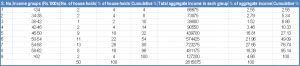 | Table 5- Pattern of distribution of income generated from hybrid rice cultivation in Ambedkar nagar district of Uttar Pradesh |