


ISSN : 2320-3404
EISSN : 2320-5644



MOHANKUMAR R.1*, KARTHIK R.2, PARAMESH V.3, SUDHAKARA T.M.4, MANJUNATHACHARI K.5
1Department of Agronomy, College of Agriculture, University of Agricultural Sciences, GKVK, Bangalore- 560 065, Karnataka, India.
2Department of Agronomy, College of Agriculture, University of Agricultural Sciences, GKVK, Bangalore- 560 065, Karnataka, India.
3Department of Agronomy, College of Agriculture, University of Agricultural Sciences, GKVK, Bangalore- 560 065, Karnataka, India.
4Department of Agronomy, College of Agriculture, University of Agricultural Sciences, GKVK, Bangalore- 560 065, Karnataka, India.
5Department of Agronomy, College of Agriculture, University of Agricultural Sciences, GKVK, Bangalore- 560 065, Karnataka, India.
* Corresponding Author : mohanomkey@gmail.com
Received : 17-04-2012 Accepted : 11-10-2012 Published : 21-10-2012
Volume : 1 Issue : 1 Pages : 4 - 6
World Res J Agron 1.1 (2012):4-6
Maize is often inter-seeded with the pulse crop field bean using a replacement design in southern transitional zone of Karnataka. A field study was conducted to evaluate knowledge of farmers about practicing the field bean as intercrop along with the maize. From the survey, it was observed that maize + field bean is the most popular intercropping system of maize belt of study area, about 80 % of the maize growers are practicing row proportion of 8:2 with 200 kg DAP as basal dose and 50 kg of urea as top dress as and when they receive the subsequent rains. The study also indicates the major reason for adoption of this type of cropping system is all farmer are mainly growing field bean for the green pods as vegetables, about 80% of farmers are using for fodder purpose and some of them are getting the benefits of half time employment and soil fertility improvement. In this research, source of extension agency for adopting maize-field bean intercropping systems were studied and the knowledge was flowing from the indigenous knowledge. Concurrently, experiments were conducted to standardize the maize-field bean intercropping systems and to explore options for improvement. The results of this study clearly indicate that recommendations for intercropping should be based on intercropping research and cannot simply be extrapolated from results obtained with pure stands of the respective component crops. The ideal intercropping combination was maize + field bean 4:2 with 100 % recommended dose of fertilizer to both the crops for better economic viability of the intercropping system.
Farmers perception, intercropping, maize, field bean, land equivalent ratio, net returns, benefit cost ratio.
The sustainability of current yield and prospects of higher yield are threatened by soil compaction, low level of organic carbon, extensive monoculturing, erosion of indigenous bio diversity and ill distribution of rainfall all of which are typical of this region. Intercropping of indigenous genotype like local field bean in maize not only provide nutritional security but also cause for yield, economics and environmental stability to the maize belt in future. Maize is one such crop which provides an opportunity for inclusion of intercrop because of the plasticity of the crop to row spacing. In Southern Transitional Zone of Karnataka, crops are being cultivated during rainy season. The amount and distribution of rainfall also favors for the cultivation of maize and field bean (var. local).
Methodology followed was purposive random sampling method during June 2010, a field survey has been carried out in selected two talukas of Davanagere district (Channagiri and Honnali) and two villages in each taluk were selected through purposive sampling. We have taken about 20 farmers from the each village for survey purpose, thus 40 farmers forms the sample size. The study area is located at 14Ëš.0I to 14Ëš.1I North latitude and 75Ëš.40 I to 75Ëš. 421 East longitude with an altitude of 650 meters above mean sea level. Both quantitative and qualitative data were collected. Unstructured and semi structured interviews were used for the collection of quantitative information. Questions and questionnaires were pre-tested. At each site, the villages of each thaluk as well as 20 farmers from each villages were selected. Each site was in addition described with key indicators such as the type of crops, land holding, source of irrigation, purpose of cultivation, marketing facility, economic viability and other information were collected.
A field experiment on ‘Standardization of maize and field bean intercropping system in Southern Transitional Zone of Karnataka’, was carried out at Zonal Agricultural Research Station, Navile, Shimoga on sandy loam soils during Kharif 2010. The experiment was laid out in a randomized complete block design with nine treatments replicated thrice. The treatments comprises of maize + field bean (4:1, 4:2 and 8:2) with 100 per cent NPK to only main crop, maize + field bean (4:1, 4:2 and 8:2) with 100 per cent NPK to both the crops and sole crop of maize and field bean. To asses the biological feasibility and economic viability of the cropping mixture we have used the intercropping indices given by Willey (1979) and Heibseh (1978).
The most frequently encountered maize based intercropping system was maize + field bean at 8:2 row proportion, followed by maize + pigeon pea at 8:2 row proportion. The cent per cent opinion obtained by the farmers about practicing of growing field bean along with maize is to get the short term income by selling the green pods and the haulm of the field bean used as the very good palatable fodder [Table-1] , [Table-2] , [Table-3] .
Although the surveyed farmers expressed their desire to grow in particular field bean, which can full fill both economic viability and domastic need of the farmers when it was grown under maize in all the villages [Table-4] . And in Joladalu and Gonana Katte villages farmers are also aware of Soil fertility, market sustainability and insurance against natural calamities. The opinion survey reveals the purpose of inclusion of component crop along with the maize is to get the additional income from the crops of different duration and main aim is to get the fodder during lean period for livestock without losing the original yield of maize for marketing purpose.
All the farmers of the study are were practicing the crop combination with 8:2 row proportions without any discrimination in the nutrient management to the component crop rows with the spacing of 45 cm x 15 cm. probable reason for practicing above row proportion and spacing may be get the more number of maize population per unit area to obtain higher maize yield and higher plant population of both the component compared to the recommended row spacing for that zone by the university.
Based on field survey undertaken and the feedback from the knowledge of practicing maize based pulse intercropping system especially field bean as a component crop was coming from the indigenous knowledge of the farmers, and was expressed all the served farmers of all the village.
All the intercropping systems showed superiority to maize in term of maize grain equivalent yield, irrespective of row proportion which were fertilizer with recommended dose of fertilizer to the both the crops. Highest MEY (4888 kg ha-1) was obtained with maize + field bean 4:2 with 100 per cent NPK to both the crops which was comparable with other treatments which were fertilized to both the crops. This might be due to efficient utilization of resources and less competition between the both component species. This is in line with the findings of Rana, et al. (2006).
All intercropping situations recorded land equivalent ratio more than unity, indicating higher biological efficiency of the system. Intercropping of maize + field bean 4:2 with 100 per cent NPK to both the crop recorded better biological potential 37% higher yield advantage compared to sole cropping. the ATER value recorded more than one indicating that maize gave more yield (1.68) than the sole cropping with respect to time and space dimension in maize + field bean 4:2 with 100 per cent NPK to both the crop, maize proved the dominant companion to intercrop in all the treatments irrespective of row proportion which were fertilized to both the crops, having the lower competition ratio, land equivalent coefficient and in case of aggressivity well fertilized treatments of intercropping showed relatively dominance of field bean over maize which help in getting the higher maize grain equivalent yield and better system productivity.
The monitory advantage indict superior economic viability of maize + field bean intercropping in 4:2 row proportions with 100 per cent NPK to both the crops, over other intercropping system. Maize + field bean intercropping in 4:2 row proportions with 100 per cent NPK to both the crops recorded highest net returns (Rs.38830 ha-1) and B:C ratio (3.24) followed by maize + field bean intercropping in 8:2 row proportions with 100 per cent NPK to both the crops (35312) and B:C ratio (2.84) indicating the superiority of these systems over farmers practice, sole maize and other treatments. This is due to increased proportion of net returns in relation to cost of cultivation.
Based on the survey under taken it was noticed that maize and field bean intercropping system was practiced by the farmers through the indigenous knowledge. Maize as a main crop for marketing purpose and field bean local variety for culinary purpose and as source fodder for the livestock was the main outcome of the results of the survey. Intercropping of maize + field bean 4:2 row proportion with 100 per cent NPK to both the crop (100:50:25 kg NPK per ha-1 and 25:50:25 kg NPK per ha-1 for maize and field bean respectively) provides higher maize equivalent yield, net returns and B:C ratio.
[1] Heibseh C.K. (1978) interpretation of yield obtained in crop mixture Agronomy Abstract American society of agronomy, 41, USA.
» CrossRef » Google Scholar » PubMed » DOAJ » CAS » Scopus
[2] Rana K.S., Shivran R.K and Kumar A. (2006) Indian J. Agron., 51(1), 24-68.
» CrossRef » Google Scholar » PubMed » DOAJ » CAS » Scopus
[3] Willey R.W. (1979) Field crop Abstract, 32(1), 1-10.
» CrossRef » Google Scholar » PubMed » DOAJ » CAS » Scopus
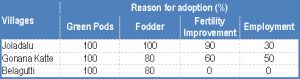 | Table 1- Reasons for adoption of field bean in maize based intercropping system |
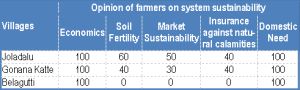 | Table 2- Opinion of farmers on system sustainability of maize + field bean intercropping system |
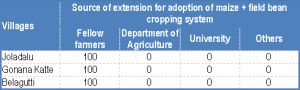 | Table 3- Source of extension agency through which knowledge / awareness for intercropping of field bean with maize Nutrient management practice followed by farmers (System) Basal dose: 200 kg DAP Top dressing: 50 kg Urea |
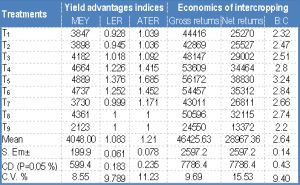 | Table 4- MEY, LER, ATER, gross return, net return and B:C ratio as influenced by maize and field bean intercropping system and nutrient management T<sub>1</sub>-Maize + field bean 4:1 with 100% NPK to main crop T<sub>2</sub>- Maize + field bean 4:2 with 100% NPK to main crop T<sub>3</sub>- Maize + field bean 8:2 with 100% NPK to main crop T<sub>4</sub>- Maize + field bean 4:1 with 100% NPK to both the crops T<sub>5</sub>- Maize + field bean 4:2 with 100% NPK to both the crops T<sub>6</sub>- Maize + field bean 8:2 with 100% NPK to both the crop T<sub>7</sub>- Farmers practice T<sub>8</sub>-Sole maize T<sub>9</sub>- Sole field bean |