


ISSN : 2320-3404
EISSN : 2320-5644



MOHANKUMAR R.1*, GIRIJESH G.K2, KRISHNAMURTHY N.3, REDDY V.C.4, VAGEESH T.S.5
1Department of Agronomy, College of Agriculture, University of Agricultural Sciences, GKVK, Bangalore- 560 065, Karnataka, India.
2Department of Agronomy, College of Agriculture, University of Agricultural Sciences, GKVK, Bangalore- 560 065, Karnataka, India.
3Department of Agronomy, College of Agriculture, University of Agricultural Sciences, GKVK, Bangalore- 560 065, Karnataka, India.
4Department of Agronomy, College of Agriculture, University of Agricultural Sciences, GKVK, Bangalore- 560 065, Karnataka, India.
5Department of Agronomy, College of Agriculture, University of Agricultural Sciences, GKVK, Bangalore- 560 065, Karnataka, India.
* Corresponding Author : mohanomkey@gmail.com
Received : 17-04-2012 Accepted : 09-10-2012 Published : 19-10-2012
Volume : 1 Issue : 1 Pages : 1 - 3
World Res J Agron 1.1 (2012):1-3
Result of an experiment conducted during the Kharif season of 2010 with maize and field bean intercropping system with different row proportion and nutrient management revealed that the grain yield of sole maize was higher than the intercropping systems, whereas among intercropping system farmers practice has registered the significantly lowest maize grain yield over other intercropping treatments. But the total grain equivalent yield, monitory advantage, net returns and benefit cost ratio of maize + field bean 4:2 with 100 per cent NPK to both the crops was highest over other. This treatment accounted for maximum land equivalent ratio (1.37), area time equivalent ratio (1.68), land equivalent coefficient (0.43), modest competitive ratio (0.89) and minimum aggressivity (-0.002) which proved the efficient system productivity. Intercropping decrease the available nitrogen, phosphorus and potassium in the soil. However, maize + field bean 4:2 and 8:2 with 100 per cent NPK to both the crops recorded highest available N, P and K status of soil.
competition functions, intercropping, maize, field bean.
Intercropping is an approach which offers the opportunity to increase the productivity per unit area and per unit time by efficient utilization of natural resources Ahmed and Rao (1982). Among cereals, maize being a wide spaced crop offers such opportunity of intercropping with legumes like field bean. But what is the row proportion and fertilizer dose has to be applied has not been standardized. Keeping this fact in view, present investigation was conducted the experiment on “Standardization of maize (Zea mays L.) + field bean (Dolichos lablab L.) intercropping system in Southern Transitional Zone of Karnatakaâ€.
A field experiment was conducted during Kharif 2010 at Zonal agricultural Research station, Navile, Shimoga. The soil was sandy loam in texture having low organic carbon (0.39 %) and available nitrogen (229 kg ha-1), phosphorus (139 kg ha-1) and potassium (174 kg ha-1) were low, high and medium, respectively with pH 5.7. a set of nine treatments comprising of maize + field bean 4:1 with 100 NPK to only main crop, maize + field bean 4:2 with 100 NPK to only main crop, maize + field bean 8:2 with 100 NPK to only main crop, maize + field bean 4:1 with 100 NPK to both the crop, maize + field bean 4:2 with 100 NPK to both the crop, maize + field bean 8:2 with 100 NPK to both the crop, farmers practice (8:2 row proportion with 200 kg DAP + 50 kg urea ha-1), sole maize and sole field bean. Crops were planted in line at the spacing of 45 cm x 20 cm in case of maize and 45 cm x 15 cm in case of field bean as per the treatment details. Seeds of maize (NAH 2049) and field bean (var. local) were used, planting were done on 15th June 2010). A common dose of fertilizer at 100:50:25 and 25:50:25 kg NPK per hectare respectively was applied to sole crop of maize and field bean. To the intercropping system a fertilizer dose proportionate to the area occupied by intercrop population was applied in addition to the fertilizer dose given to the base crop. For assessing the biological feasibility and economic viability of the system, land use and production efficiency were computed as suggested by Willey (1979) and Heibseh (1978).
Sole maize showed higher growth and yield attributes over intercropped maize [Table-1] plant height, leaf area index, dry matter production, grains per cob and 100 grain weight of maize decreased significantly in intercropping depend on the row proportion. Maize in association with field bean in 4:2 row proportion with 100 per cent NPK to both the crop has recorded taller plants, higher LAI, more dry matter production, grains per cob and test weight compare to other treatments. Maximum reductions in growth and yield attributes were recorded in farmers practice due to lack of recommended dose of fertilizer and also luxuriant growth and establishments of field bean exerted more competition.
Sole crop resulted in higher grain and stover yield in comparison to their intercrop due to less interspaces competition and increased habitat population. Significantly higher grain yield of maize was recorded under sole stand. Among different intercrop combination significantly higher grain and stover yield were recorded under the maize + field bean 8:2 with 100 per cent NPK to both the crops [Table-1] . This was recorded on account of improvement in the yield attributes and the higher plant population per unit area.
Significantly higher growth, yield attributes were noticed in maize + field bean 4:2 with 100 per cent NPK to both the crops and sole field bean yielded significantly higher grain and stover yield over other intercropped stands [Table-1] . Magnitude of reduction due to intercropping with maize varied with plant population and nutrient management to field bean. This might be due to the more inter space available for every four rows maize and recommended dose of fertilizer application.
All the intercropping systems showed superiority to maize in term of maize grain equivalent yield [Table-2] irrespective of row proportion which were fertilizer with recommended dose of fertilizer to the both the crops. Highest MEY (4888 kg ha-1) was obtained with maize + field bean 4:2 with 100 per cent NPK to both the crops which was comparable with other treatments which were fertilized to both the crops. This might be due to efficient utilization of resources and less competition between the both component species. This is in line with the findings of Rana, et al. (2006).
All intercropping situations recorded land equivalent ratio more than unity, indicating higher biological efficiency of the system [Table-2] . Intercropping of maize + field bean 4:2 with 100 per cent NPK to both the crop recorded better biological potential 37 % higher yield advantage compared to sole cropping. the ATER value recorded more than one indicating that maize gave more yield (1.68) than the sole cropping with respect to time and space dimension in maize + field bean 4:2 with 100 per cent NPK to both the crop, maize proved the dominant companion to intercrop in all the treatments irrespective of row proportion which were fertilized to both the crops, having the lower competition ratio, land equivalent coefficient and in case of aggressivity well fertilized treatments of intercropping showed relatively dominance of field bean over maize which help in getting the higher maize grain equivalent yield and better system productivity.
The monitory advantage indict superior economic viability of maize + field bean intercropping in 4:2 row proportions with 100 per cent NPK to both the crops, over other intercropping system [Table-2] . Maize + field bean intercropping in 4:2 row proportions with 100 per cent NPK to both the crops recorded highest net returns (Rs.38830 ha-1) and B:C ratio (3.24) followed by maize + field bean intercropping in 8:2 row proportions with 100 per cent NPK to both the crops (35312) and B:C ratio (2.84) indicating the superiority of these systems over farmers practice, sole maize and other treatments. This is due to increased proportion of net returns in relation to cost of cultivation.
[1] Heibseh C.K. (1978) Agronomy Abstract American Society of Agronomy, 41, USA.
» CrossRef » Google Scholar » PubMed » DOAJ » CAS » Scopus
[2] Willey R.W. (1979) Field crop Abstract, 32(1), 1-10.
» CrossRef » Google Scholar » PubMed » DOAJ » CAS » Scopus
[3] Rana K.S., Shivran R.K. and Kumar A. (2006) Indian J. Agron., 51(1), 24-68.
» CrossRef » Google Scholar » PubMed » DOAJ » CAS » Scopus
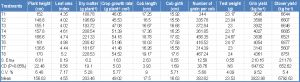 | Table 1- Growth and yield component of sole and intercrop of maize as influenced by intercropping system and nutrient management |
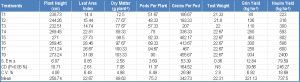 | Table 2- Growth and yield component of sole and intercrop of field bean as influenced by intercropping system and nutrient management |