


ISSN : 2320-3390
EISSN : 2320-5652



KANDASAMY S.1*, MUTHUSAMY G.2, THANGASWAMY S.3, SENTHILKUMAR B.4
11Department of Biotechnology, Muthayammal College of Arts and Science, Rasipuram- 637 408, Tamilnadu, India
2Division of Biotechnology, College of Environmental and Bioresource Sciences, Chonbuk National University, Iksan-570 752, Korea.
3Department of Biotechnology, Mahendra Arts & Science College, Kalippatti- 637 501, Tamil Nadu, India
4Department of Biotechnology, Muthayammal College of Arts and Science, Rasipuram- 637 408, Tamilnadu, India
* Corresponding Author : ksk.selvam@gmail.com
Received : 28-04-2012 Accepted : 25-10-2012 Published : 28-10-2012
Volume : 1 Issue : 1 Pages : 7 - 10
World Res J Antimicrob Agents 1.1 (2012):7-10
DOI : http://dx.doi.org/10.9735/2320-3390.1.1.7-10
In this study, the screening of antibiotic producing actinomycetes was isolated from swampy soil. Only 14.2% of the isolates give positive results in producing antimicrobial substances. But these antibiotics are effective against both gram positive and gram negative bacteria. The result also supported the view that though small quantities of different antibiotics are produced by many microorganisms but their effectiveness against common pathogens is comparatively rare event. The isolates of Sreptomyces sp. May be consider as potent antibiotic producers in this study as these isolates produced maximum zone of inhibition and its product have high commercial value of active agent against common pathogens. It is reported that the only genera Sreptomyces, the members of Actinomycetales account for the approximately 93% producing secondary metabolites.
actinomycetes, pathogens, Actinomycin, Antibiotics.
Actinomycetes are mostly soil-dwelling organisms of great abundance and ecological important that produce an array of secondary metabolites, many of which have specific antibacterial or antifungal properties. Actinomycetes are recognized as a separate group of organisms, are distinct from bacteria and fungi. They may be defined as gram positive bacteria which from branching mycelia and may produce a spore bearing mycelium. They have attained a remarkable place in the modern science as the biggest source of therapeutically important compounds. With the discovery of actinomycin and streptomycin in 1940s by S.A Waksman, thousands of antibiotics were reported from various genera of actinomycetes. The actinomycetes can be classified based on its chemical and molecular composition and boundaries of the organisms. Over 45 genera are new validly described with an increasing tendency to define them on the basis of characters such as wall chemo type, menaquinone composition, nucleic acid pairing and RNA oligonuceleotide sequencing.
Sreptomyces are filamentous bacteria living mostly in the soil. They synthesis numerous secondary metabolites. The best known of these metabolites are antibiotics, Sreptomyces produce other molecules of pharmacological interest as well as herbicides and insecticides. Industries has been using Sreptomyces as a source of natural products for more than 50 years and in looking for new molecules, particularly in the field of antibiotics, where new products are needed to fight pathogen which have become resistant to the existing antibiotics. Screening programs have exploited the natural diversity of Sreptomyces, but this approach is less fruitful.
The saprophytic actinomycetes are important primary colonizers of soil organic material, the bulk at which is in the form of insoluble polymers. Actinomycete’s ability to penetrate and solubilize these polymers, whether at plant (lignocellulose) or animal (chitin) origin, allows them to persist in the microbial succession beyond the initial phase of rapid bacterial growth. The saprophytic actinomycetes require neutral to alkaline pH and absolute requirement for aerobic conditions. The soil samples from different parts of the world were collected and analyzed by several workers, which resulted in the isolation of many new antibiotics. Earlier reports show that the Indian soils are also potential source of antibiotic producing actinomycetes.
Soil is clearly the origin of most saprophytic actinomycetes recovered from rivers and lakes but the additional factors present in the marine environment. Salinity and depth, very low temperatures and high pressures. Some actinomycetes are thermotolerents, which has survived at 102°C for 1 hour; Actinomycetes constitute a significant property of the microbial population in soil microorganisms, their viable count often exceeding 1 million/gm. The soil is also the most prolific source of isolates, many of which produce antibiotics and other useful metaboilites invitro. More than 90% of actinomycete genera have been isolated from soil, from there, population of Sreptomyces are dominant and wide spread in most of the areas.
The colonization of actinomycete hyphae on solid medium produces spores and fragments; it may be dispersed by sporulation or fragmentation. Many actinomycetes rely on air dispersal and form an aerial mycelium bearing hydrophobic spores. . A large increasing range of media and selective inhibitors are used to isolate and enumerate soil actinomycetes. This formulated media reduces spread of motile bacteria but hinders the distinction between colonies of actinomycetes and other bacteria The mangrove soil in Namakkal district of Tamil Nadu bearing a good number of endemic and endangered flora and fauna and well known for its biodiversity is supposed to be a potential habitat for some of industrially and scientifically important microorganisms.
The present study was a preliminary attempt to enumerate and isolate the potential actinomycetes of this area and their distribution in different mangrove habitats and also studied antispectral activity of isolated actinomycetes species against common pathogens.
Soil samples were collected from different points of Tamil nadu, India allowed to air dry.
Suspended 10gm of each dry soil sample in 100ml sterile distilled water in a 250ml conical flask shake the flask on a rotary shaker for 15 minutes at room temperature. This soil suspension was used for further studies.
1 ml of soil sample was taken from soil suspension and serially diluted up to 10-4 in sterile distilled water and plated on sterile Kuster’s agar.The plates were incubated at room temperature for 15 days. After incubation the isolated and preserved.
Glycerol 10g
Casein 0.3g
Potassium nitrate 2g
Sodium chloride 2g
Di potassium hydrogen phosphate 2g
Magnesium sulphate 0.05g
Calcium carbonate 0.02g
Ferrous sulphate 0.01g
Agar 15g
pH 7±0.1
Distilled water 1000ml
The isolated colonies with different morphology were streaked on sterile Kuster’s agar plates and incubated at room temperature for 15 days. The isolated colonies were identified and transferred to Kuster’s agar slant and preserved at 4°C. These cultures were used for further study.
The isolated actinomycetes colonies were observed under high power magnifying lens. The colony morphology with respect to colour, aerial mycelium, size and nature of colony and reverse side colour were observed and identified [1] .
Take a clean grease free glass slide and place 1-2 drops of water suspended and tease actinomycetes colony, gently press cover slip and observed under high-power objective.
The sterile Kuster’s agar plates were prepared and the respective cultures were swabbed on the medium and inserted 3-4 sterile square cover slips at an angle 45o and incubated at room temperature for 8-10 days. After incubation, the cover slips were carefully removed and the cover slips were performed wet mount technique and observe under high power magnification. The morphological characters were observed and identified (plate-2).
Preliminary screening of antibiotic producing strains against human pathogens was done by cross-streak method [10] .
Di potassium sulphate 0.5 g
Casein 3.0 g
Maize starch 10.0 g
Peptone 1.0 g
Yeast extract 1.0 g
Malt extract 10.0 g
Agar 15.0 g
pH 7.5
Distilled water 1000ml
The isolated actinomycetes strains were cross-streaked on CSPY-ME medium and incubated for 5 days. After incubation, overnight culture of test organisms. Escherichia coli, proteus vulgaris, salmonella typhi, Staphylococcus aureus were streaked against the isolated actinomycetes strains. The plates were incubated at 37°C for overnight. After incubation screened antagonistic activity of the actionomycetes against pathogens and the antibiotic producing strains were isolated.
The selected potent antibiotic producers were cultivated in 100ml conical flask containing 50ml sterile Arginine-Glycerol-Salt (AGS) medium for 5 days at room temperature.
Arginine monohydrochloride 1.0 g
Glycerol 12.5 g
Di potassium hydrogen phosphate 1.0 g
Magnesium sulphate 0.5 g
Ferrous sulphate 0.01 g
Copper sulphate 0.001 g
Zinc sulphate 0.001 g
Manganese sulphate 0.001 g
Agar 15.0 g
pH 7.0
Distilled water 1000ml
From the seed medium 5% of inoculums were transferred to 250 ml of sterile AGS medium in 500 ml conical flask and incubated fro 5-7 days at room temperature in stationary condition.
After incubation the culture fluid was filtered by using Whatman No: 1 filter paper and collect the filtrate, the pH of the filtrate was adjusted to 3 with 0.5m HCl and 10ml of Di-ethyl ether was added with vigorous shaking. Then the mixture was allowed to half an hour for separation of aquous phase and organic phase. The top layer was separated carefully that contain antibiotics, which was collected in a separate beaker and allow evaporating. Finally the residue was a separate beaker and allows evaporating. Finally the residue was collected which contained antibiotics and dissolved in 2-3ml of isopropanol. This antibiotic solution were stored and used for the preparation of antibiotic discs.
Different concentrations 10, 20, 30 and 4µ1 of the antibiotic solutions were added to the sterile disc and allowed to dry in hot air oven. The dried discs were used for studying of antibacterial activity against common pathogens with standard antibiotics.
The prepared different concentrated discs were placed aseptically on the Muller-Hinton agar swabbed with pathogenic organism. The sterile and commercially available vancomycin antibiotic disc also placed as control.
The plates were incubated. The diameter of the inhibition zones produced was noted after 12-20 hours incubation at 37°C.
The antibiotic activity of the isolates were measured in terms of the diameter of the inhibition zones and characterized as strong (>20mm), moderate (12-20mm) and weak (<12 mm) [9] .
The percent occurrence of the antagonistic actinomycetes in a particular habit was determined using the following formula.
In this work the soil samples were collected from different locations in Tamil nadu state in India.
The actinomycetes were isolated and identified based on its morphological, cultural characters and cover slip culture techniques [Fig-1] . From these, totally 35 actinomycetes were isolated and tabulated in [Table-1] .
The isolated actinomycetes were screened against common pathogens by cross-streak method [Fig-2] .
From these the antibiotic producing strains were screened and tabulated in [Table-2] .
The isolated Sreptomyces were inoculated into fermentation medium and the antagonistic activity of the Actinomyces sp. were studied against common pathogens such as E.coli, S.aureus, P.aeruginosa and S.typhi by disc diffusion method [Fig-3] and represented in [Table-3] .
The percentage of occurrence of antibiotic producing actinomycetes also was found to be 14.2%.
The screening of antibiotic producing actinomycetes was isolated from swampy soil. The thousands of actinomycetes were isolated and screened in different research laboratories since 1937 [6] . These surveys resulted in isolation of several new genera and species as well as discovery of new antibiotics. The results suggested that the careful exploration of new soil and habitats high continue to be useful [5] .
Only 14.2% of the isolates give positive results in producing antimicrobial substances. But these antibiotics are effective against both gram positive and gram negative bacteria. The result also supported the view that though small quantities of different antibiotics are produced by many microorganisms but their effectiveness against common pathogens is comparatively rare event.
The isolates of Sreptomyces sp. May be consider as potent antibiotic producers in this study as these isolates produced maximum zone of inhibition and its product have high commercial value of active agent against common pathogens. It is reported that the only genera Sreptomyces, the members of Actinomycetales account for the approximately 93% producing secondary metabolites [2] .
The habitat wise correlations of the actinomycetes also isolated, though the swampy flourished in the actinomycetes flora as evidence from the number of organism per gram of soil and the maximum number of isolates as compared to other habitats. The swampy soil area, soil around the respiratory root system and the inland soil of Pichavaram relatively give high actinomycetes populations. The actinomycetes in Mouth River of sea and stream mouth area soil were comparatively less. It can be assumed that the adverse micro climatic condition prevalent in the swampy soil containing higher organic content one of the caresses for the increase in the number of actinomycetes.
[1] Benedict R.G., Lindenfelser L.A., Stodola F.H. and Traufler D.H. (1951) J. Bact., 62 487- 497.
» CrossRef » Google Scholar » PubMed » DOAJ » CAS » Scopus
[2] Bushell M. (1982) Progress in Industrial Microbiology, 17, 101-107.
» CrossRef » Google Scholar » PubMed » DOAJ » CAS » Scopus
[3] Eberaad Kuster E. (1963) Enzyme Chemistry of Phenolic Compounds, 81-86.
» CrossRef » Google Scholar » PubMed » DOAJ » CAS » Scopus
[4] EL-Nakeeb and Lechevallier (1963) Provc. Soc. Ex. Biol. Med, 64, 50-54.
» CrossRef » Google Scholar » PubMed » DOAJ » CAS » Scopus
[5] Hoodfellow M., Williams S.T. and Mordarski M. (1988) Actinomycetes in Biotechnology. Academic Press, New York, 78-82.
» CrossRef » Google Scholar » PubMed » DOAJ » CAS » Scopus
[6] Nakhi-mvovskaia M.V. (1937) Microbiologiya, 6 131-157.
» CrossRef » Google Scholar » PubMed » DOAJ » CAS » Scopus
[7] Raytapadorr S., and Paul A.K. (1995) Envt. Ecol., 10, 884-888.
» CrossRef » Google Scholar » PubMed » DOAJ » CAS » Scopus
[8] Sara Montserrat, Perez Pons Josep A., Godia Francesc and Alvero Carles Cassas (1998) Appl. Biochem. and Biotechnol., 234-248.
» CrossRef » Google Scholar » PubMed » DOAJ » CAS » Scopus
[9] Shiburaj (1998) Soil Biol. Biochem., 7 345-348.
» CrossRef » Google Scholar » PubMed » DOAJ » CAS » Scopus
[10] Waksman S.A. and Lechevalier H.A. (1962) The Actinomycetes., Wilkins Company, Baltimore, USA., (3)20.
» CrossRef » Google Scholar » PubMed » DOAJ » CAS » Scopus
[11] Waksman S.A., Horning E.S., Weesch M. and Woodruft H.B. (1940) Soil Sci., 54, 281-296.
» CrossRef » Google Scholar » PubMed » DOAJ » CAS » Scopus
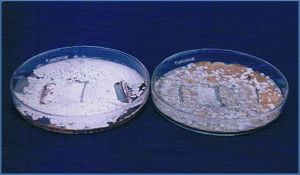 | Fig. 1- Cover Slip Culture Techniques for Identification of Actinomycetes |
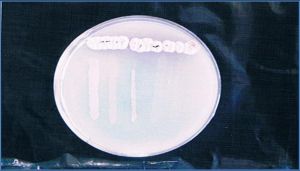 | Fig. 2- Screening of Antibiotic Producing Strains |
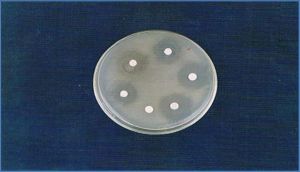 | Fig. 3- Antibiotic Disc Diffusion Method |
 | Table 1- Isolated Actinomycetes sp from sample. |
 | Table 2-Isolation of antibiotic producing strains |
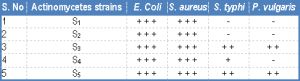 | Table 3-Extracted Antibiotic Substance at 40µL concentration against common pathogens +++ : Strong; ++ : Moderate; - : Weak |