


ISSN : 2320-3390
EISSN : 2320-5652



BHUSARI K.P.1, MEHERE A.P.2, CHARBE N.B.3*, WAROKAR A.S4, DESHMUKH M.P.5, DANGRE S.C.6
1Sharad Pawar College of Pharmacy, Wanadongri, Higna Road, Nagpur- 441 110, MS, India.
2Sharad Pawar College of Pharmacy, Wanadongri, Higna Road, Nagpur- 441 110, MS, India.
3Sharad Pawar College of Pharmacy, Wanadongri, Higna Road, Nagpur- 441 110, MS, India.
4Sharad Pawar College of Pharmacy, Wanadongri, Higna Road, Nagpur- 441 110, MS, India.
5Sharad Pawar College of Pharmacy, Wanadongri, Higna Road, Nagpur- 441 110, MS, India.
6Sharad Pawar College of Pharmacy, Wanadongri, Higna Road, Nagpur- 441 110, MS, India.
* Corresponding Author : nitincharbe10@yahoo.com
Received : 23-03-2012 Accepted : 11-10-2012 Published : 21-10-2012
Volume : 1 Issue : 1 Pages : 1 - 6
World Res J Antimicrob Agents 1.1 (2012):1-6
DOI : http://dx.doi.org/10.9735/2320-3390.1.1.1-6
A series of 3-((E)-5-(substitutedbenzylidene)-2-(2-chlorophenyl)-4-oxothiazolidin-3-yl)-2-phenylquinazolin-4(3H)-one (V) 1-12 have been synthesized. In order to establish optimization of different parameters of chemical transformation, that is the reaction pathway for each step and reaction conditions in the each step, in the present paper, different solvents and catalysts were used. The structures of the synthesized compounds were assigned on the basis of elemental analysis, IR, 1H NMR and 13C NMR spectral data. All the newly synthesized compounds were screened against various strains of bacteria and fungi.
Quinazoline, 2-phenylquinazolin-4(3H)-one, Antimicrobial activity, 4-thiazolidinones.
The rapid rise in bacterial resistance to the traditional antibiotics such as penicillin’s [1] and tetracycline [2] has encouraged a continuing search for new classes of compounds with novel modes of anti-bacterial activity. The quinazolinones have emerged as anti- microbial agents of an immense interest because of their broad spectrum of in-vitro activity and their in-vivo chemotherapeutic activity [3,4] .
Quinazolin-4(3H)-ones with substitution at position3, has been reported to be associated with anti-microbial properties [5] . Examples of these substitutions were substituted phenyl ring moieties [6] , bridged phenyl rings [7,8] , heterocyclic rings [9] and aliphatic systems [10] .
Quinazoline derivatives represent one of the most active classes of compounds possessing a wide spectrum of biological activity. They are widely used in pharmaceuticals and agrochemicals; for example, fluquinconazole fungicide for the control of agriculture diseases Several reports have been published on the biological activity of quinazoline derivatives, including their bactericidal, herbal and anti-tumour activity Thus, their synthesis has been of great interest in the elaboration of biologically active heterocyclic compounds11 Novel non-steroidal progesterone receptor antagonists with a 3-phenylquinazoline-2,4-dione/2-phenylisoquinoline- 1,3-dione skeleton were developed and their structure-activity relationships were investigated [12] . 2-phenylquinazoline analogues have shown to possess anti-prion [13] , antiviral and cytotoxic [14] , topoisomerase- I inhibitors [15] , antibacterial activities [15] etc.
Similarly, various 4-thiazolidinones [16] have attracted considerable attention as they are also endowed with a wide range of pharmaceutical activities including anaesthetic [17] , anticonvulsant [18] , antibacterial (19] and antiviral [20] . Furthermore, drug research and development have led to the discovery of new pharmacologically active agents, including imidoxy [21] compounds such as succinimidoxy [22] . 4-Thiazolidinones may be considered as phosphate bioisosteres and therefore inhibit the bacterial enzyme MurB which is involved in the biosynthesis of peptidoglycan layer of the cell wall [23] . In addition, some thiazolidinones were recently reported as novel inhibitors of mycobacterial rhamnose synthetic enzymes [23] . This new approach is believed to be selective as rhamnose is not found in humans, but is essential for mycobacterial cell wall synthesis in animals [24] .
Looking to the medicinal importance of quinazolinone and thiazolidinone, we report here the synthesis of new class of heterocyclic molecules in which both of these moieties are present and try to develop potential bioactive molecules. The structures of the compounds synthesized were assigned on the basis of elemental analysis, IR, 1H NMR, 13C NMR and Mass spectral data. These compounds were evaluated for their antimicrobial screening on different strains of bacteria and fungi.
General Procedures. Laboratory Chemicals were supplied by Merck Ltd. Melting points were determined by the open tube capillary method and are uncorrected. The purity of the compounds was monitored by thin layer chromatography (TLC) plates (silica gel G) in the solvent system n-hexane: ethyl acetate (V/V = 1:3). The spots were observed by exposure to iodine vapour or by UV light. The IR spectra were obtained on a Perkin-Elmer 1720 FT-IR spectrometer (KBr pellets). The 1H NMR and 13C NMR spectra were recorded on a Bruker Avance II 400 spectrometer using TMS as the internal standard in DMSO. Elemental analysis of the newly synthesized compounds was carried out on Carlo Erba 1108 analyzer.
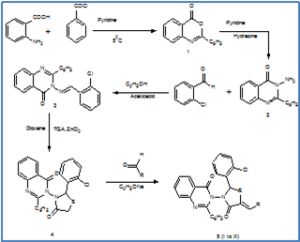
To a solution of the 2-chlorobenzaldehyde (1.0 mmol) in ethanol (15 mL) was added 3-amino-2-phenyl-4(3H)-quinazolinone (1.0 mmol) and a few drops of glacial acetic acid was added. The reaction mixture was refluxed for 3-8 h and the course of the reaction was monitored by TLC [ n-hexane/ethyl acetate (V/V =1:2) ] to its completion. The reaction mixture was cooled. The crude product was recrystallized from 95% ethanol to give the intermediate compound- (III). Yield 73%, m.p. 178°C; IR (KBr, cm-1) m: 3051, 1650 (quinazolinone ring, Benzene ring Ar-H), 3072 (CH stretching), 1671 (C‚O stretching), 1605, 1580 (C‚N stretching), 1562-1439 (C‚C, quinazolinone ring, benzene ring), 838 (C-Cl stretching). 1H NMR (DMSO): d (ppm):7.4-7.9(m 4H quinazolinone), 7.2-7.6(m, 4H, Ar-H) 8.1 (s, 1H, ‚CH group), 7.29.7.62(m, 5H, Ar-H)
Anal. Calcd for C24H15ClN4O: C, 70.16; H, 3.68; N, 13.64. Found: C, 70.22; H, 3.74; N, 13.67.
To a solution of compound-(III) (0.01 mol) in 1,4-dioxane (50 ml) was added mercapto acetic acid (0.01 mol) with stirring and a little amount of anhydrous ZnCl2 was added. The mixture was refluxed for 10-12 hrs., after the completion of the reaction, it was cooled and the excess solvent distilled and poured into sodium bicarbonate solution to neutralize it. The solid product was filtered, washed with cold water. The resulting light brown colour product was obtained. The completion of the reaction was checked by TLC [ n-hexane/ethyl acetate (V/ V=1:3) ]. The crude product was recrystallized from 95% ethanol to give the intermediate compound-(IV). Yield 73%, m.p. 178°C; IR(KBr, cm cm-1) m: 3052, 1650 (quinazolinone ring, benzene ring Ar-H), 1677, 1686 (C‚O stretching), 1609, 1582 (C‚N stretching), 1564-1448 (C‚C, quinazolinone ring, benzene ring), 849 (C-Cl stretching): 1H NMR (DMSO): d (ppm): 3.38-3.28 (s, 1H, CH2 group), 7.4-7.9(m 4H quinazolinone), 7.2-7.6(m, 4H, Ar-H) 8.1 (s, 1H, ‚CH group), 7.29.7.62(m, 5H, Ar-H) Anal. Calcd for Molecular Formula = C23H17N3O2S: C, 69.15; H, 4.29; N, 10.52 Found: C, 69.42; H, 3.58; N, 11.12.
Compound-(IV) (0.01 mol) was taken in ethanol (25 ml) and substituted aromatic aldehydes (0.01 mol) wer slowly added to it with stirring and a catalytic amount of sodium ethoxide was added. The reaction mixture was refluxed for 6-7 hrs., after the completion of the reaction, the product came out and excess amount of solvent was distilled out and the crude product was filtered off and washed with ethanol, dried and recrystallized in ethanol. The completion of the reaction was checked by TLC [ n-hexane/ethyl acetate (V/V = 1:3) ] to give the final product 5I-X.
Yield, 62%, off yellow crystalline solid, mp 292-293°C. IR (KBr, cm cm-1) m: 3057, 1650 (quinazolinone ring, benzene Ar-H), 3080 (‚CH stretching), 1675, 1681 (C‚O stretching),
1605, 1589 (C-N stretching), 1568-1445 (C=C, quinazolinone ring, benzene ring), 3065 (‚CH stretching), 845 (C-Cl stretching), 768, 692 (mono substituted benzene ring 1H NMR (DMSO): d (ppm): 7.29-8.14 (m, 4H nitro benzene)7.24 (s, 1H, CH group), 7.4-7.9(m 4H quinazolinone),7.2-715(m,, 4H, Ar-H ) 7.2-7.6(m, 4H, Ar-H) 7.94 (s, 1H, ‚CH group), 7.29.7.62(m, 5H, Ar-H), 5.92 (s, 1H, S-CH-N),. 13C NMR (DMSO) d (ppm): 133.5, 122.4, 151.3,120.9, 128.8, 127.4, 164, 161, 128.7, 52.2, 164.4, 129.3, 125.2, 136.1, 132.5, 129.6, 120.3, 148.3, 121.3, 105.3, 133.1, 128.9, 128.6, 126.9, 129.2, 128.9, 130.2, 128.9, 126.1. Anal. Calcd for C33H20Cl2N4O2S: C, 65.24; H, 3.31; N, 9.22. Found: C, 65.32; H, 3.35; N, 9.30.
Yield, 68%, off yellow crystalline solid, mp 292-293°C. IR (KBr, cm cm-1) m: 3057, 1650 (quinazolinone ring, benzene Ar-H), 3080 (‚CH stretching), 1675, 1681 (C‚O stretching), 1605, 1589 (C-N stretching), 1568-1445 (C=C, quinazolinone ring, benzene ring), 3055 (‚CH stretching), 845 (C-Cl stretching), 768, 692 (mono substituted benzene ring 1H NMR (DMSO): d (ppm): 7.29-8.23 (m, 4H nitro benzene) 6.79 (s, 1H, CH group), 7.4-7.9(m 4H quinazolinone), 7-7.5 1(m,, 4H, Ar-H ) 7.2-7.6(m, 4H, Ar-H) 7.94 (s, 1H, ‚CH group), 7.29.7.62(m, 5H, Ar-H), 5.92 (s, 1H, S-CH-N),. 13C NMR (DMSO) d (ppm): 164, 161, 120.9, 128.8, 127.4, 133.5, 122.4, 151.3128.7, 126.1, 128.9, 130.2, 128.9, 126.1, 52.2, 164.4, 129.3, 105.3, 133.1, 128.9, 128.6, 126.9, 129.2, 125.2, 136.1,121.3, 148.3, 120.3, 129.6, 132.5. Anal. Calcd for Molecular Formula = C30H19ClN4O4S :Composition: C, 63.55; H, 3.38; N(9.88%). Found: C, 63.32; H, 3.35; N, 9.30.
Yield, 62%, off yellow crystalline solid, mp 292-293°C. IR (KBr, cm cm-1) m: 3057, 1650 (quinazolinone ring, benzene Ar-H), 3080 (‚CH stretching), 1675, 1681 (C‚O stretching), 1605, 1589 (C-N stretching), 1568-1445 (C=C, quinazolinone ring, benzene ring), 3043 (‚CH stretching), 845 (C-Cl stretching), 768, 692 (mono substituted benzene ring 1H NMR (DMSO): d (ppm): 7.56-8.14 (m, 4H nitro benzene) 6.82 (s, 1H, CH group), 7.4-7.9(m 4H quinazolinone), 7-7.15 1(m, 4H, Ar-H ) 7.94 (s, 1H, ‚CH group), 7.29.7.62(m, 5H, Ar-H), 5.92 (s, 1H, S-CH-N). 13C NMR (DMSO) d (ppm): 133.5, 122.4, 151.3, 120.9, 128.8, 127.4, 164,161, 128.7, 52.2, 164.4, 129.3, 125.2, 141.3, 127.3, 121, 147.6, 121, 127.3, 105.3, 133.1, 128.9, 128.6, 126.9, 129.2, 126.1, 128.9, 130.2, 128.9, 126.1. Anal. Calcd for Molecular Formula = C30H19ClN4O4S: Composition = C, 63.55; H, 3.38; N, 9.88. Found: C, 63.32; H, 3.35; N, 9.56.
Yield, 63%, off yellow crystalline solid, mp 292-293°C. IR (KBr, cm cm-1) m: 3057, 1650 (quinazolinone ring, benzene Ar-H), 3080 (CH stretching), 1675, 1681 (C‚O stretching), 1605, 2950 (-CH3 stretching), 1568-1445 (C=C, quinazolinone ring, benzene ring), 3052 (‚CH stretching), 845 (C-Cl stretching), 768, 692 (mono substituted benzene ring 1H NMR (DMSO): d (ppm): 7.01-7.29 (m, 4H 4-methyl benzene), 6.68 (s, 1H, CH group), 7.4-7.9(m 4H quinazolinone), 7-7.15 1(m, 4H, Ar-H ), 7.29.7.62(m, 5H, Ar-H), 5.92 (s, 1H, S-CH-N), 2.35 (s, 3H, CH3). 13C NMR (DMSO) d (ppm): 164, 161, 120.9, 128.8, 127.4, 133.5, 122.4, 151.3, 128.7, 126.1, 128.9, 130.2, 128.9, 126.1, 52.2, 164.4, 129.3, 105.3, 133.1, 128.9, 128.6, 126.9, 129.2, 125.2, 132.2,126.3, 129, 137.6, 129, 126.3, 24.3, Anal. Calcd for Molecular Formula = C31H22ClN3O2S: Composition =C, 69.46; H, 4.14; N, 7.84. Found: C, 63.32; H, 3.35; N, 9.56.
Yield, 70%, off yellow crystalline solid, mp 292-293°C. IR (KBr, cm cm-1) m: 3057, 1650 (quinazolinone ring, benzene Ar-H), 3080 (‚CH stretching), 1675, 1681 (C‚O stretching), 1605, 845 (C-Cl stretching), 1568-1445 (C=C, quinazolinone ring, benzene ring), 3049 (‚CH stretching), 845 (C-Cl stretching), 768, 692 (mono substituted benzene ring 1H NMR (DMSO): d (ppm): 7.01-7.29 (m, 4H 4-methyl benzene), 6.68 (s, 1H, CH group), 7.4-7.9(m 4H quinazolinone), 7-7.15 1(m, 4H, Ar-H ), 7.29.7.62(m, 5H, Ar-H), 5.92 (s, 1H, S-CH-N),7.08-7.24(m, 4H Ar-Cl). 13C NMR (DMSO) d (ppm):133.5, 122.4, 151.3, 120.9, 128.8, 127.4, 164, 161.0, 128.7, 52.2,164.4, 129.3, 125.2, 133.1, 127.8, 126.8, 129.4, 128.8, 131.2, 105.3, 133.1, 128.9, 128.6, 126.9, 129.2, 126.1, 128.9, 130.2, 128.9, 126.1. Anal. Calcd for Molecular Formula = C30H19Cl2N3O2S. Composition =C, 64.75; H,3.44; N, 7.55, Found: C, 64.32; H, 3.35; N, 8.66.
Yield, 60%, off yellow crystalline solid, mp 292-293°C. IR (KBr, cm cm-1) m: 3057, 1650 (quinazolinone ring, benzene Ar-H), 3080 (‚CH stretching), 1675, 1681 (C‚O stretching), 1605, 845 (C-Cl stretching), 1568-1445 (C=C, quinazolinone ring, benzene ring), 3082 (CH stretching), 5.39 (s, 1H, -OH group), 768, 692 (mono substituted benzene ring 1H NMR (DMSO): d (ppm): 7.01-7.29 (m, 4H 4-methyl benzene), 6.68 (s, 1H, CH group), 7.4-7.9(m 4H quinazolinone), 7-7.15 1(m, 4H, Ar-H ), 7.29.7.62(m, 5H, Ar-H), 5.92 (s, 1H, S-CH-N),7.08-7.24(m, 4H Ar-Cl). 13C NMR (DMSO) d (ppm):164, 161, 120.9, 128.8, 127.4, 133.5, 122.4, 151.3, 128.7, 126.1, 128.9, 130.2, 128.9, 126.1, 52.2, 164.4, 129.3,1.5.3, 133.1, 128.9, 128.6, 126.9, 129.2, 125.2, 127.8, 127.8, 115.8, 157.7, 115.8, 127.8. Anal. Calcd for Molecular Formula = C30H20ClN3O3S.
Composition = C,66.97; H, 3.75; N, 7.81, Found: C, 66.39; H, 3.75; N, 7.66.
Yield, 65%, off yellow crystalline solid, mp 292-293°C. IR (KBr, cm cm-1) m: 3057, 1650 (quinazolinone ring, benzene Ar-H), 3073 (CH stretching), 1675, 1681 (C‚O stretching), 1605, 845 (C-Cl stretching), 1568-1445 (C=C, quinazolinone ring, benzene ring), 3082 (CH stretching), 5.39 (s, 1H, -OH group), 768, 692 (mono substituted benzene ring 1H NMR (DMSO): d (ppm): 7.01-7.29 (m, 4H 4-methyl benzene), 6.68 (s, 1H, CH group), 7.4-7.9(m 4H quinazolinone), 7-7.15 1(m, 4H, Ar-H ), 7.29.7.62(m, 5H, Ar-H), 5.92 (s, 1H, S-CH-N),7.08-7.24(m, 4H Ar-Cl). 13C NMR (DMSO) d (ppm):164, 161, 120.9, 128.8, 127.4, 133.5, 122.4, 151.3, 128.7, 126.1, 128.9, 130.2, 128.9, 126.1, 52.2, 164.4, 129.3,1.5.3, 133.1, 128.9, 128.6, 126.9, 129.2, 125.2, 127.8, 127.8, 115.8, 157.7, 115.8, 127.8. Anal. Calcd for Molecular Formula = C30H20ClN3O3S.
Composition = C,66.97; H, 3.75; N, 7.81, Found: C, 66.49; H, 3.78; N, 7.56.
Yield, 68%, off yellow crystalline solid, mp 292-293°C. IR (KBr, cm cm-1) m: 3062, 1654 (quinazolinone ring, benzene Ar-H), 3073 (CH stretching), 1675, 1681 (C‚O stretching), 1605, 845 (C-Cl stretching), 1568-1445 (C=C, quinazolinone ring, benzene ring), 3082 (CH stretching),, 768, 692 (mono substituted benzene ring). 1H NMR (DMSO): d (ppm): 7.01-7.89 (m, 4H 4-methyl benzene), 6.78 (s, 1H, CH group), 7.4-7.9(m 4H quinazolinone), 7-7.15 1(m, 4H, Ar-H ), 7.29.7.62(m, 5H, Ar-H), 5.92 (s, 1H, S-CH-N),7.08-7.24(m, 4H Ar-Cl). 13C NMR (DMSO) d (ppm):164, 161, 120.9, 128.8, 127.4, 133.5, 122.4, 151.3, 128.7, 126.1, 128.9, 130.2, 128.9, 126.1, 52.2, 164.4, 126.3,1.5.3, 134.1, 128.9, 128.6, 126.9, 129.2, 125.2, 127.8, 127.8, 115.8, 157.7, 115.8, 127.8. Anal. Calcd for Molecular Formula = C30H20ClN3O3S.
Composition = C,66.97; H, 3.75; N, 7.81, Found: C, 66.59; H, 3.76; N, 7.56.
Yield, 74%, off yellow crystalline solid, mp 292-293°C. IR (KBr, cm cm-1) m: 3062, 1654 (quinazolinone ring, benzene Ar-H), 3073 (CH stretching), 1675, 1681 (C‚O stretching), 1605, 845 (C-Cl stretching), 1568-1445 (C=C, quinazolinone ring, benzene ring), 3082 (CH stretching), 2810-2819 (dimethyl amino stretching), 768, 692 (mono substituted benzene ring). 1H NMR (DMSO): d (ppm): 7.01-7.89 (m, 4H 4-methyl benzene), 6.78 (s, 1H, CH group), 7.4-7.9(m 4H quinazolinone), 5.00 (s, 1H, -OH group), 7.0-7.15 1(m, 4H, Ar-H ), 7.29.7.62(m, 5H, Ar-H), 5.00 (s, 1H, -OH group), 5.92 (s, 1H, S-CH-N),7.08-7.24(m, 4H Ar-Cl) 2.85 (s, H. CH3-N-CHÂ3). 13C NMR (DMSO) d (ppm):164,161, 120.9, 128.8, 127.4, 133.5, 122.4, 151.3, 128.7, 126.1, 128.9, 130.2, 128.9, 126.1, 52.2, 164.4, 129.3,105.3, 133.1, 128.9, 128.6, 126.9,129.2, 125.2, 124.7, 127.3, 114.2, 148.8, 114.2, 127.3, 40.3. Anal. Calcd for Molecular = C32H25ClN4O2S
Composition = C, 68.02; H,4.46; N, 9.91, Found: C, 68.39; H, 4.36; N, 9.58.
Yield, 77%, off yellow crystalline solid, mp 292-293°C. IR (KBr, cm cm-1) m: 3057, 1650 (quinazolinone ring, benzene Ar-H), 3080 (CH stretching), 1675, 1681 (C‚O stretching),, 1568-1445 (C=C, quinazolinone ring, benzene ring), 3052 (‚CH stretching), 845 (C-Cl stretching), 768, 692 (mono substituted benzene ring 1H NMR (DMSO): d (ppm): 7.14-7.30 (m, 5H 4-methyl benzene), 6.68 (s, 1H, CH group), 7.4-7.9(m 4H quinazolinone), 7-7.15 1(m, 4H, Ar-H ), 7.29.7.62(m, 5H, Ar-H), 5.92 (s, 1H, S-CH-N), 2.35 (s, 3H, CH3). 13C NMR (DMSO) d (ppm): 164, 161, 120.9, 128.8, 127.4, 133.5, 122.4, 151.3, 128.7, 126.1, 128.9, 130.2, 128.9,126.1, 52.2, 164.4, 129.3, 105.3, 133.1, 128.9, 128.6, 126.9, 129.2, 125.2, 135.2, 126.4, 128.7, 128, 128.7, 126.4. Anal. Calcd for Molecular Formula = C30H20ClN3O2S. Composition = C, 69.02;H, 3.86; N, 8.05. Found: C, 69.21; H, 3.77; N, 8.56.
Intermediate compound 1 and compound 2 were prepared by procedure mention in literature procedures [25] . The reaction conditions for the synthesis of (II) were optimized in various solvents at different temperatures and different time. The results were observed and data was reported in [Table-1] . In step-(II), ethanol was used as a solvent and refluxed at 78°C, reaction was completed in 4 h and yield was found to be 24%. When we used isopropanol as a solvent and at 85°C temperature for 4 hrs., we found that 31% yield was obtained in step II. Pyridine was used as a solvent and reaction mixture was refluxed at 116°C for 3 hrs., we found that 87% yield was obtained. Thus for the synthesis of intermediate compound 2, pyridine is considered to be appropriate solvent and higher temperature (more than 100°C) was the perfect parameter for step-2. Further synthesis of the derivatives was done as per the procedure mention in 2.2.3.
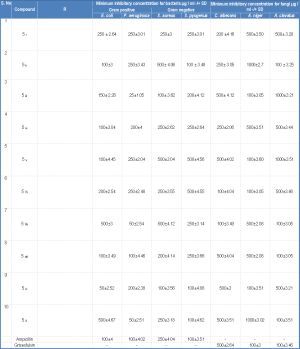
Minimum Inhibitory Concentration for bacteria (MICb) of all the synthesized compounds was determined against four different strains, viz two Gram positive bacteria (Staphylococcus aureus and S. pyogenes and two Gram negative bacteria (Escherichia coli and Pseudomonas aeruginosa) compared with standard drug. Ampicillin by broth dilution method [26] . For Antifungal activities, minimum inhibitory concentration for fungi (MICf) of all the synthesized compounds was determined against Candida albicans, Aspergillus niger and A. clavatus organisms were compared with standard drugs Greseofulvin by same method, which showed 100 lg/ml MICf against all fungi used for the antifungal activity.
From screening results, final compound 5ix possesses very good activity against E. coli. Compounds 5ii, 5iv, 5v and 5viii were good active against E. coli compared with standard
ampicillin. Final compound 5iii possesses an excellent activity against P. aeruginosa and compound 5vii possesses very good activity against P. aeruginosa, while compound 5viii possesses good activity against P. aeruginosa as compared to standard ampicillin. Final compounds 5viii and 5ix possesses very good activity against S. aureus, while compounds 5i, 5iv, 5vi, 5viii and 5x possesses good activity against S. aureus as compared to standard ampicillin. Final compounds 5ii, 5viii and 5ix are considered as good active against S. pyogenus as compared to ampicillin. The remaining compounds of the entire series possesses only moderate to poor antibacterial activity.
Antifungal screening data showed that final compounds 5vi and 5vii possesses very good activity against C. albecans, while compounds 5i, 5iii and 5iv possess good activity against C. albecans as compared to the standard griseofulvin. Compounds 5iii, 5v, 5vi and 5ix possesses good activity against A. niger as compared to the standard griseofulvin. Compounds 5iii, 5vii, 5viii and 5x possesses good activity against A. clavatus as compared to the standard griseofulvin.
Some of the newly synthesized compounds exhibited promising antibacterial activities against E. coli, S. aureus, P. aeruginosa and S. pyogenus. Some exhibited very good antifungal activity against C. albicans, A. niger and A. clavatus. Compounds 5vii and 5x possessed very good activity against both bacterial and fungal species. It seems that the methyl group at para position and hydroxy group at second position are very significant for activity against both bacterial and fungal species. These results make novel quinazolinone derivatives interesting lead molecules for further synthetic and biological evaluation.
[1] Nathwani D. and Wood M.J. (1993) Drugs, 4(2), 866-894.
» CrossRef » Google Scholar » PubMed » DOAJ » CAS » Scopus
[2] Schappinger D. and Hillen W. (1996) Arch. Microbiol, 165, 359-369.
» CrossRef » Google Scholar » PubMed » DOAJ » CAS » Scopus
[3] El-Gazzar A.B.A., Youssef M.M., Youssef A.M.S., Abu-Hashem A.A. and Badria F.A. (2008) European Journal of Medicinal Chemistry, 44(5), 609-624.
» CrossRef » Google Scholar » PubMed » DOAJ » CAS » Scopus
[4] Said M.M. and Hussein M.M. (1994) Bull. Fac. Pharm., 32(9), 341-347.
» CrossRef » Google Scholar » PubMed » DOAJ » CAS » Scopus
[5] Bhargava P.N. and Prakash S. (1997) Indian J. Chem., 39(B), 18-22.
» CrossRef » Google Scholar » PubMed » DOAJ » CAS » Scopus
[6] Abdel-Rahman T.M. (1997) Heterocycl. Commun., 3(2), 535-538.
» CrossRef » Google Scholar » PubMed » DOAJ » CAS » Scopus
[7] Mosaad S., Mohamed M.M., Kamel E.M., Kassem N.A., Sherein I., Abd El-M. and Marwa F. (2010) Eur. J. Med. Chem., 45(12), 3311-3319.
» CrossRef » Google Scholar » PubMed » DOAJ » CAS » Scopus
[8] Aono S., Marui F., Itoh M., Yamooka M., Nakao F. (1996)Eur. Patent No. 735035.
» CrossRef » Google Scholar » PubMed » DOAJ » CAS » Scopus
[9] Pandey S.K., Singh A. and Nizamuddin A. (2009) Eur. J. Med. Chem., 44(21), 1188-1197.
» CrossRef » Google Scholar » PubMed » DOAJ » CAS » Scopus
[10] Salehi P., Dabiri M., Zolfigol M.A. and Baghbanzadeh M. (2005) Tetrahedron Letters, 46(2), 7051-7053.
» CrossRef » Google Scholar » PubMed » DOAJ » CAS » Scopus
[11] Raffa D., Daidone G., Schillaci D., Maggio B., Plescia F. (1999) Pharmazie., 54(23), 251-254.
» CrossRef » Google Scholar » PubMed » DOAJ » CAS » Scopus
[12] Chevalier J., Atifi S., Eyraud A., Mahamoud A., Pajes J. (2001) J. Med. Chem., 44(3), 4023-4026.
» CrossRef » Google Scholar » PubMed » DOAJ » CAS » Scopus
[13] Barthel A. and Trieschmann L. (2009) Archiv der Pharmazie, 342 (4), 445-452.
» CrossRef » Google Scholar » PubMed » DOAJ » CAS » Scopus
[14] Rao A. and Zappala M. (2004) Arkivoc., 37(3), 147-155.
» CrossRef » Google Scholar » PubMed » DOAJ » CAS » Scopus
[15] Le T.N., Yang S.H., Khadka D.B., Van H.T. (2011) Bioorg. Med. Chem., 19(14), 4399-404.
» CrossRef » Google Scholar » PubMed » DOAJ » CAS » Scopus
[16] Pan B., Huang R.Z., Ying H.J., (2010) Bioorg. Med. Chem. Lett., 20(19), 2461-2464.
» CrossRef » Google Scholar » PubMed » DOAJ » CAS » Scopus
[17] Surrey A.R. (1949) J. Am. Chem. Soc., 71(56), 3354- 3356.
» CrossRef » Google Scholar » PubMed » DOAJ » CAS » Scopus
[18] Troutman H.D. and Long L.M. (1948) J. Am. Chem. Soc., 70, 3436-3439.
» CrossRef » Google Scholar » PubMed » DOAJ » CAS » Scopus
[19] Sayyed M. and Mokle S. (2006) Arkivoc., ii,187-192.
» CrossRef » Google Scholar » PubMed » DOAJ » CAS » Scopus
[20] Rao A. and Zappala M. (2004) Arkivoc., v, 147-155.
» CrossRef » Google Scholar » PubMed » DOAJ » CAS » Scopus
[21] Wolfgang L. (1998) Eur. J. Pharmcol., 56(5), 342, 1-13.
» CrossRef » Google Scholar » PubMed » DOAJ » CAS » Scopus
[22] Farror Y.A., Rutkowaka M.C., Grochowski J., Serda P., Pilati T., Cory M., Nicholson J.M. and Scott K.R. (1993) J. Med. Chem., 36(5), 3517-3525.
» CrossRef » Google Scholar » PubMed » DOAJ » CAS » Scopus
[23] Gursoy A., Otuk G. and Terzioglu N. (2005) Turkish J. Pharm. Sci., 2(3), 1-10.
» CrossRef » Google Scholar » PubMed » DOAJ » CAS » Scopus
[24] Andres C.J., Bronson J.J., D’Andrea S.V., Deshpande M.S., Falk P.J., Grant-Young K.A., Harte W.E., Ho H., Misco P.F., Robertson J.G., Stock D., Sun Y. and Walsh A.W. (2000)Bioorg. Med. Chem. Lett., 10(4), 715-717.
» CrossRef » Google Scholar » PubMed » DOAJ » CAS » Scopus
[25] Siddappa K., Reddy K. and Reddy C.V. (2008) Eur. J. Chem., 5(4), 155-162.
» CrossRef » Google Scholar » PubMed » DOAJ » CAS » Scopus
[26] Rattan A. (2000) Churchill, B.I., Livingstone, New Delhi, 85-105.
» CrossRef » Google Scholar » PubMed » DOAJ » CAS » Scopus
 | Fig. 1- Synthesized Compounds (1 to 5 <sub>1 to X</sub>) |
 | Table 1- Antimicrobial activity of the final synthesized compounds 5 <sub>i-x</sub> |