


ISSN : 0976-8920
EISSN : 0976-8939



SAIKIA T.1*, BARUAH K.K.2
1Department of Chemistry, D.C.B. Girls’ College, Jorhat-785001, Assam, India.
2Department of Environmental Science, Tezpur University, Tezpur-784028, Assam, India
* Corresponding Author : saikia.tarun55@gmail.com
Received : 12-09-2012 Accepted : 27-11-2012 Published : 12-12-2012
Volume : 3 Issue : 3 Pages : 90 - 94
J Crop Sci 3.3 (2012):90-94
DOI : http://dx.doi.org/10.9735/0976-8920.3.3.90-94
Conflict of Interest : None declared
Iron toxicity is a major nutrient disorder affecting rice production of wetland rice in the irrigated and rain fed ecosystem. High concentration of ferrous iron (Fe2+) in water logged acid soils is a constraint for higher rice production in Assam a state of North Eastern India. Three rice (Oryza sativa) varieties- Mahsuri, Ranjit (high yielding variety) and Siyal Sali (traditional variety) were grown in four different levels of Fe2+ iron, viz- Control, 100ppm, 200ppm and 300ppm. Iron 300 ppm in the medium was found to induce severe bronzing disorder in the variety Ranjit and Siyal Sali. Variety Mahsuri maintained higher total soluble protein, higher superoxide dismutase and catalase activity. Varieties Ranjit and Siyal Sali exhibited an increasing trend of peroxidase and polyphenol oxidase activity at higher level of Fe2+ in growth medium. Significant reductions in superoxide dismutase and catalase activities were observed in the varieties Ranjit and Siyal Sali. The results of antioxidative enzyme activities demonstrate that rice cultivars differ in their response to iron tolerance and tolerance properties depend largely on the enhanced activity of these enzymes.
bronzing score, iron toxicity, Oryza sativa, physiological disorder, antioxidants.
Rice is one of the most important food crops of most of the Asian Countries. Lowland rice frequently suffers from iron toxicity and is reported to be an important yield limiting factor in flooded rice [1] . Iron toxicity in rice has been subjected to various investigations, on toxicity mechanism and screening for iron tolerant cultivars [2,3] . Rice plants affected by an overloading of iron, show tiny brown spots starting from the tips, spreading towards the base of lower leaves [2] . Tissue iron may catalyze the generation of active oxygen species via the iron catalyzed Haber-Weiss reaction (Fenton reaction). Without iron this reaction is reported to be slow in the medium [4] . Under waterlogged situation, excess of water soluble iron in growth medium and its translocation into plant cells retard crop growth and cause oxidative damage within the cells [5] .
Iron as an essential element for all plants has many important biological roles in processes as diverse as photosynthesis, chloroplast development and chlorophyll biosynthesis evident from several reports [6-9] . It is a major constituent of the cell redox systems like heme proteins including cytochromes, catalase, peroxidase, Fe-S proteins like feredoxin, aconitase and superoxide dismutase (SOD) [6] . The Fe (II)/Fe (III) redox couple plays an important role in plant growth by enhancing the enzymatic redox reaction [10] . Higher concentration of Fe2+ ion within plant cell may accelerate many redox reactions where Fe2+ acts as an electron donor [11] .
Plant cells employ their antioxidant defense systems like SOD, POD, PPO and CAT to protect the tissues from iron mediated oxidative damage [11] . Super oxide dismutase reduce the activity of super oxide radicals to yield H2O2 [10] which is further regulated enzymatically by catalases and peroxidases [12,13] . The activity study of these antioxidants helps to select the tolerant rice varieties to grow in iron toxic soil [11] .
Rice genotypes differ widely in tolerance to Fe toxicity and hence many cultivars of rice are able to grow in Fe2+ toxic condition without displaying any symptom of toxicity [1,14] . Limited Fe2+ uptake, exclusion of Fe2+ by root surface and its retention within the tissues [5] and strong activity of phytoferritin [1] might be some of the reasons for iron tolerance in rice. Identification of rice genotypes tolerant to iron toxicity may be an effective biological and environment friendly approach for ameliorating Fe toxicity and antioxidant activities of the rice varieties may be a suitable tool for the identification of tolerant genotypes. The present investigation was carried out with the objectives of studying the antioxidant activities of certain enzymes in few rice varieties. The study also aimed at identification of iron toxicity tolerant rice cultivars for growing in acid soils of Assam.
A pot experiment was conducted during monsoon rice season in the year 2011. Soil was collected from a rice field located at Titabor, Assam (soil type-sandy loam, total iron in the soil was 350ppm, pH 5.1, available phosphorus 12kg.ha-1, nitrogen 450kg.ha-1, potash 118kg ha-1 and organic carbon 0.86%). The experiment was conducted in randomized block design. Plastic pots (size 6″×12″) were filled with 7kg well prepared soil in each pot. Three rice (Oryza sativa L.) varieties viz. Mahsuri (HYV), Ranjit (HYV) and Siyal Sali (traditional) were transplanted in four different levels of Fe2+ in the form of FeSO4.7H2O. Concentrations of Fe2+ solutions were control (without added iron), 100, 200 and 300 ppm respectively. The Fe2+ solutions were added in the pot one week after transplanting at an interval of seven days. A uniform waterlogged environment was maintained with distilled water in the pots throughout the experimental period. Leaf bronzing scores were recorded by IRRI standard evaluation system (1976) at maximum tillering (MT stage), panicle initiation (PI stage) and at grain filling stage (GF stage). Total soluble proteins in the leaf tissues were estimated in different growth stages (MT, PI, GF, and before harvesting stage) by the method of Lowry, et al. [15] . SOD, catalase, POD and PPO activity was measured in leaf tissues of fully matured leaves collected at active tillering stage. SOD activity was assayed by the method of Giannopolitis and Ries [16] . Catalase was assayed by measuring the decrease in the H2O2 concentration at 240nm [17] . The enzyme peroxidase (POD) and polyphenol oxidase (PPO) were extracted as described by Kar and Mishra [18] . The enzyme activities were expressed as units per gram fresh weight (U g-1 FW).
Statistical analyses of experimental data were carried out by using SPSS software. Analysis of variance was carried out to test the significance of treatment effect. F-test, coefficient of variance and critical difference were calculated by standard method [19] .
In the present investigation a characteristic yellow orange discoloration of older leaves starting from tip of the leaf was observed in varieties Ranjit and Siyal Sali grown in the medium with higher iron (200 and 300ppm Fe2+). This characteristic bronzing symptoms of leaves was used as an index of Fe-toxicity tolerance [1] . Such bronzing symptoms on plant leaves due to higher Fe2+ concentration is also reported by Baruah, et al. [1] and Backer and Asch [20] . The Fe toxicity responses were assessed from bronzing scores and expressed as percentage of bronzed leaves. Bronzing symptoms on leaves of sensitive varieties Ranjit and Siyal Sali increased as a function of concentration and is in conformity with Baruah, et al. [1] , Backer and Asch. [20] . At grain filling stage, the variety Ranjit recorded highest bronzing scores followed by Siyal Sali [Fig-1] at 300ppm Fe2+ concentration. Mahsuri did not show leaf bronzing irrespective of Fe2+ concentration in the medium. Fe2+ uptake regulatory mechanism - avoidance to toxic Fe2+ iron in plant tissues and tolerance to elevated Fe2+concentration in the leaf tissues might have contributed to varietal difference to higher Fe2+ through a mechanism suggested by Backer and Asch [20] .
Higher Fe uptake by plant is reported to reduce the protein synthesis in leaf [11] . Ferritin is considered crucial for iron homeostasis. It consists of multimeric spherical protein called phytoferritin, able to store upto 4500 Fe atoms inside its cavity in non toxic form. It functions as a cellular Fe buffer [21] . A resistant variety may accumulate more amount of phytoferritin which forms complex with Fe2+, reducing Fe toxicity damage. Large amount of Fe2+in plant is reported to be responsible for protein degradation [1] and we propose that Fe2+ may lead to formation of reactive oxygen radicals which are highly phytotoxic and cause protein degradation in the line of mechanism reported by Davies [22] and Blokhina et al, [23] . Perhaps this is the reason for which Mahsuri did not show severe leaf bronzing and maintained high total leaf proteins at 300ppm Fe2+ [Table-1] . A significant reduction in total soluble protein was observed in Ranjit and Siyal Sali grown at higher level of Fe2+ iron. For sensitive variety, higher Fe2+ concentrations lead to rapid increase in lipid peroxidation accompanied with growth retardation [24] and shift the balance of free radical metabolism towards production of active oxygen species that impair the cellular structure irreversibly and damage membrane proteins [25] , a mechanism that might operate in the varieties Ranjit and Siyal Sali.
SOD is the key antioxidant in aerobic cells responsible for reduction of reactive oxygen species. SOD activity determines the concentration of O2-, and H2O2 [26] . The metal cofactors of SOD enzymes are in oxidized form (M n+1) which catalyze the dismutation of super oxide radicals, one electron reduction process to produce molecular O2 and H2O2 [27] . The soluble Fe2+ induces the formation of harmful reactive oxygen species in aerobic cells of plants. To overcome this, plant cells develop enzymatic mechanism to reduce the damaging effects by the following reaction scheme.
The damage of plant cells occur when ROS production exceeds the activity of antioxidant system [28] . Hence plants with strong antioxidant activities have been shown to be tolerant to oxidative stress [29] . Excess liberation of H2O2 under stress conditions sometimes may deactivate the SOD activity, specially Fe-SOD and Cu/Zn-SOD isoform [30] . The SOD activity in plant not only depends on the production of ROS, it also depends on the type of rice varieties [12,13] , nature of stress [31] , degree and duration of stress [25] .
In our experiment the varieties Ranjit and Siyal Sali maintined a higher SOD activity compared to Mahsuri in controlled soil [Fig-2] [Table-2] . With the increment of Fe2+ concentration the varieties Ranjit and Siyal Sali recorded a sharp decrease in SOD activity. The decrease of SOD activity may be due to enzyme inhibition, as higher iron is likely to inhibit the enzyme as reported by Dey, et al., [12] . The total SOD activities of these two rice cultivars are found to be higher in control than 100ppm, 200ppm and 300 ppm Fe2+ in growth medium. A possible reason of this decreasing trend is, unlike in resistant plant, the shoots of Ranjit and Siyal Sali may accumulate a greater amount of Fe2+ ions which may inhibit the mechanism of SOD production. Similar results are reported in Fe2+ sensitive rice varieties with lower SOD at higher concentration of Fe2+ [11,32] . Excess Fe2+ iron uptake by roots and its translocation into shoot increases the cellular Fe2+ ions and reduces Cu2+/Zn2+ concentration due to their antagonistic behavior with iron [31] . As a result higher Fe2+ concentration may reduce the SOD activity by accelerating the supper oxides dismutation reaction in reversible direction. Hence a common ion effect mechanism may operate in varieties Ranjit and Siyal Sali resulting into decreased SOD activity.
Variety Mahsuri recorded an increasing trend of SOD activity at higher Fe2+. Limited iron uptake [1] and the active oxygen detoxifying mechanism of tolerant rice cultivars [12] may be involved in Mahsuri. Similar findings are also reported by Bode, et al. [11] in IR97 and established it as iron tolerant rice cultivar. Thus increased SOD activity in Mahsuri indicates its positive role in controlling the cellular level of ROS and repairing possible oxidative damage [10] caused by Fe2+.
Peroxidase (POD) is not only one of the defense proteins but also an important antioxidant involved in response to environmental stress [33] . Peroxidase reduces toxic effect of H2O2 and thus severity of oxidative stress is reduced [34] . In our study peroxidase activity was found to be higher in all the varieties irrespective of Fe2+ iron concentration in the medium [Fig-3] [Table-3] and is in agreement with the findings of other reports [13] . A significant induction of POD activity was found in Ranjit and Siyal Sali at higher level of Fe2+ in the medium. The increased POD activity was not effective in reducing oxidative stress caused by higher Fe2+ in these two varieties, similar observations have been reported elsewhere [24,35] . Although the POD activity in Mahsuri did not change at 200ppm and 300ppm Fe2+ but the activity of this enzyme at 200ppm and 300 ppm Fe2+ was higher than the control plants grown at 100 ppm Fe2+. Our results are in conformity with Agarwal, et al., [32] . The lower POD activity in Mahsuri compared to other two varieties might be due to lower Fe2+ uptake or translocation of less Fe2+ from roots to leaves, a mechanism suggested by Sahrawat [5] .
Polyphenol oxidase (PPO) is a terminal oxidase which can directly pass electrons to O2 when the intermediate products of plant respiration are oxidized. It catalyzes many oxidation reactions of compounds like phenol to quinone [13] . PPO is also involved in synthesis of lignin, a cell wall compound containing phenolic groups [34] . PPO is reported to play a significant role in defense mechanism of plants and in oxidative stress [34] . Role of PPO in browning phenomena is well documented and is involved in release of oxidized polyphenol, a compound responsible for bronzing due to Fe toxicity. In our study we observed an increasing trend of PPO under the influence of higher Fe2+ in the medium [Fig-4] [Table-4] . We propose that the induction of PPO activity might be due to its role in phenolic compound syntheses. These phenolic compounds also can directly scavenge the molecular species of active oxygen in plant, a mechanism reported by Michalak, [36] and Zheng, et al., [13] . Hence less tolerance of the varieties Ranjit and Siyal Sali to Fe2+ stress has contributed to high PPO activity.
The intercellular level of H2O2 is regulated by wide range of enzymes, the most important being catalase [12] . CATs are tetrameric heme containing enzymes with the potential to directly dismutate H2O2 into H2O and O2 [10] . The CAT activities are reported to increase significantly by heavy metal stress [13] . In our experiment, although a drop in CAT activity was observed at 100 ppm iron, but at higher ferrous ion concentration an increasing trend of CAT activity was observed in the variety Mahsuri [Fig-5] [Table-5] . The induction of CAT activity in Mahsuri indicates a better antioxidant activity against oxidative damage. Catalase activities may play a role in iron tolerance in rice [11] ; we also suggest a similar mechanism in variety Mahsuri. On the other hand, varieties Siyal Sali and Ranjit recorded a decreasing trend of CAT activity under higher Fe2+ concentrations. CAT activity for both the varieties declined significantly at 300 ppm Fe2+. Similar results are reported by Agarwal, et al., [32] and Dey, et al., [12] . The reduction of CAT activity in Ranjit and Siyal Sali is due to acceleration of Fenton reaction in forward direction [32,37] .
In Siyal Sali and Ranjit inhibitory effect of iron induced oxidative stress was more which might lead to suppression of antioxidant enzyme activities. Therefore these two varieties are identified as Fe2+ sensitive variety. At the same time the variety Mahsuri which maintained better antioxidative enzyme activities in terms of active functions of CAT [Fig-5] [Table-5] , SOD [Fig-2] [Table-2] accompanied by lower POD [Fig-3] [Table-3] , PPO [Fig-4] [Table-4] activity and higher soluble protein [Table-1] at 300 ppm Fe2+ is considered as iron tolerant variety suitable to grow in iron toxic soil environment.
We thank Director, Tea Research Association, Jorhat and Dr. R. Tamuli (HOD), Department of Biochemistry, TRA, Jorhat, Assam for valuable help in conducting the biochemical analysis at their laboratory.
DAT: Days After Transplanting, HYV: High Yielding Variety, POD: Peroxidase, PPO: Polyphenol Oxidase, SOD: Superoxide Dismutase, CAT: Catalase, ROS: Reactive Oxygen Species, FW: Fresh Weight.
[1] Baruah K.K., Das S., Das K. (2007) Journal of Plant Nutrition, 30, 1871-1883.
» CrossRef » Google Scholar » PubMed » DOAJ » CAS » Scopus
[2] Ponnamperuma F.N., Bradfield R., Reech M. (1955) Nature, 175, 265.
» CrossRef » Google Scholar » PubMed » DOAJ » CAS » Scopus
[3] Tanaka A., Loe R. and Lavasero S.A. (1996) Journal of Soil Science Plant Nutrition, 12, 32-38.
» CrossRef » Google Scholar » PubMed » DOAJ » CAS » Scopus
[4] Halliwell B. (2006) Plant Physiology, 141, 312-322.
» CrossRef » Google Scholar » PubMed » DOAJ » CAS » Scopus
[5] Sahrawat K.L. (2010) Plant Stress. Global Science Books.
» CrossRef » Google Scholar » PubMed » DOAJ » CAS » Scopus
[6] Marschner H. (1995) Mineral Nutrition of Higher Plants, Academic Press, London, 313-323.
» CrossRef » Google Scholar » PubMed » DOAJ » CAS » Scopus
[7] Robinson N.J., Procter C.M., Connolly E.L., Guerinot M.L. (1999) Nature, 397, 694-697.
» CrossRef » Google Scholar » PubMed » DOAJ » CAS » Scopus
[8] Cody G.D., Boctor N.Z., Filley T.R., Hazen R.M., Scott J.H., Sharma A., Yoder H.S.Jr. (2000) Science, 289, 1337-1340.
» CrossRef » Google Scholar » PubMed » DOAJ » CAS » Scopus
[9] Waters B.M., Blevins D.G., Eide D.J. (2002) Plant Physiology, 129, 85-94.
» CrossRef » Google Scholar » PubMed » DOAJ » CAS » Scopus
[10] Gill S.S. and Tuteja N. (2010) Plant Physiology Biochemistry, 48, 909-930.
» CrossRef » Google Scholar » PubMed » DOAJ » CAS » Scopus
[11] Bode K., Doring O., Luthje S., Neue H., Bottger M. (1995) Protoplasm, 184, 249-255.
» CrossRef » Google Scholar » PubMed » DOAJ » CAS » Scopus
[12] Dey S.K., Dey J., Patra S., Pothal D. (2007) Brazilian Journal of Plant Physiology, 19, 53-60.
» CrossRef » Google Scholar » PubMed » DOAJ » CAS » Scopus
[13] Zheng G., Lv H.P., Gao S., Wang S.R. (2010) Plant, Soil and Environment, 56, 508-515.
» CrossRef » Google Scholar » PubMed » DOAJ » CAS » Scopus
[14] Olaleye A.O., Ogunkunle A.O., Singh B.N., Akinbola G.E., Tabi F.O., Fayinminu O.M., Iji E. (2009) Journal of Plant Nutrition, 32, 1-17.
» CrossRef » Google Scholar » PubMed » DOAJ » CAS » Scopus
[15] Lowry O.H., Rosebrough N.J., Farr A.L., Randall R.J. (1951) Journal of Biochemistry, 193, 265-275.
» CrossRef » Google Scholar » PubMed » DOAJ » CAS » Scopus
[16] Giannopolitis C.N., Ries S.K. (1977) Plant Physiology, 59, 309-314.
» CrossRef » Google Scholar » PubMed » DOAJ » CAS » Scopus
[17] Aebi H. (1984) Enzymology, 105, 121-126.
» CrossRef » Google Scholar » PubMed » DOAJ » CAS » Scopus
[18] Kar M., Mishra D. (1976) Plant Physiology, 57, 315-319.
» CrossRef » Google Scholar » PubMed » DOAJ » CAS » Scopus
[19] Ott R.L. and Longnecker M.T. (2008) An Introduction to Statistical Methods and Data Analysis, 6th ed. Duxbury Press.
» CrossRef » Google Scholar » PubMed » DOAJ » CAS » Scopus
[20] Backer M., Asch F. (2005) Journal of Plant Nutrition and Soil Science, 168, 558-573.
» CrossRef » Google Scholar » PubMed » DOAJ » CAS » Scopus
[21] Zancani M., Peresson C., Tubaro F., Vianello A., Macri F. (2007) Plant Science, 173, 182-189.
» CrossRef » Google Scholar » PubMed » DOAJ » CAS » Scopus
[22] Davies K.J. (1987) Journal of Biological Chemistry, 262, 9895-9901.
» CrossRef » Google Scholar » PubMed » DOAJ » CAS » Scopus
[23] Blokhina O., Virolainen E., Fagerstedt K.V. (2003) Annals of Botany, 91,179.
» CrossRef » Google Scholar » PubMed » DOAJ » CAS » Scopus
[24] Fang W.C., Wang J.W., Lin C.C., Kao C.H. (2001) Plant Growth and Regulation, 35, 75-80.
» CrossRef » Google Scholar » PubMed » DOAJ » CAS » Scopus
[25] Arora A., Sairam R.K., Srivastava G.C. (2002) Current Science, 82, 1227-1338.
» CrossRef » Google Scholar » PubMed » DOAJ » CAS » Scopus
[26] Selote D.S., Khanna-Chopra R. (2004) Plant Physiology, 121, 462-471.
» CrossRef » Google Scholar » PubMed » DOAJ » CAS » Scopus
[27] Muscoli C., Cuzzocrea S., Riley D.P., Zweir J.L., Thiemermann C., Wang Z.Q., Salvemini D. (2003) British Journal of Pharmacology, 140, 445-460.
» CrossRef » Google Scholar » PubMed » DOAJ » CAS » Scopus
[28] Navrot N., Rouhier R., Galhaye E., Jaquot J.P. (2007) Plant Physiology, 129, 185-195.
» CrossRef » Google Scholar » PubMed » DOAJ » CAS » Scopus
[29] Mittler R., Vanderauwera S., Gollery M., Breusegem F. (2005) Trends in Plant Science, 9, 490-498.
» CrossRef » Google Scholar » PubMed » DOAJ » CAS » Scopus
[30] Alscher R.G., Erturk N., Heath L.S. (2002) Journal of Experimental Botany, 53, 1331-1341.
» CrossRef » Google Scholar » PubMed » DOAJ » CAS » Scopus
[31] Shao G., Chen M., Wang W., Mou R., Zhang G. (2007) Plant Growth and Regulation, 53, 33-42.
» CrossRef » Google Scholar » PubMed » DOAJ » CAS » Scopus
[32] Agarwall S., Sairam R.K., Meena R.C., Tyagi A., Srivastava G.C. (2006) Journal of Plant Science, 1, 86-97.
» CrossRef » Google Scholar » PubMed » DOAJ » CAS » Scopus
[33] Flohe L., Ursini F. (2008) Redox Signal, 10, 1613-1625.
» CrossRef » Google Scholar » PubMed » DOAJ » CAS » Scopus
[34] Mayer A.M. (2006) Phytochemistry, 67, 2318-2331.
» CrossRef » Google Scholar » PubMed » DOAJ » CAS » Scopus
[35] Sinha S., Saxena R. (2006) Chemosphere, 62, 1340-1350.
» CrossRef » Google Scholar » PubMed » DOAJ » CAS » Scopus
[36] Michalak A. (2006) Polish Journal of Environmental Studies, 15, 523-530.
» CrossRef » Google Scholar » PubMed » DOAJ » CAS » Scopus
[37] Ranieri A., Castagna A., Baldan B. and Soldatini G.F. (2001) Journal of Experimental Botany, 52, 25-35.
» CrossRef » Google Scholar » PubMed » DOAJ » CAS » Scopus
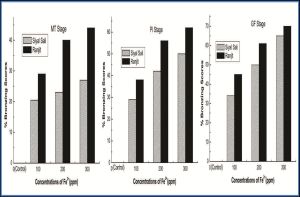 | Fig. 1- Leaf bronzing scores for seedlings of three lowland rice cultivars subjected to different concentrations of Fe2<sup>+</sup> iron at three different growth stages |
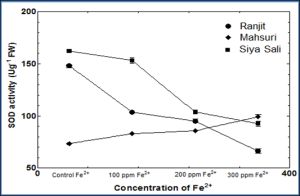 | Fig. 2- Effect of different level of Fe2<sup>+</sup> on SOD activity of three rice cultivars. <i>The vertical bar represents standard errors multiplied by 20</i> |
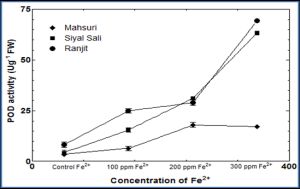 | Fig. 3- Effect of different level of Fe2<sup>+</sup> on POD activity of three rice cultivars. <i>The vertical bar represents standard errors multiplied by 5</i> |
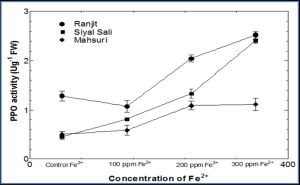 | Fig. 4- Effect of different level of Fe2<sup>+</sup> on PPO activity of three rice cultivars <i>The vertical bar represents standard errors multiplied by 5.</i> |
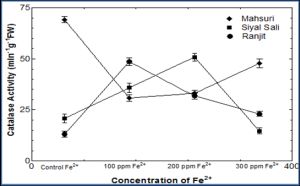 | Fig. 5- Effect of different level of Fe2<sup>+</sup> on CAT activity of three rice cultivars <i>The vertical bar represents standard errors</i> |
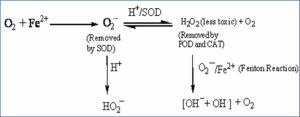 | Fig. 6- |
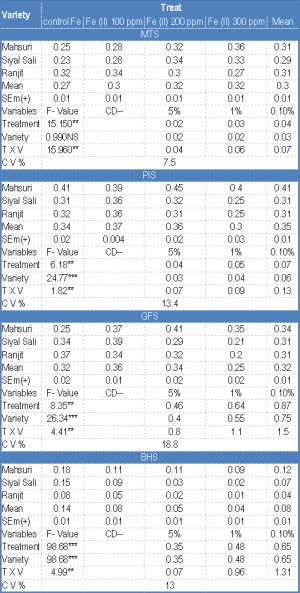 | Table 1- Effect of different level of Fe (II) on total soluble protein (mg.g-1 FW) *Significant at 5% level of probability, **Significant at 1% level of probability, ***Significant at 0.1% level of probability. NS: represent not significant, MTS: maximum tillering stage, PIS: panicle initiation stage, GFS: grain filling stage, BHS: before harvesting stage |
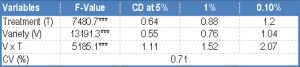 | Table 2- Effect of different level of Fe2+ on SOD activity of three rice cultivars *** represents significance at 0.1% level of Probability |
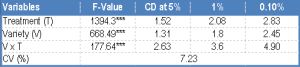 | Table 3- Effect of different level of Fe2+ on POD activity of three rice cultivars *** represents significance at 0.1% level of Probability |
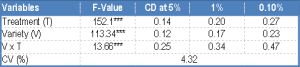 | Table 4- Effect of different level of Fe2+ on PPO activity of three rice cultivars *** represents significance at 0.1% level of Probability |
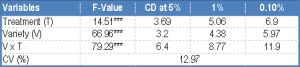 | Table 5- Effect of different level of Fe2+ on CAT activity of three rice cultivars *** represents significance at 0.1% level of Probability |