


ISSN : 0976-9943
EISSN : 0976-9951



WANI M.1*, SAHA S.2, BIDWAI J.3, KHETMALAS M.4
1Dr. D.Y. Patil Biotechnology and Bioinformatics Institute, Dr. D.Y. Patil Vidyapeeth, Tathawade, Pune- 411033, MS, India
2Dr. D.Y. Patil Biotechnology and Bioinformatics Institute, Dr. D.Y. Patil Vidyapeeth, Tathawade, Pune- 411033, MS, India
3Dr. D.Y. Patil Biotechnology and Bioinformatics Institute, Dr. D.Y. Patil Vidyapeeth, Tathawade, Pune- 411033, MS, India
4Dr. D.Y. Patil Biotechnology and Bioinformatics Institute, Dr. D.Y. Patil Vidyapeeth, Tathawade, Pune- 411033, MS, India
* Corresponding Author : minal.wani@dpu.edu.in
Received : 10-10-2012 Accepted : 05-11-2012 Published : 13-11-2012
Volume : 2 Issue : 1 Pages : 8 - 11
J Hortic Lett 2.1 (2012):8-11
DOI : http://dx.doi.org/10.9735/0976-9943.2.1.8-11
The present investigation is carried out to study the effects of mineral salts like silver nitrate and cobalt nitrate along with organic supplement sucrose on the vase life and carbohydrate metabolism during senescence of Gerbera jamesonii cv. Danalin flowers. Gerbera flowers were procured from a commercial floriculture unit and placed in treatment solutions. The flowers kept in distilled water were treated as control. Biochemical changes in various carbohydrates and related enzymes were studied up to 9th day of incubation. The starch content was maintained high in both silver nitrate and cobalt nitrate treated flowers whereas the control flowers exhibited lower level of starch contents. An increase in total soluble carbohydrates was reported in both treated and control flowers up to the 5th day of incubation whereas a steep fall was shown by both cobalt nitrate treated and control flowers. An alternate and considerable increase and decrease in reducing sugars content was observed by the flowers under treatments. Lowest level of total soluble carbohydrates and reducing sugar contents were exhibited by the control flowers. Amylase enzyme activity was observed increasing throughout the post harvest studies in both treated and control flowers, but the control flowers exhibited highest activity on the 9th day. A slight increment in invertase activity was shown by both silver nitrate and cobalt nitrate treated flowers while control flowers showed a significant rise in activity. Maintenance of elevated carbohydrate contents and reduced level of hydrolyzing enzymes exhibited by the flowers under mineral salts and sucrose treatments can be correlated with the delay in senescence and increase in post harvest vase life of Gerbera flowers.
Gerbera, post harvest life, carbohydrates, mineral salts.
In floriculture industry, the quality of flowering crops is limited by its longevity, which is influenced by senescence. It is important to know the mechanism of senescence and should be delayed through different treatments, which ultimately leads to the increase of the postharvest life of cut flowers. Gerbera hybrida cv. Danalin flower was selected for the studies since it was one of the most commonly available and has great aesthetic value. Senescence is a concert of related physiological and biochemical processes. Petal senescence is an irreversible process [7] and certain biochemical changes occur during the process.
Numerous preservatives including ions such as calcium, cobalt, silver and others have been found to be beneficial to cut flowers. Cobalt nitrate is known for its inhibition of ethylene biosynthesis [31] and the increase in vase life of flowers by cobalt can be partly attributed to the reduction in ethylene evolution. Beyer [2] stated the silver ion to be a potent anti-ethylene agent in cut flower senescence. Awad, et al. [1] reported that placing flowers in sucrose solution after silver nitrate dipping enhanced the longevity of Calendula and Zinnia. Venkatarayappa, et al [26] observed an increase in fresh weight percentage by cobalt treatment in cut rose flowers. Murali [17] observed that cut gladioli placed in cobalt, nickel and sucrose shows longer vase life than that of control flowers. In the literature of cut flower physiology much attention has been given to the effects and roles of exogenously supplied sugar in improving duration and quality of vase life. Supplementation of exogenous sugars to cut flowers generally delays visible senescence in petals of many flowers such as Sandersonia sp., Iris sp., and carnations [25] . Short Vase life of flowers can be attributed to blockage of veins in cut flower stems due to bacterial accumulation. Bacteria in vase water may block vessels on the cut surface [10] . The overall role of mineral salts is reported as to prevent the bacterial contamination.
Carbohydrates are necessary for the growth of any plant part as carbohydrates provide energy and the building blocks for growth processes. Petals of many cut flowers contain considerable free carbohydrate levels when senescence symptoms are already visible [24] . Exogenous sugars delay senescence in many cut flowers which indicates that senescence of cut flowers is closely related to depletion of energy required for synthetic reactions. Carbohydrate status of a flower is an important factor, which affect the post harvest life of cut flowers. The present investigation is carried out to study the effects of mineral salts like silver nitrate and cobalt nitrate along with organic supplement sucrose on the vase life and carbohydrate metabolism during senescence of Gerbera jamesonii cv. Danalin flowers.
Experiments were conducted with Gerbera jamesonii cv. Danalin flowers procured from a commercial floriculture unit in Pune. Gerbera flowers on the day of blooming were obtained and the stem part was trimmed under water to 20 cm. The flowers were placed individually in tubes containing 40ml of treatment solutions of AgNO3 (5mg l-1) + 4% Sucrose and CoNO3 (250mg l-1) + 4% Sucrose. The flowers kept in distilled water were treated as control. Five flowers were kept in each treatment with each flower representing a replication. All these flowers were maintained at room temperature (30±2°C).
Biochemical changes in various carbohydrates and related enzymes from the flower petals were studied on the 1st, 5th and 9th day of incubation. Total soluble carbohydrates were extracted from the flower petals and its concentration determined following the method of Witham, et al [30] . Reducing sugar contents were analyzed by the method of Lindsay [12] and starch contents by the method given by Mc Ready, et al [15] . The activity of α-amylase was estimated according to the modified method of Plummer [20] and invertase activity by modified method of Sumner [23] .
The current study results indicated that all the treatments have increased the vase life of flowers by maintaining the carbohydrate pool in the petals. CoNO3 and AgNO3 along with sucrose maintained keeping quality of the flowers for a long period of time during post harvest incubation.
From the studies conducted on starch content of the petals [Fig-1] it was observed that there was a sharp increase in concentration from 1st day to the 5th day followed by a steep decrease from 5th day to 9th day of post harvest studies. This can be attributed to the rise in level of amylase enzyme activity. Amylase degrades starch in to dextrose and maltose showing a lower level of starch on the 9th day. Ferreira and De Swardt [3] observed that a fall in starch concentration also coincides with fall in respiratory rate. Overall effect of treatments indicated maximum starch content in CoNO3 + sucrose treatment whereas lower concentration of starch was indicated in control flowers. This was in accordance with the findings of King and Moris [11] and Gao and Yang [5] where cut rose flowers treated with 8-hydroxyquinoline, citric acid and silver nitrate increased starch content over control flowers. Starch is the nutritional reserve and buffers against the excessive growth in osmotic potential, so it is essential for maintaining freshness of cut flowers.
Carbohydrates are the building blocks and are required for maintaining flower quality. Flowers lack chlorophyll therefore depends on leaves for their carbohydrate supply. Usually sucrose is the form of sugar transported from leaves to flowers. An increase is seen in level of total soluble carbohydrates [Fig-2] from 1st day to the 5th day followed by a drop from 5th day to 9th day. The initial increase is due to carbohydrate production during photosynthesis. It is believed that maintenance of carbohydrate pool in corolla is one of the important factors for delaying senescence [16] . The decline in the later stage is due to the action of hydrolytic enzymes and increased rate of respiration. Similar results were also obtained by Olley, et al. [19] where they found that single cut flower maintained in eppendorf tubes showed rapid decrease in the sugar content. Yamane et.al, [32] reported loss of soluble carbohydrates during senescence of Gladiolus perianth.
The study of reducing sugars content [Fig-3] indicated that, in mineral salts and sucrose treatments there is a considerable elevation in reducing sugar concentration from 1st day to 5th day. It can be inferred that sugars from keeping solution are taken up as hexoses and sucrose is hydrolysed to reducing sugars. Lukszewska [13] observed accumulation of reducing sugars in sucrose fed flowers of Dahlia. There is gradual decline in reducing sugars level in control flowers as senescence starts, this drop can be attributed to the high rates of respiration [21] leading to the depletion of respiratory substrate during senescence. Ranwala and Miller [22] reported that sucrose supplied in the vase solution increased the concentrations of glucose, fructose and sucrose in both leaves and tepals during vase life. On the 9th day, the control showed increased concentration of reducing sugars due to the increased activity of invertase enzyme, on the other hand the treatments showed a considerable decline in concentration from 5th day to the 9th day. This can be attributed to the effect of mineral salts which lowered the breakdown of starch resulting in decline in concentration of reducing sugars.
The studies conducted on amylase enzyme [Fig-4] indicated an increase in activity from 5th to 9th day of incubation. Similar upsurge in amylase levels was also reported by Vimala [28] in Vinca rosea. This rise suggests a drop in starch content. Ferrreira, et al [4] also observed an increase in amylase activity and concomitant degradation of starch in perianth leaves of gladiolus flowers. The overall effect of periods indicated maximum amylase content on the 9th day of studies and among the treatments maximum amylase was observed in control flowers. On the 9th day, treatments showed relatively higher concentration of starch, which in turn suggests maximum starch degradation in case of control flowers.
A slight increment in invertase activity [Fig-5] was shown by both silver nitrate and cobalt nitrate treated flowers on 5th and 9th day while a significant rise in activity was observed in control flowers on the 9th day of studies. This is in contrast to the report by Lukaszewska [14] that a fall in invertase activity in cut roses. A change in sugar composition is accompanied by changes in invertase activity [9] . Invertase activity was higher in case of control rather than in the flowers under treatments. It can be assumed that in treatments, during petal senescence the invertase inhibitor prevents the hydrolysis of sucrose to glucose and fructose and thereby enables carbohydrate transfer from wilting petals to neighboring organs for the reuse of the constituents [6] .
Hence it can be inferred that by using vase solutions, the longevity of flowers can be increased by maintaining the water balance and sugar content. Sucrose plays a significant role in delaying senescence. Sucrose feeding of cut spikes of Consolida ajacis enhanced vase life as compared to controls [29] . Significantly lower levels of the ethylene precursor ACC were observed in sucrose-treated flowers [27] . Addition of sugars also limits transpiration by reducing stomatal opening; as a result vase life of the cut Gerberas is increased. Silver nitrate reduces the rate of senescence. It has antimicrobial activity, which enhances the water uptake by preventing the plugging of vessels, thus increasing the vase life from around 4 days to 11 days. Similar effect of silver nitrate is also reported by Hussein [8] . Cobalt nitrate delays senescence by limiting Ethylene biosynthesis and maintaining water balance. Murr, et al. [18] reported that the rate of water uptake in cut roses was maintained at a high level by cobalt nitrate treatment. It has been suggested that the beneficial effect of cobalt through the partial closure of stomata could be the main reason for retaining more water and thereby contributing to the increased fresh weight, resulting in the extension of post harvest life of gerbera flowers up to 9-11 days at room temperature.
Maintenance of elevated carbohydrate contents and reduced level of hydrolyzing enzymes exhibited by the flowers under mineral salts and sucrose treatments can be correlated with the delay in senescence and increase in post harvest vase life of Gerbera flowers. More detailed assessment of carbohydrate concentrations by tissues would yield more insight into the role of starvation in the processes leading to cell death.
Authors wish to thank Dr. D.Y. Patil Vidyapeeth, Pune for providing the laboratory facilities. The assistance of students Amrita singhar and Anubha Kumari are duly acknowledged.
[1] Awad A.R.E., Meawad A., Kamel Dawh and El-Saka M. (1986) Acta. Hort., 181, 177-182.
» CrossRef » Google Scholar » PubMed » DOAJ » CAS » Scopus
[2] Beyer E.M. (1976) Plant Physiol., 58, 268-271.
» CrossRef » Google Scholar » PubMed » DOAJ » CAS » Scopus
[3] Ferreira D.I and De Swardt G.H. (1980) Agroplantae, 12, 53-59.
» CrossRef » Google Scholar » PubMed » DOAJ » CAS » Scopus
[4] Ferreira D.I., Van der Merwe J.J. and De Swardt G.H. (1986) Acta Hort., 177, 203-210.
» CrossRef » Google Scholar » PubMed » DOAJ » CAS » Scopus
[5] Gao Y. and Yang M.R. (1992) Jiangsu J. Agri. Sci., 8(1), 43-46.
» CrossRef » Google Scholar » PubMed » DOAJ » CAS » Scopus
[6] Halaba J. and Rudnicki R.M. (1983) Scientia Hort., 40, 83-90.
» CrossRef » Google Scholar » PubMed » DOAJ » CAS » Scopus
[7] Halevy A.H., Mayak S. (1979) Hort. Rev., 1, 204-236.
» CrossRef » Google Scholar » PubMed » DOAJ » CAS » Scopus
[8] Hussein H.A.A. (1994) Acta Hort., 368, 106-116.
» CrossRef » Google Scholar » PubMed » DOAJ » CAS » Scopus
[9] Ichimura K. (1998) JARQ, 32, 275-280.
» CrossRef » Google Scholar » PubMed » DOAJ » CAS » Scopus
[10] Kazemi M., Hadavi E. and Hekmati J. (2010) World Applied Sci. J., 10, 737-740.
» CrossRef » Google Scholar » PubMed » DOAJ » CAS » Scopus
[11] King G.A. and Moris S.C. (1994) J. Am. Soc. Hort. Sci., 119(5), 1000-1005.
» CrossRef » Google Scholar » PubMed » DOAJ » CAS » Scopus
[12] Lindsay H. (1973) Potato Res., 16, 176-179.
» CrossRef » Google Scholar » PubMed » DOAJ » CAS » Scopus
[13] Lukszewska A.J. (1980) Acta. Hort., 109, 241-246.
» CrossRef » Google Scholar » PubMed » DOAJ » CAS » Scopus
[14] Lukszewska A.J. (1986) Acta. Hort., 181, 87-92.
» CrossRef » Google Scholar » PubMed » DOAJ » CAS » Scopus
[15] Mc Ready R.M., Silveria J.G.V. and Owens H.S. (1950) Anal.Chem., 22, 1156-1158.
» CrossRef » Google Scholar » PubMed » DOAJ » CAS » Scopus
[16] Mehta P.M, Kumar S.K.V and Lucyamma Joseph (1999) Ad. Plant Sci., 12(II), 399-401.
» CrossRef » Google Scholar » PubMed » DOAJ » CAS » Scopus
[17] Murali T.P. (1990) Acta. Hort., 266, 307-316.
» CrossRef » Google Scholar » PubMed » DOAJ » CAS » Scopus
[18] Murr D.P., Venkatarayappa T., Tsujita M.J. (1979) Can. J. Plant Sci., 59, 1169-1171.
» CrossRef » Google Scholar » PubMed » DOAJ » CAS » Scopus
[19] Olley C.M., Joyce D.C. and Irving D.E. (1996) New Zealand J. Crop and Hort. Sci., 24(2), 143-150.
» CrossRef » Google Scholar » PubMed » DOAJ » CAS » Scopus
[20] Plummer D. (1988) Biochemical Education, McGraw Hill, 16(2), 98-100.
» CrossRef » Google Scholar » PubMed » DOAJ » CAS » Scopus
[21] Pritchard M.K., Hew C.S. and Wang H. (1991) J. Hort. Sci., 66(2), 209-214.
» CrossRef » Google Scholar » PubMed » DOAJ » CAS » Scopus
[22] Ranwala Anil P. and William B. Miller (2009) Postharvest Biol. Technol., 52(1), 91-96.
» CrossRef » Google Scholar » PubMed » DOAJ » CAS » Scopus
[23] Sumner J.B. (1935) J. Biol. Chem., 69, 393.
» CrossRef » Google Scholar » PubMed » DOAJ » CAS » Scopus
[24] Van der Meulen-Muisers J.J.M., van Oeveren J.C., van der Plas L.H.W., van Tuyl J.M. (2001) Postharvest Biol. Technol., 21, 201-211.
» CrossRef » Google Scholar » PubMed » DOAJ » CAS » Scopus
[25] van Doorn Wouter G. (2004) Plant Physiology, 134, 35-42.
» CrossRef » Google Scholar » PubMed » DOAJ » CAS » Scopus
[26] Venkatarayappa T., Tsujita M.J. and Murr D.P. (1980) J. Amer. Soc. Hort. Sci., 105(2), 148-151.
» CrossRef » Google Scholar » PubMed » DOAJ » CAS » Scopus
[27] Verlinden S., Vicente Garcia J.J. (2004) Post Harvest Biol. Technol., 31, 305-312.
» CrossRef » Google Scholar » PubMed » DOAJ » CAS » Scopus
[28] Vimala Y. (1991) J. Indian Bot. Soc., 70, 75-78.
» CrossRef » Google Scholar » PubMed » DOAJ » CAS » Scopus
[29] Waseem Shahri, Inayatullah Tahir, Sheikh Tajamul Islam and Mushtaq Ahmad. (2010) Afr. J. of Plant Science, 4(9), 346-352.
» CrossRef » Google Scholar » PubMed » DOAJ » CAS » Scopus
[30] Witham E.H., Blayder D.E. and Decline R.M. (1971) Exp. in Plant Physiology.van Nostrand Reinhold Co., New York, 16-17.
» CrossRef » Google Scholar » PubMed » DOAJ » CAS » Scopus
[31] Wu M.J., Zacarias L., Reid M.S. (1991) Scientia Hortic., 48, 109-116.
» CrossRef » Google Scholar » PubMed » DOAJ » CAS » Scopus
[32] Yamane K., Abriu S., Fujishige N., Sakiyama R. and Ogata R.(1993) J. Japan Soc. Hort. Sci., 62(3), 575-580.
» CrossRef » Google Scholar » PubMed » DOAJ » CAS » Scopus
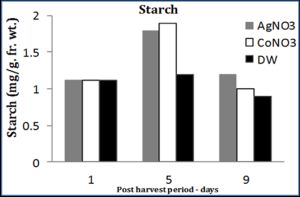 | Fig. 1- Effect of vase solutions on cut Gerbera jamesonii cv. Danalin flowers during post harvest period on starch |
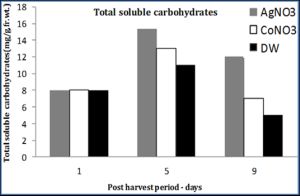 | Fig. 2- Effect of vase solutions on cut Gerbera jamesonii cv. Danalin flowers during post harvest period on Total soluble carbohydrates |
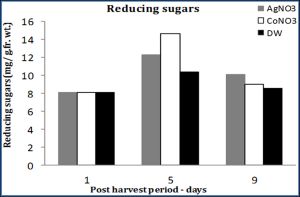 | Fig. 3- Effect of vase solutions on cut Gerbera jamesonii cv. Danalin flowers during post harvest period on Reducing sugars |
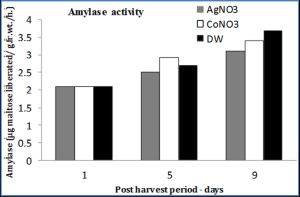 | Fig. 4- Effect of vase solutions on cut Gerbera jamesonii cv. Danalin flowers during post harvest period on Amylase activity |
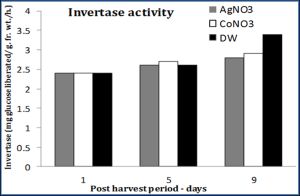 | Fig. 5- Effect of vase solutions on cut Gerbera jamesonii cv. Danalin flowers during post harvest period on Invertase activity |