


ISSN : 0976-996X
EISSN : 0976-9978



DINESH SUBRAMANIAM1, NASREEN NAWABJAN2, JEEVAN MALAYAN3, LAVANYA MOHANAM4, MYTHILY VAIKUNTAM5, ELANCHEZHIYAN MANICKAN6*
1Division of Virology and Immunology, Department of Microbiology , Dr. ALM. PG Institute of Basic Medical Science, University of Madras, Taramani, Chennai- 600 113, India
2Division of Virology and Immunology, Department of Microbiology , Dr. ALM. PG Institute of Basic Medical Science, University of Madras, Taramani, Chennai- 600 113, India
3Division of Virology and Immunology, Department of Microbiology , Dr. ALM. PG Institute of Basic Medical Science, University of Madras, Taramani, Chennai- 600 113, India
4Division of Virology and Immunology, Department of Microbiology , Dr. ALM. PG Institute of Basic Medical Science, University of Madras, Taramani, Chennai- 600 113, India
5Blood Bank, Voluntary Health Services, Adyar, Chennai- 600 025, India
6Division of Virology and Immunology, Department of Microbiology , Dr. ALM. PG Institute of Basic Medical Science, University of Madras, Taramani, Chennai- 600 113, India
* Corresponding Author : emanickan@yahoo.com
Received : 12-09-2011 Accepted : 03-10-2011 Published : 15-12-2011
Volume : 2 Issue : 2 Pages : 25 - 29
Vet Sci Res 2.2 (2011):25-29
DOI : http://dx.doi.org/10.9735/0976-996X.2.2.25-29
Conflict of Interest : None declared
Significant amount of research is done to find novel drugs to control chronic viral hepatitis. HBV causes both acute and chronic viral hepatitis of which a greater proportion of patients with chronic disease lead to liver cirrhosis and hepatocellular carcinoma. Currently interferon therapy and lamivudine treatment are available however such treatments has been known for their inefficient recovery and elicitation of side effects. Marine resources are considered to be harboring many biologically active agents. Padina tetrastromatica (P. tetrastomatica) is a brown algae and found abundantly on the Indian coastal area especially on the east coast and knowledge on its bioactivities are poorly known. Methonolic extracts of P. tetrastomatica were tested for their anti HBV activity by HBsAg binding inhibition assay. 5 mg/ml concentration of the extract completely inhibited the binding efficiency and at this concentration there was cytotoxic effects observed by MTT assay. These findings are suggestive that P. tetrastomatica preparation are possessing a strong anti HBV activities and further experiments are warranted to fully explore the other properties of the marine algae, P. tetrastromatica.
HBV, ELISA, HBsAg, Padina tetrastromatica
Hepatitis B virus (HBV) causes significant morbidity and mortality worldwide. HBV infection can be acute which get cured completely or chronic during which the virus persists in the liver for a long time and occasionally for their life. Despite the universal vaccination of neonates and infants during the last years and the subsequent reduction in the incidence of new infections with hepatitis B virus (HBV), chronic HBV infection remains a significant public health problem worldwide [1,2] . It is estimated that there are approximately 400 000 000 people with chronic HBV infection and that more than 500 000 people die every year due to complications of HBV related chronic liver disease [2] . Although considerable improvements in the evaluation and treatment of patients with chronic HBV infection have occurred during the last decade, several issues regarding the optimal management of such patients still challenging. All patients with chronic HBV infection are at increased risk for hepatocellular carcinoma (HCC) compared with the general population and the risk increases substantially in patients with prolonged high viremia and cirrhosis [3,4] . Recent data suggest that patients with chronic HBV infection and HBV DNA above 104 copies/ mL (approximately 2000 IU/mL) are at increased risk for cirrhosis and HCC regardless of ALT activity and are therefore possible candidates for treatment [4,5] .
Therapy of chronic hepatitis B is currently based on two different strategies: (a) a finite course of treatment with pegylated interferon aimed to induce a sustained virological response that is maintained long-term after therapy withdrawal and (b) an indefinite treatment with oral anti-HBV nucleoside/nucleotide analogues (NUCs) aimed to achieve long-term complete suppression of HBV replication. The first strategy is typically used in patients with less advanced liver disease, with high ALT and no too high HBV-DNA and is particularly successful in the younger patients and in those infected with HBV genotype A or B. The suppressive strategy is instead typically adopted for patients with more advanced liver disease, and for those who have failed or cannot tolerate interferon therapy. Recently, following the implementation of third generation NUCs with high antiviral potency and barrier to resistance, the indication of oral therapy has gained credibility and indication, although most guidelines still recommend to start these drugs only in the presence of significant and progressive liver disease [6] . The goal of therapy for patients with HBV infection is to prevent the progression of liver disease to cirrhosis and hepatic cell cancer. In recent years, progress has been made in the treatment of chronic HBV infections. Nucleos(t)ide analogs such as lamivudine have been approved as initial therapy for chronic HBV infections. Currently, lamivudine is the first line of treatment of chronic HBV infections.
Treatment with Interferon α is also an approved method of treatment for chronic HBV infections [7] . However, interferon α therapy is associated with several side effects and often unsatisfactory response rates. Among the reasons that have been cited for explaining the poor response rate to interferon are: 1) the immune tolerance to HBV after infection at birth or during early childhood [8] , and 2) persistence of the viral covalently closed circular (ccc) DNA in the liver [9] . Thus the optimal first-line anti-HBV therapy with the best long-term cost/benefit ratio is yet to be developed.
Now there is a need for the clinical development of more efficacious yet safe and non-toxic cytoprotective agents for the adequate management of hepatitis. In this context antiviral and hepatoprotective drugs development from alternative natural sources plays important role. Several medicinal herbs has been reported in Ayurvedha, Sidda and Unani for their medicinal properties. In recent times, many attempts to identify the active anti-HBV substances in Phyllanthus extracts is being investigated [10,11] . Though Phyllanthus amarus (P. amarus) extracts shown to possess bioactivities to clear the carrier status of HBV infections its efficacy during chronic HBV infections is reported to be equivocal [12] . This necessitates the search for novel anti HBV drugs from marine sources. Significant interest on marine organisms has developed recently due to their possession of pharmacologically bioactive substances that had been used against bacteria, viruses and tumors [13-15] . Despite the increasing number of new findings about seaweed metabolites possessing biological activity on the last three decades few products having actual potential have been identified or developed [15] . Antiviral activities of extracts derived from various marine has been documented [16-26] . In the present study, an attempt was made to assess the anti HBV activity of Padina tetrastromatica (P. tetrastromatica) [Fig-1] by HBsAg biding inhibition assay.
In August 2010, Padina tetrastromatica was collected from Rameshwaram coast, India. The impurities were removed by rinsing in sterile distilled water and authenticated at the Department of Botany, University of Madras, Chennai. The algae was shade dried, powdered and stored at room temperature until use. Methanol extract of P. tetrastromatica was prepared by adding 50 gm of algal powder in 500 ml of methanol and then filtered using Whatman filter paper (No.1). The filtrate was allowed to evaporate for about 2-3 days. The dried filtrate was collected, weighed and it was stored at 4°C until use.
Equal volume of pre-titrated HBV and varying concentration of methanolic extract was mixed and incubated at 37° C for 5 days. The mixture was assayed on day 5 for the presence of bound/unbound HBsAg using ELISA kit (Hepanostika HBsAg kit). Controls included in the experiment are drug positive control (Elan-PA001) and drug negative control (Nonoxynol-9). Other controls included the kit positive and negative controls. ELISA was performed as per the manufacturer protocol. Briefly, to the anti HBsAg antibody precoated plates extract treated HBV virus was added and incubated for 1 hour at 37oC. Then the plates were washed and secondary antibody-HRP conjugate was added and further incubated for 1 hour at 37oC. Then the plates were washed and TMB substrate was added and incubated at room temperature for 30 minutes. To this stop solution was added and the plates were read at 450 nm in ELISA reader (BioTek). Experiments were done 3 times and one representative experiment is described. Results are represented as ELISA optical density (OD) and percentage (%) inhibition.
Percentage inhibition= (OD of Test-OD of the control)/OD of the control x 100.
Anti HBV property of P. tetrastromatica was evaluated by studying the inhibition of HBsAg binding by the extracts. In this evaluatory study first varying concentration of P. tetrastromica (dose response) was tested for its anti HBV activity. Secondly two different doses of virus were tested for the drug efficacy. Table-1 represent the dose response profile of P. tetrastromatica and % inhibition above 90% was considered significant. As shown in the table-1 98.6% inhibition (virus concentration 1.5 pg/ml) of HBV was noticed at a drug concentration of 5 mg/ml and 96.7% with 10 mg/ml. Up to 10 mg/ml concentration of P. tetrastromatica did not show any drug toxicities by MTT assay (data not shown). An in-house preparation, Elan-PA001 served as drug positive control which completely inhibited HBV. A potent anti HIV drug Nonoxonol-9 was used as negative HBV drug which showed <1.0% activity. As anticipated the group received sterile distilled did not show any anti HBV activity.
In order to assess whether the anti HBV activity of P. tetrastromatica was virus dose dependent varying concentrations of HBV such as 3 pg/ml, 1.5 pg/ml and 0.75 pg/ml were tested against 5 mg/ml concentration of the P. tetrastromatica extract. The results revealed that P. tetrastromatica extracts completely inhibited the 1.5 pg/ml of HBV as shown in the above experiment Table-2. A similar inhibitory activity was noticed with the lower virus dose of 0.75 pg/ml also. When the virus dose was increased to 3 pg/ml this inhibitory activity was abrogated suggesting the 1.5 pg/ml may be the highest concentration that could be nullified by the P. tetrastromatica (data not shown).
Exploring novel drugs to combat HBV infections especially the chronic HBV hepatitis is needed very desperately. Marine sources serves as a potential treasure hunt platforms for unique drug development that could be used to treat viral hepatitis. In this evaluatory study varying concentration of P. tetrastromatica was tested for the anti HBV activity and it was found that 5 mg/ml concentration of P. tetrastromatica completely neutralized the HBV suggesting its medicinal scope to treat viral hepatitis. P. tetrastromatica extracts inhibited 1.5 pg/ml of HBV suggesting the magnitude of inhibition. Bioactivities of several marine algae has been reported but medicinal value of P. tetrastromatica has not been studied so far suggesting the pioneering nature of our study.
Chronic HBV infections can lead to liver cirrhosis and hepatocellular carcinoma [27] Considering the severity of clinical outcome proper treatment modalities must be in place to fight against human HBV infection. One of the very important proteins of HBV is the surface antigen (HBsAg) which helps the virus in adherence to the target tissue [28,29] . Importance of HBsAg is multifold and it is highly immunogenic [30] . HBsAg is also known as “australia antigen†and found in 4 phenotypes namely adw, ayw,adr, and ayr and each phenotype is epidimiologically important [31,32] . Presence of HBsAg in a patient is an indication that it is a recent infection and antibodies to HBs (anti HBs antibody) are efficient in clearing the HBV [33,34] . Besides that there are two other important antigens namely HBcAg and HBeAg are important for the complete clearance of the virus during chronic infections [35] . In chronic HBV infection both HBsAg and antibodies to HBs (anti HBs) are found in the patients and presence of HBsAg helps in the new infection of hapatocytes.
HBV infects hepatocytes and causes viral hapatitis. Receptors for HBV is not fully known and it is speculated that preS domain of surface protein of the virus bind to carboxypeptidase D molecules found on hepatocytes. Thus the surface antigen (HBsAg) plays an important role in virus attachment to the hepatocytes and any methodology that would interfere with this initial binding can prevent the virus attachment to the host tissue. In this context the current investigation is very important hence our study clearly show P. tetrastromatica extract inhibit HBsAg binding to its receptor and in this study anti HBs antibody act as the receptor. In this study we clearly demonstrated that 5 mg/ml concentration of the extract inhibited the virus binding and this inhibition was noticed upto 1.5 pg/ml concentration of the virus. To our knowledge this may of the first report to show that P. tetrastromatica extracts are very efficacious in inhibition of HBV binding to its receptor. This study also opens up new avenues to further explore the molecular mechanisms of HBV viral entry inhibition. Thus P. tetrastromatica has got wide scope to use it as medicine against infectious diseases.
[1] Lee W.M. (1997) N Engl J Med., 337, 1733-1745.
» CrossRef » Google Scholar » PubMed » DOAJ » CAS » Scopus
[2] Maddrey W.C. (2000) J Med Virol., 61, 362- 366.
» CrossRef » Google Scholar » PubMed » DOAJ » CAS » Scopus
[3] Beasley R.P. (1988) Cancer, 61, 1942-1956.
» CrossRef » Google Scholar » PubMed » DOAJ » CAS » Scopus
[4] Chen C.J., Yang H.I., Su J., Jen C.L., You S.L., Lu S.N., Huang G.T., Iloeje U.H. (2006) JAMA. 295, 65-73.
» CrossRef » Google Scholar » PubMed » DOAJ » CAS » Scopus
[5] Iloeje U.H., Yang H.I., Su J., Jen C.L., You S.L., Chen C.J. (2006) 130, 678-686.
» CrossRef » Google Scholar » PubMed » DOAJ » CAS » Scopus
[6] Alberti A., Caporaso N. (2011) Dig Liver Dis., 43(1), S57-63.
» CrossRef » Google Scholar » PubMed » DOAJ » CAS » Scopus
[7] Dusheiko G.M. (1995) Pharmacol Ther., 65, 47–73.
» CrossRef » Google Scholar » PubMed » DOAJ » CAS » Scopus
[8] Lai C.L., Chien R.N., Leung N.W.Y. (1998) N Engl J Med., 339, 61–68.
» CrossRef » Google Scholar » PubMed » DOAJ » CAS » Scopus
[9] Lin E., Luscombe C., Colledge D., Wang Y.Y., Locarnini S. (1998) Antimicrob Agents Chemother., 42, 2132–2137.
» CrossRef » Google Scholar » PubMed » DOAJ » CAS » Scopus
[10] Thyagarajan S.P., Subramanian S., Thirunalasundari T., Venkateswaran P.S., Blumberg B.S. (1988) The Lancet, 332 (8614), 764-766.
» CrossRef » Google Scholar » PubMed » DOAJ » CAS » Scopus
[11] Min S.S., Eun H.K., Young Ik.L. (2005) Antiviral Research, 67, 163-168.
» CrossRef » Google Scholar » PubMed » DOAJ » CAS » Scopus
[12] Venkateswaran P.S., Millman I., and Blumberg B.S. (1987) Proc. Natl. Acad. Sci. USA, 84, 274-278.
» CrossRef » Google Scholar » PubMed » DOAJ » CAS » Scopus
[13] Blunden G. (1993) Interdisciplinary Science Reviews, 18, 73-80.
» CrossRef » Google Scholar » PubMed » DOAJ » CAS » Scopus
[14] Ireland C. M., Copp B. R., Foster M.P., McDonald L.A., Radisky D. C., & Swersey C. (1993) New York: Plenum Publishing Corporation, 1-37.
» CrossRef » Google Scholar » PubMed » DOAJ » CAS » Scopus
[15] Smit A. J. (2004) Journal of Applied Phycology, 16, 245-262.
» CrossRef » Google Scholar » PubMed » DOAJ » CAS » Scopus
[16] De Almeida C.L., Falcao Hde. S., Lima G.R., Montenegro Cde. A., Lira N.S., De Athayde- Filho P.F.,Rodrigues L.C., De Souza Mde.F., Barbosa-Filho J.M., Batista L.M. (2011) Int J Mol Sci., 12(7), 4550-73.
» CrossRef » Google Scholar » PubMed » DOAJ » CAS » Scopus
[17] Mendes Gda. S., Soares A.R., Martins F.O., Albuquerque M.C., Costa S.S., Yoneshigue- Valentin Y., Gestinari L.M., Santos N., Romanos M.T. (2010) Rev Inst Med Trop Sao Paulo, 52(1), 3-10.
» CrossRef » Google Scholar » PubMed » DOAJ » CAS » Scopus
[18] Abrantes J.L., Barbosa J., Cavalcanti D., Pereira R.C., Frederico Fontes C.L., Teixeira, V.L., Moreno Souza T.L., Paixao I.C. (2010) Planta Med., 76(4), 339-44.
» CrossRef » Google Scholar » PubMed » DOAJ » CAS » Scopus
[19] Harden E.A., Falshaw R., Carnachan S.M., Kern E.R., Prichard M.N. (2009) Antiviral Res., 83(3), 282-9.
» CrossRef » Google Scholar » PubMed » DOAJ » CAS » Scopus
[20] Serkedjieva J., Konaklieva M., Dimitrova-Konaklieva S., Ivanova V., Stefanov K., Popov S. (2000) ZNaturforsch C, 55(1-2), 87-93.
» CrossRef » Google Scholar » PubMed » DOAJ » CAS » Scopus
[21] Schaeffer D.J., Krylov V.S. (2000) Ecotoxicol Environ Saf., 45(3), 208-27.
» CrossRef » Google Scholar » PubMed » DOAJ » CAS » Scopus
[22] Ivanova V., Rouseva R., Kolarova M., Serkedjieva J., Rachev R., Manolova N. (1994) Prep Biochem., 24(2), 83-97.
» CrossRef » Google Scholar » PubMed » DOAJ » CAS » Scopus
[23] Cardellina J.H 2nd., Munro M.H., Fuller R.W., Manfredi K.P., McKee T.C., Tischler M., Bokesch H.R., Gustafson K.R., Beutler J.A., Boyd M.R. (1993) J Nat Prod., 56(7), 1123-9.
» CrossRef » Google Scholar » PubMed » DOAJ » CAS » Scopus
[24] Beress A., Wassermann O., Tahhan S., Bruhn T., Beress L., Kraiselburd E.N., Gonzalez L.V., De Motta G.E., Chavez PI. (1996) J Nat Prod., 56(4), 478-88.
» CrossRef » Google Scholar » PubMed » DOAJ » CAS » Scopus
[25] Esanu V. (1981) Virologie, 32(1), 57-77.
» CrossRef » Google Scholar » PubMed » DOAJ » CAS » Scopus
[26] Richards J.T., Kern E.R., Glasgow L.A., Overall J.C. Jr., Deign E.F., Hatch M.T. (1978) Antimicrob AgentsChemother., 14(1), 24-30.
» CrossRef » Google Scholar » PubMed » DOAJ » CAS » Scopus
[27] Blumberg B.S., Millman I., Venkateswaran P.S., Thyagarajan S.P. (1989) Cancer Detect. Prev., 14, 195–201.
» CrossRef » Google Scholar » PubMed » DOAJ » CAS » Scopus
[28] Neurath A.R., Kent S.R.H., Strick, N., & Parker K. (1986) Cell, 46, 429-436.
» CrossRef » Google Scholar » PubMed » DOAJ » CAS » Scopus
[29] Neurath A.R., Strick N., Sproul P., Ralph H.E., & Valinsky J. (1990) Virology, 176,448-457.
» CrossRef » Google Scholar » PubMed » DOAJ » CAS » Scopus
[30] Carman W., Thomas H., & Domingo E. (1993) Lancet, 341, 349-353.
» CrossRef » Google Scholar » PubMed » DOAJ » CAS » Scopus
[31] Le Bouvier G.L. (1971) J. infect. Dis., 123, 671-675.
» CrossRef » Google Scholar » PubMed » DOAJ » CAS » Scopus
[32] Tiollais P., Pourcel E., & Dejean A. (1985) Nature, 317, 489-495.
» CrossRef » Google Scholar » PubMed » DOAJ » CAS » Scopus
[33] Hoofnagle J.H., (1981) Annu Rev Med., 32, 1-11.
» CrossRef » Google Scholar » PubMed » DOAJ » CAS » Scopus
[34] Hallday M.L., Kang L.Y., Rankin J.G., Coates R.A., Corey P.N.J., Hu Z.H., Zhou T. K., Yuan G.J., & Yao E.L. (1992) lnt. j. Epidemiol., 21, 564-573.
» CrossRef » Google Scholar » PubMed » DOAJ » CAS » Scopus
[35] Liaw Y.F., Chu C.M., Huang M.J., Sheen I.S., Yang C.Y., Lin D.Y. (1984) Liver, 4, 301-306.
» CrossRef » Google Scholar » PubMed » DOAJ » CAS » Scopus
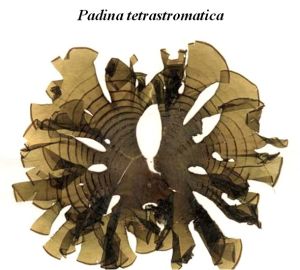 | Fig. 1- Structure of Padina tetrastromatica: They exclusively marine forms. They have different forms from simple, freely branched filaments to highly differentiated forms. They can be distinguished into blades, stipes and holdfast |
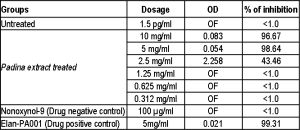 | Table 1- Anti-HBV activity of methanolic extract of Padina tetrastromatica. Various concentrations of Padina tetrastromatica was tested for its anti HBsAg inhibition activity on day 5 by ELISA. Virus concentration=1.5 pg/ml; Untreated = group that received sterile distilled water; OF=OD over 4.0 |
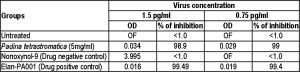 | Table 2- Anti HBV activity against two different doses of HBV. Stock virus was diluted to 1.5 pg/ml and 0.75 pg/ml and tested for the drug’s anti HBV activity by ELISA |