


ISSN : 0976-996X
EISSN : 0976-9978



NIKKHAH A.1*
1Department of Animal Sciences, University of Zanjan, Zanjan 313-45195 Iran
* Corresponding Author : nikkhah@znu.ac.ir
Received : 29-06-2011 Accepted : 16-07-2011 Published : 18-07-2011
Volume : 2 Issue : 1 Pages : 17 - 20
Vet Sci Res 2.1 (2011):17-20
DOI : http://dx.doi.org/10.9735/0976-996X.2.1.17-20
Conflict of Interest : None declared
The main objective was to establish diurnal and post-feeding patterns of rumen ammonia and peripheral blood urea (BU) in response to feeding timing in once-daily-fed dairy cows following 28-d adaptation periods. Four multiparous and four primiparous lactating Holstein cows (82 days in milk) were used in a cross-over design study with two 6-week periods. Each period had 4-wk of adaptation. A total mixed ration (TMR) with 49.8% concentrate was offered at either 0900 or 2100 h to permit 5-10% orts. Jugular blood was sampled via catheters every 2 h for two 24-h period during wk-5 of each period. The proportion of daily TMR intake consumed within 3-h post-feeding was 55% in 2100-fed cows, and 46% in 0900 h-fed cows (P<0.05). Rumen ammonia was higher at 2-h but lower at 6-h post-feeding, and remained numerically lower between 6-20 h post-feeding in cows fed at 2100 h vs. 0900 h. Feeding time did not affect BU daily averages. Blood urea increased shortly after morning but not evening feeding. Blood urea was higher for about 12 h pre-feeding in evening vs. morning fed cows. Results establish that timing of feeding and thus eating alters postprandial and diurnal patterns of feed intake, rumen ammonia, and peripheral BU. Time of eating can therefore affect splanchnic and peripheral nitrogen metabolism and efficiency in lactating cows. These data serve as a metabolic model for other high-producing livestock and humans.
Peripheral urea, rumen, ammonia, evening feeding, eating, rhythm, physiology
Introduction
Blood urea (BU) in ruminants has distinct diurnal rhythms with a post-feeding rise in goats [1-3] . Diurnal rhythms of BU have been demonstrated in lactating cows fed once daily at 0900 h [4] . Blood urea peaked at 1100 h (2-h post-feeding) and dropped until midnight after which it rose again. In transition and early lactation cows fed twice daily at 0700 and 1300 h, BU rose after feed delivery at 0730 h but not after feed delivery at 1300 h [5] . In early and mid lactation cows fed twice daily at 0700 and 1500 h, BU rose after feeding at 0700 h and peaked during 1100-1200 h, after which it dropped to a nadir at 0000 h [6] . Seemingly, post-feeding rises in BU in twice-daily fed cows occur in the first but not in the second feed delivery. The post-feeding response in BU could be attributed to different amounts of feed consumed after different feed deliveries. This important entity has not been measured in parallel in any of the previous studies. Also, conclusive data are lacking on how time of eating affects BU rhythmicity. Day fed cows usually eat little feed after midnight partly because fresh feed is absent [7] . As a result, the rumen fill decreases towards early morning as hunger develops. The considerable morning N intake results in a rapid rumen ammonia release that increases hepatic urea synthesis and causes a surge in BU [4] . This cascade may be less pronounced in subsequent feed deliveries. The primary objective was to establish postprandial rhythms of peripheral urea and rumen ammonia in lactating dairy cows in response to feeding at 0900 h vs. 2100 h following 28-d adaptation periods.
Animal Management and Experimental Design
Four multiparous (645 ± 75 kg BW; 77 ± 25 days in milk, mean ± SD) and four primiparous (576 ± 46 kg BW; 90 ± 33 days in milk) lactating Holstein cows were housed in tie stalls (Dairy Metabolism Unit, Glenlea Research Station, University of Manitoba, Winnipeg). Four of cows had rumen cannula. Cows were offered a total mixed ration (TMR) with forage to concentrate ratio of 50.2:49.8% (dry matter basis) ad libitum. The experimental design was a cross-over with two 6-wk periods. The first 4-wk was for adaptation. The average outdoor air temperature and relative humidity in sampling weeks were -3.7°C and 78.9%, respectively. Indoor metabolism unit temperature was kept between 5-25°C (neutral zone) at all times. The TMR was fed once daily at either 0900 h or 2100 h. The daily supply of TMR was adjusted based on the intake of individual cows in the previous day to allow for 5-10% orts. The TMR dry matter had 25.1% alfalfa silage, 25.1% barley silage, 39.2% energy supplement, 10.6% protein supplement, 17.3% CP, 39.2% NDF, 27.1% ADF, and 29% NFC. Cows had unlimited access to fresh water. The 24-h patterns of feed intake were monitored continuously using a data acquisition system (Grow-Safe System, Model 4000, Airdrie, AB). Every other morning during the adaptation weeks, cows were allowed 2-h of exercise. The fresh TMR was prepared every morning. Cows were milked twice daily in their stalls at 0400 and 1600 h. Lights were on from 0345 until 2245 h. Experimental procedures involving animal surgery and care were in accordance with the guidelines of the Canadian Council on Animal Care [8] .
Rumen fluid was sampled on Monday and Tuesday during wk-4 at 0, 2, 3, 4, 6, 8, 12, 16, 20, 24 h post-feeding to determine diurnal patterns of rumen ammonia. Upon sampling, rumen fluid was centrifuged at 1800 × g for 12 min to store the supernatant at -20°C. Ammonia concentration was measured according to Novozamsky, et al. [9] , and absorbance was read at 630 nm on a Pharmacia Biotech Ultraspec 2000 UV/visible spectrophotometer (Biochrom, Cambridge, UK).
The cows were catheterized in the jugular vein on the first day wk-5. The next day, the catheters were flushed with a sterilized heparinised saline solution (0.9% NaCl, and 50 unit heparin/ml). Blood samples were drawn every 2 h for two 24-h periods. Each 24-h sampling period started at 0900 h and ended at 0700 h on the next day. Catheters were flushed with 10 ml of heparinised saline solution between 2-h samplings to inhibit clot formation within catheters and extension sets. Blood samples were transferred into green-top vacutainer tubes with anti-coagulant (Na-heparin), put immediately on ice, and centrifuged at 3000 × g for 20 min at 4°C to harvest plasma. The plasma was kept at -20°C until metabolite analysis. Plasma concentrations of urea were determined using an automatic analyzer (Stat Profile ® Critical Xpress, 02454-9141 Nova Biomedical, Waltham, MA) with enzymatic sensors
Data were analyzed with Mixed Model Procedure of SAS [10] . Effects of time of feeding (TF), parity, and their interaction were fixed, and effects of period and cow (parity) were random. Repeated rumen and blood data were analyzed as a linear Mixed Model with the best fitted covariance structures [11] . The model used for rumen ammonia concentrations included fixed effects of TF, parity, hour, TF × parity, hour × parity, and TF × hour × parity. The effects of cow (parity), period, and TF × period × cow (parity) were considered random. Prior to variance analyses, normal distribution and variance homogeneity of residuals were ensured using Proc Univariate of SAS [10] . The significance was declared at P < 0.05 and trends were discussed at 0.05 < P < 0.10.
Rumen ammonia and BU exhibited significant diurnal rhythms (P < 0.05; [Table-1] , [Fig-1] , [Fig-2] . Postprandial rhythms of PU were altered by altered feeding time (P < 0.05). Blood urea increased shortly after morning feeding but not after evening feeding [Fig-2] . Peaking at 2-h post-feeding in cows fed at 0900 h, BU declined progressively until 10-h post-feeing. Plasma urea in cows fed at 2100 h decreased from 4-10 h post-feeding and rose sharply at 12-h post-feeding. It remained higher until 2-h before the next feeding, when compared to cows fed at 0900 h [Fig-2] . Time of feeding did not affect BY daily averages (P > 0.10, [Table-1] ).
The BU levels have been shown to depend mainly on digestive processes [1] . Plasma urea tended to rise at 2-h post-feeding in the 0900 h-fed cows. Rumen ammonia also rose drastically at 2-h post-feeding [Fig-1] . Gastric ammonia is a predominant substrate for hepatic urea synthesis early post-feeding [2] . Therefore, the peak in rumen ammonia can shortly be followed by a peak in circulating urea [2] . After the post-feeding peak, BU in the 0900 h-fed cows declined steadily until reaching a nadir at 12-h post-feeding when it started to rise gradually to attain its baseline by the next feeding. Unlike the 0900 h-fed cows, the 2100 h-fed cows did not have a post-feeding rise in BU. The significant rise in BU at 2-h after morning and not evening feeding may partly be related to the shorter peak in rumen ammonia in the 2100 h-fed cows. The increased BU at 10-h post-feeding with evening vs. morning feeding could be due to a larger evening rumen fluid volume (107 vs. 90 L) and greater N intake shortly after evening feeding. Perhaps the more extensive evening vs. morning rumen fermentation may increase recycling circulating urea in an effort to sustain microbial growth and splanchnic tissue integrity and metabolism. Since fecal and urinary N excretion were decreased by evening eating [13] , such hypothesized increases in splanchnic N and energy demands may explain the higher BU at 10-h post-feeding in the 2100 h-fed cows.
Despite greater DMI within 3-h after evening vs. morning feeding, evening and morning fed cows had similar rumen retention times of fluid and solids [14] . A larger nocturnal than day-time rumen fill has been reported in grazing cows [15] and sheep [16] . The reference to grazing ruminants is of importance because grazing occurs mostly during day and particularly around sunrise, afternoon, and sunset. The pasture studies further substantiate that rumen kinetics of passage and digestion differ between day and night. These findings support an evolutionary notion that rumination has a circadian rhythm occurring mostly overnight [17] . Hence, offering feed in evening when ruminants have evolved to ruminate (and ensalivate) could increase nutrient digestibility partly via increased rumen volume and maintained rumen outflow rate. As such, it may be inferred that rumen fermentation capacity was greater with evening vs. morning feeding. Under such nocturnally prolonged and capacious rumen fermentation, the splanchnic tissue would require more energy and N to remain effectively functional. Gut tissues including the reticulorumen, small and large intestines, pancreas, spleen and associated muscles and adipots have high N and energy turnover rates [18,19] . The greater N intake along with the greater N turnover would imply greater ammonia, urea, and amino acids exchange among gut, liver, and peripheral tissues [18] . The greater N turnover results from increased splanchnic energy requirements to transfer and remove N metabolism end products [19] . Consequently, instead of excretion as urea in the urine, ammonia and organic acids (e.g., α-ketoglutarate, aspartate, and formate) serve splanchnic and peripheral tissues as renewable sources of N and energy. The logic is consistent with the reduced N partitioning towards urine by evening instead of morning feeding [20] . Greater diet fermentability can increase gut N requirements that increases urea recycling via saliva and plasma [18] .
Feeding more frequent than once daily has been shown to eliminate diurnal patterns of BU [21] . In the present study, TMR was delivered once daily. However, rumen ammonia remained at peak from 2-6 h after morning feeding while it was at peak only at 2-h after evening feeding [Fig-2] . The higher BU during the 12-h preceding evening but not morning feeding was thus likely not mainly related to rumen ammonia. Transamination involves aspartate, glutamate, glutamine, alanine, and glycine that contribute to hepatic urea formation, especially at times of elevated glucose demand. Up to 40% of hepatic glucose output in lactating cows can come from amino acids [22] . The amino acids utilization for glucose synthesis increases with their increased availability, and lower rumen propionate and lactate supplies [20,22] . Accordingly, the higher BU at and after 12 h post-feeding by evening instead of morning feeding, when it was expected to be lower might reflect such hepatic amino acids use for gluconeogenesis [4,6] . It is, however, unknown if such a possible role in hepatic N metabolism was induced by an increased amino acids provision or by decreased propionate and lactate supply. Moreover, hormones and gut peptides can potentially affect hepatic N assimilation [12] . The larger rumen volume by evening vs. morning feeding may have increased splanchnic N and energy demands. Evening feeding may thus have subsequently increased N exchanges across splancnhic tissues, likely contributing to higher BU through 12-h pre-feeding. Therefore, eating timing is a major component of digestive regulation of diurnal rhythms of BU in lactating dairy cows
Following 28-d adaptation periods, the proportion of daily feed intake consumed within 3-h post-feeding was 55% in cows fed at 2100 h, and only 46% in cows fed at 0900 h. Rumen ammonia was higher at 2-h post-feeding but was lower at 6-h post-feeding and remained numerically lower between 6-20 h post-feeding in cows fed at 2100 h vs. 0900 h. Feeding time did not affect daily averages of BU. Blood urea increased shortly after feeding in morning fed cows but not in evening fed cows. Blood urea was consistently higher for about 12-h pre-feeding in evening fed cows. Results establish that altering time of feeding/eating in once-daily-fed cows alters postprandial and diurnal patterns of feed intake, rumen ammonia, and peripheral BU. Therefore, timing of eating may alter splanchnic and peripheral N use in lactating cows. These findings serve as a metabolic model for other high-producing livestock and humans.
The Ministry of Science, Research and Technology and University of Zanjan are gratefully acknowledged for supporting the author’s programs of optimizing global science edification in the new millennium.
[1] Piccione G., Caola G. and Refinetti R. (2003) Comparative Biochemistry and Physiology, 134, 563-572.
» CrossRef » Google Scholar » PubMed » DOAJ » CAS » Scopus
[2] Gustafsson A.H. and Palmquist D.L. (1993) Journal of Dairy Science, 76, 475–484.
» CrossRef » Google Scholar » PubMed » DOAJ » CAS » Scopus
[3] Coggins C.R.E. and Field A.C. (1976) Journal of Agricultural Science, 86, 595-602.
» CrossRef » Google Scholar » PubMed » DOAJ » CAS » Scopus
[4] Lefcourt A.M., Huntington J.B., Akers R.M., Wood D.L. and Bitman J. (1999) Domestic Animal Endocrinology, 16, 41-55.
» CrossRef » Google Scholar » PubMed » DOAJ » CAS » Scopus
[5] Plaizier J.C., Fairfield A.M., Azevedo P.A., Nikkhah A., Duffield T.F., Crow G.H., Bagg R., Dick P. and McBride B.W. (2005) Journal of Dairy Science, 88, 3595-3602.
» CrossRef » Google Scholar » PubMed » DOAJ » CAS » Scopus
[6] Blum J.W., Bruckmaier R.M., Vacher P.Y., Munger A. and Jans F. (2000) Journal of Veterinary Medicine, 47, 43-60.
» CrossRef » Google Scholar » PubMed » DOAJ » CAS » Scopus
[7] Ominski K.H., Kennedy A.D., Wittenberg K.M. Moshtaghi Nia S.A. (2002) Journal of Dairy Science 85, 730-737.
» CrossRef » Google Scholar » PubMed » DOAJ » CAS » Scopus
[8] Canadian Council on Animal Care (1993) Guide to the Care and Use of Experimental Animals. Vol. 1. E. D. Olfert, B. M. Cross, and A. A. McWilliam, eds. CCAC, Ottawa, ON, Canada.
» CrossRef » Google Scholar » PubMed » DOAJ » CAS » Scopus
[9] Novozamsky I., Van Eck R., Schouwenburg J.C.H. and Walinga F. (1974) Netherlands Journal of Agricultural Sciences, 22, 3–5.
» CrossRef » Google Scholar » PubMed » DOAJ » CAS » Scopus
[10] SAS Institute, Inc. (2003) SAS/STAT user’s guide. V. 9.1. SAS Institute, Inc., Cary, NC.
» CrossRef » Google Scholar » PubMed » DOAJ » CAS » Scopus
[11] Wang Z. & Goonewardene L.A. (2004) Canadian Journal of Animal Science 84, 1-11.
» CrossRef » Google Scholar » PubMed » DOAJ » CAS » Scopus
[12] Reynolds C.K. (2002) Journal of Animal Science, 80(Suppl. 2), E74–E84.
» CrossRef » Google Scholar » PubMed » DOAJ » CAS » Scopus
[13] Nikkhah A., Furedi C., Kennedy A., Wittenberg K. and Plaizier J.C. (2011) Canadian Journal of Animal Science, 91(1), 113-122.
» CrossRef » Google Scholar » PubMed » DOAJ » CAS » Scopus
[14] Nikkhah A. (2011) Open Access Animal Physiology, 3, 9-12.
» CrossRef » Google Scholar » PubMed » DOAJ » CAS » Scopus
[15] Taweel H.Z., Tas B.M., Dijkstra J. and Tamminga S. (2004) Journal of Dairy Science, 87, 3417-3427.
» CrossRef » Google Scholar » PubMed » DOAJ » CAS » Scopus
[16] Thomson B.C., Cruickshank G.J., Poppi D.P. and Sykes A.R. (1985) Proceedings of New Zealand Society of Animal Production, 45, 117-120.
» CrossRef » Google Scholar » PubMed » DOAJ » CAS » Scopus
[17] Gordon J.G. and McAllister I.K. (1970) Journal of Agricultural Science, 291-297.
» CrossRef » Google Scholar » PubMed » DOAJ » CAS » Scopus
[18] Huntington G.B. (1989) Canadian Journal of Animal Science 69, 215-223.
» CrossRef » Google Scholar » PubMed » DOAJ » CAS » Scopus
[19] Huntington G.B. (1990) Reproduction Nutrition Development, 30, 35-47.
» CrossRef » Google Scholar » PubMed » DOAJ » CAS » Scopus
[20] Nikkhah A., Furedi C., Kennedy A., Crow G., and Plaizier J. (2008) Journal of Dairy Science, 91, 1-12.
» CrossRef » Google Scholar » PubMed » DOAJ » CAS » Scopus
[21] Folman Y., Neumark H., Kaim M. and Kaufmann W. (1981) Journal of Dairy Science, 64, 759.
» CrossRef » Google Scholar » PubMed » DOAJ » CAS » Scopus
[22] Danfær A., Tetens V. and Agergaard, N. (1995) Comparative Biochemistry and Physiology, 111B, 201-210.
» CrossRef » Google Scholar » PubMed » DOAJ » CAS » Scopus
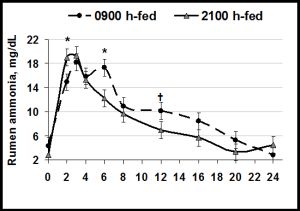 | Fig. 1- Postprandial feeding patterns of rumen ammonia in cows fed either at 0900 h or at 2100 h. Within each hour, * = P < 0.05. |
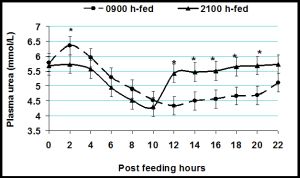 | Fig. 2- Postprandial feeding patterns of plasma urea in cows fed either at 0900 h or at 2100 h. Within each hour, * = P < 0.05. |
 | Table 1- Effects of time of feeding (TF), sampling hour (H), parity (P), and interactions on blood urea concentrations<sup>1</sup>. <sup>1</sup>Standard errors are for differences of least square means. <sup>2</sup>Hours of sampling were expressed as hours of day. Thus, a significant effect of TF × H corresponds to a significant effect of TF on diurnal rhythms of blood urea. NS = not significant or P > 0.15; †= 0.05 < P ≤ 0.10; * = P < 0.05; *** = P < 0.001. |