


ISSN : 0976-996X
EISSN : 0976-9978



TURKI I.Y.1*, ELKADIER O.A.2, AMIN M.EL3, HASSABO A.A.4
1College of Animal Production, Sudan University
2College of Animal Production, Sudan University
3College of Animal Production, Sudan University
4College of Animal Production, Sudan University
* Corresponding Author : intesar2@yahoo.com
Received : 30-01-2011 Accepted : 16-07-2011 Published : 18-07-2011
Volume : 2 Issue : 1 Pages : 8 - 12
Vet Sci Res 2.1 (2011):8-12
DOI : http://dx.doi.org/10.9735/0976-996X.2.1.8-12
Conflict of Interest : None declared
A feeding trial was carried out to evaluate and study the effect of six dietary protein sources on the performance of Western Baggara cattle. Ninety bulls were used in feeding trial. Six iso-caloric and iso-nitrogenous diets of protein feed ingredients guar germ (GGM), guar hull meal (GHM), sunflower cake (SFC), sesame cake (SC), groundnut cake (GNC) and cotton seed cake (CSC) were formulated. Bulls were fattened from an average initial live weight 200 kg to a target 300 kg live weight The results showed that the fattening performance of the experimental animals was significantly (P <0.05) affected by the different dietary protein sources. CSC tended to be superior for the daily live weight gain (1181g) and feed conversion ratio efficiency (6.97 kg DM/kg live wt gain), while it was intermediate in daily DM intake (8.23kg).Guar meals (Hull and Germ) had a lower feed intake (6.96kg and 7.23kg, respectively) and daily weight gain (870.9and 934g), with poor feed conversion ratio (8.06 and 7.97) for the tow diets, respectively. The present study concluded that SFC induced DM, ME, CP intake, , so we could advice farmers to use SFC in fattening diets, after they must attended some other characteristics as storage should be carefully considered (e.g. spontaneous fire). From the economical side of view the study showed that GGM and GHM were signed a lowest cost to produce kg meat than the other dietary treatments, in spite of their lower values in daily weight and FCE ratio. On the other hand, CSC in superior values in fattening performance followed by GNC and SC, respectively.
oilseeds, cake, guar, germ, guar hull, Baggara beef cattle, DM intake, performance
Sudan is one of the few countries of the world that could contribute greatly towards the alleviation of the at least part of the present world deficit in animal protein. Protein is one of the critical nutrients for young growing and fattening animals. Being more expensive than other feeds, optimal use of protein is necessary (Church, 1977). Oil cakes are the industrial by products used extensively in livestock and poultry feeds (Mc.Donald et al., 1978; Ensminges et al., 1980; In Sudan, Elzubeir et al., 1990 and Mohmmed et al., 1995, etc). Guar meal is considered as a cheap protein source (45–55%) in the ruminants and poultry nutrition. The high content of the meal protein offers a good source of essential amino acid (Smith et al., 1959 and Patel et al., 1970). The object of this study is to examine the effects of feeding different variable different variable diets contains six different source of protein on Baggara cattle fattening performance. Degradability of these proteins feed ingredients was also studied.
Experimental Animals
Ninety bulls of the Baggara ecotypes with an average of 200 kg live weight were used. They were purchased from the local market in three batches of thirty animals each. A complete randomized block design was used. There were three blocks each made of six plots experimental.
Six complete diets were formulated to contain different protein feed ingredient (guar germ meal, guar hull meal, sunflower cake, sesame cake, groundnut cake or cotton seed cake). Percentages of ingredients of the experimental diets are shown in [Table-1] . Experimental animal were allowed an adaptation period of two weeks. Diets offered and refused were weighed daily to calculate DM intake.
Dry matter intake
The feed intake of each group was calculated daily as the difference between residual amounts and offered. The average dry matter values of feed were measured so the dry matter intake is determined.
Bulls were fattened from an average initial live weight 200 kg to a target 300 kg live weight. Weekly the experimental animals were individually weighed and the daily weight gain was recorded.
The proximate analysis of the experimental diets [Table 2] was performance according to association of analytical chemist AOAC [980] . Sample from the fresh and residual feed were taken regularly for dry matter determination.
Feedlot Performance
Data of feedlot performance of the experimental bulls are shown in [Table-3] . Daily gain was significantly affected by dietary treatments, [Fig-1] . Bulls fed diet of cotton seed cake and groundnut gained more weight to attain the target slaughter weight of 300kg (P>0.05) than other bulls that fed diets of sunflower cake and sesame cake. Bulls fed Guar diets had taken more time to attain the target weight.
The results indicated that the different protein feed sources had a significant (P<0.05) effect on performance of experimental animals. Bulls fed on sunflower cake, cottonseed cake and groundnut cake diets consumed more (P<0.05) feed than those on guar meal diets. On the other hand no significant differences (P<0.05) were observed among oilseed cakes diets. This observation was in agreements with the results of Elfadil [980] who evaluated sesame cake, groundnut cake and cottonseed cake for fattening zebu calves. It also agreed with Mohamed (1998); Suliman [1999] and Karalozo et al. [1988] in comparative studies with sheep. These in significant (P<0.05) effects of protein quality particularly from original sources (oilseed cake) were explained by Preston and Willis [1974] . They concluded that protein quality effects could not be expected as an important factor when cattle enter feedlot at relatively high weight and fed for comparatively short periods. Bulls fed on groundnut cake and sesame cake consumed 7.87 kg DM/day and 7.61 kg DM/day respectively. These results obtained for dry matter intake in this experiment are in agreement with the findings of Elkhidir et al. [1995] who reported 7.33 kg DM/day for western Baggara bulls (250-300kg) fed on urea-molasses based diet plus 5% cottonseed cake. The cottonseed cake diet group, bulls in this group consuming 8.23 kg dry matter per day. The improvement in feed intake value of latter group compared to value obtained by Elkhidir et al. [1998] may be attributed to the increase of the cottonseed cake protein ratio up to 25% of the diet.
Total dry matter intake, ME intake and crude protein intake were influenced (P>0.05) by dietary treatments, [Fig-2] , [Fig-3] and [Fig-4] . Bulls given diet of sunflower cake appeared to have higher value (8.45kg/day/93J/day and 1.36kg/day) for these three parameters respectively, followed by bulls fed Cottonseed and Groundnut. Both of bulls fed on Guar meal diets groups were consumed lower amount of DM about (6.92, 7.53kg/day/ head,) for hulls and Germ, respectively.
The mean values for protein intake and ME intake ranked highest also in animals of the group fed on sunflower cake followed by others oilseed cake diet and guar germ. This result agrees with records cited by Veitia [1980] and Preston and Willis [1974] who demonstrated that increasing by-pass protein level in the diet produced an increase in ME consumption. The lower degraded rate of sunflower cake (DM and CP) increased the by-pass protein escaping from the rumen, and this excess amount of escaping protein could improve DM and ME intake which cited by the above workers.
There were significant (P<0.05) differences in DM, CP and ME intake between guar meals diet group (germ and hulls) and other groups. This may be due to the improved palatability of oilseed cakes diets than guar meal diets. These results were in line with the findings of Nagpal et al. [1971] who reported that the high levels of guar meals in the animals' diet resulted in high drop of ME intake and coefficient of digestibility of protein.
Feed conversion efficiency (FCE) was affected (P>0.05) by diversity protein sources. Bulls fed diet on cottonseed cake had improved efficiency (6.97kg DM/kg gain). Oil seeds group had significantly better (FCE) then those on guar meal groups. The average daily live weight gains were significantly (P<0.05) different among dietary treatments [Table-3] . Bulls fed on diets of oilseed cakes had improved live weight gain 1181, 1113, 1077 and 1056 g for CSC, GNC, SFC and SC diet groups respectively. These values of weight gain were slightly higher than those obtained by Elkhidir et al. (1995) who found 1044g gain per day of Baggara bulls (300kg L. wt) fed urea-molasses diet + 5% cottonseed cake. But the values of weight gain in this study were slightly lower than those findings by Jok (2000) who reported 1400g gain/day of Baggara bulls (350) kg fed on molasses diet plus 18% groundnut cake. The reason could be attributed to the high live body weight of the latter groups (350kg L. wt) than those in present study (300kg).
The fed conversion efficiency was significantly (P<0.05) different among dietary treatments. It improved from (8.06kg DM/kg wt gain) for group fed on guar germ meal diet to (6.97kg DM/kg wt gain) for group fed on cottonseed cake diet. This range of feed conversion ratio of experimental western Baggara bulls was in agreement with that ranged by Elshafie and Mcloery [1964] they found that the feed conversion efficiency of western Baggara bulls was in the range of (6.5 to 7.74kg DM/kg live weight gain). Gaili and Osman [1979] reported range from 8.75 to 9.75kg dry matter per kg live weight gain, for feed conversion efficiency of western Baggara bulls. Eltayeb et al. [1990] found that the feed conversion ratio of western Baggara cattle fed sorghum stover with different levels of concentrates diets 100, 75, 65 and 55% concentrates mixtures was 8.8, 10.8, 9.5 and 9.5kg for four groups respectively. Also Elkhider et al. [1995] stated (8.57kg DM/kg gain) feed conversion efficiency of western Baggara bulls (300kg) fed diet of molasses plus 5% cottonseed cake. This result was nearly similar to that obtained in the current study for group that fed on guar germ meal diet (8.06 DM kg/kg gain). However, the ranges of feed conversion efficiency of western Baggara bulls reported by above workers are comparable with all the results obtained in this experiment including those of guar meal.
It is noteworthy that the bulls fed on guar meal diets had lower feed conversion efficiency than those of the other experimental diets. Similar results were observed by Ahmed [1999] who found that 20% level of guar meal in the diet induced a lower daily live weight gain, feed conversion efficiency and slaughter weight. In contrast the bulls fed on diet containing cottonseed cake showed the higher feed intake and live weight gain with best feed conversion ratio. This finding is in agreement with Hunt et al. [1989] who demonstrated an exceptionally higher feed consumption, more digestible dry matter and a greater daily gain of steer fed on cottonseed cake supplemented diet. Similar results supplied by Brown and Pate [1997] who reported that cottonseed cake supplementation to (urea molasses based diet) resulted linear increases in average daily gain (ADG) and feed ratio (FR) of experimental cattle.
Brosh et al. [1989] reported that dry matter intake of diet containing 120g cottonseed cake/kg diet, was 1.22 to 1.34 higher than those diets containing (0–60 g) per kg dry matter which was highly significant (P<0.05). they also reported that digestibility of ether extract was 1.26 times higher on diets containing (120-240g) cottonseed cake per kg dry matter than diets containing (0–60g) per kg dry matter and the digestibility of crude fiber tended to increase with increasing proportion cottonseed cake in the diet.
There were significant (P<0.05) differences in the fattening periods among groups of dietary treatments. Also there were insignificant (P<0.05) differences between the experimental bulls fed on cottonseed cake, groundnut cake and sesame cake which showed a short time to reach target weight than bulls on guar germ or guar hull meal diets. This variation in time for experimental animals to reach the target weight was very eminent, table (3) for the oilseed cake fed groups which were more efficient to convert metabolisable energy to live body weight.
In a comparative study Eltayeb [1986] used cottonseed cake and dried blood as nitrogen sources in fattening diets for goats. He reported similar result with this obtained in present study. He found that cottonseed cake was shown to be superior to blood as nitrogen sources for goats. The diet containing cottonseed cake resulted in improved growth when compared with the blood diet and average daily again was also higher for goats offered cottonseed cake diet than those offered the blood diet. Goats fed cottonseed cake diet consumed significantly more feed than goats fed blood meal diet. Also goat on cottonseed diet had improved feed conversion ratio (8.7kg DM/kg gain) than those fed diet of blood meal (11.8kg DM/kg gain).
[1] AOAC (1980) Association of official analytical chemist. Official methods of analysis ed., Washington.
» CrossRef » Google Scholar » PubMed » DOAJ » CAS » Scopus
[2] Church D. C. (1977) Livestock feeds and feeding. O and B Books, Inc., Coruallis. Oregon.
» CrossRef » Google Scholar » PubMed » DOAJ » CAS » Scopus
[3] McDonald P., Edward R. A. and Grenhalgh J. F. D. (1978) Animal nutrition.Sci. Ed. Longman, Ino. New York.
» CrossRef » Google Scholar » PubMed » DOAJ » CAS » Scopus
[4] Ensminges M. E. (1980) Dairy cattle science, 2nd ed., the interstate Printers and Publishers, INC., Danville, Illnois, U.S.A.
» CrossRef » Google Scholar » PubMed » DOAJ » CAS » Scopus
[5] Elzubeir A. E., Bashir E.L., and Salih A.M. (1990) Sci. Food Agric.,52: 215-219.
» CrossRef » Google Scholar » PubMed » DOAJ » CAS » Scopus
[6] Mohmmed S., Mdljis S.M. and Abdul Hamid N. (1995) J. Sci.. Food Agric.68, 271-277.
» CrossRef » Google Scholar » PubMed » DOAJ » CAS » Scopus
[7] Smith C. R., Shekleton M. C., Wolff I. A. and Jones Q. (1959) Eco. Bot, 13:132.
» CrossRef » Google Scholar » PubMed » DOAJ » CAS » Scopus
[8] Patel B. M., Dhanibmand C. S. and Shulka P. C.(1970) Indian. Vet. J. 47: 66-70.
» CrossRef » Google Scholar » PubMed » DOAJ » CAS » Scopus
[9] Mehrez A. Z. and Orskov E. R. (1977) Study of the artificial fibre bag technique for determining the digestibility of feeds in rumen.
» CrossRef » Google Scholar » PubMed » DOAJ » CAS » Scopus
[10] Miller E.I. (1980) In Vicia faba: feeding value and processing. Ed. Bond, pp. 17-30.
» CrossRef » Google Scholar » PubMed » DOAJ » CAS » Scopus
[11] McDonald P., Edward R. A. and Greenhalgh J. F. (1981) Animal Nutrition, 3rd ed., Longmans Ltd., London.
» CrossRef » Google Scholar » PubMed » DOAJ » CAS » Scopus
[12] Elfadil A.S. (1980) Effect of varying protein sources with high urea molasses rations on fattening Zebu calves. M.Sc. thesis (Animal Production.) University of khartoum.
» CrossRef » Google Scholar » PubMed » DOAJ » CAS » Scopus
[13] Mohamed H. A. (1998) Effect of varying protein sources with molasses based diet on fatting Sudanese Desert sheep. M.Sc. thesis (Animal Production.) University of khartoum.
» CrossRef » Google Scholar » PubMed » DOAJ » CAS » Scopus
[14] Suliman G. M. (1999) Effect of dietary protein on lamp fattening. M.Sc. thesis (Animal Production.) University of khartoum.
» CrossRef » Google Scholar » PubMed » DOAJ » CAS » Scopus
[15] Karalozo A., Hatjminaogour J. and Sinapis E. (1988) World Rev. Anim. Prod., 24(3), P: 51- 54.
» CrossRef » Google Scholar » PubMed » DOAJ » CAS » Scopus
[16] Elkhidir O.A. El Khidir I.A. and Salwa E.I. (1995) Fattening of livestock in Sudan (Baggara Cattle ). Arabic report.
» CrossRef » Google Scholar » PubMed » DOAJ » CAS » Scopus
[17] Elkhidir O. A., Khalafalla A. M., Suliman Y. R. and Morgos F. I. (1998) Sudan J. Anim. Prod. I(1): P:1-6.
» CrossRef » Google Scholar » PubMed » DOAJ » CAS » Scopus
[18] Jok A.K. (2000) Sorghum gluten feed and molasses for fattening Baggara cattle. Ph.D thesis (Anim. Prod.). University of Khartoum.
» CrossRef » Google Scholar » PubMed » DOAJ » CAS » Scopus
[19] Veitia J. L., Elias A., Garcia J. and Venerco A. (1980) Effect of dietary protein level for fattining
» CrossRef » Google Scholar » PubMed » DOAJ » CAS » Scopus
[20] Nagpal M. L., Agrawal O. P. and Bhatia I. S. (1971) Indian. J. Anim. Prod. Sci., 41: 284.
» CrossRef » Google Scholar » PubMed » DOAJ » CAS » Scopus
[21] Lufadeju E. A. and Oldorunju S. A. S. (1986) J. Anim. Prod. Rev. 6(2):161-170.
» CrossRef » Google Scholar » PubMed » DOAJ » CAS » Scopus
[22] Tamminga S., Vander C. J. and Van A. M. (1979) Livestock prod. Sci. 6(4): 331-336.
» CrossRef » Google Scholar » PubMed » DOAJ » CAS » Scopus
[23] Elshafie S. A. and Mcloery G. B. (1964) J. Vet. Sci. and Anim. Husb., 5: 2-13.
» CrossRef » Google Scholar » PubMed » DOAJ » CAS » Scopus
[24] Gaili E. S. E. and Osman H. F. (1979) Trop. Agric., 56:390.
» CrossRef » Google Scholar » PubMed » DOAJ » CAS » Scopus
[25] Eltayeb A. E., Mohamed T. A. and Mohammed H. K. (1990) J. Anim. Prod. 3(2):69-79.
» CrossRef » Google Scholar » PubMed » DOAJ » CAS » Scopus
[26] Ahmed D. Z. (1999) Effect of guar meal on meat production. PhD thesis Sudan University.
» CrossRef » Google Scholar » PubMed » DOAJ » CAS » Scopus
[27] Brosh A., Holzer Z. and Levy D. (1989) Anim. Prod. 51: 109-114.
» CrossRef » Google Scholar » PubMed » DOAJ » CAS » Scopus
[28] Eltayeb A. E., Abd rhaman F. M. and Tibin I. M. (1986) Vet. Sci. and Anim. Husb.
» CrossRef » Google Scholar » PubMed » DOAJ » CAS » Scopus
[29] Katzy R., Gbel M., Poppe S. and Krawielitki K. (1993) Arch. Tieremanar, 44(4): 283-291.
» CrossRef » Google Scholar » PubMed » DOAJ » CAS » Scopus
[30] Hunt C. W., Pakinson J. F., Roeder R. A. and Falk D. G. (1989) J. Anim. Sci., (5): 1360-66.
» CrossRef » Google Scholar » PubMed » DOAJ » CAS » Scopus
[31] Brown F. W. and. Pate F. M. (1997) J. Anim Sci. 75:1666-1673.
» CrossRef » Google Scholar » PubMed » DOAJ » CAS » Scopus
[32] Orskov E. R. and Maclead N. A. (1982) In the protein contribution of feedstuff for ruminants application to feed formulation (ed. Miller, Piker and Van), PP. 76-85. Butter Worth, London.
» CrossRef » Google Scholar » PubMed » DOAJ » CAS » Scopus
[33] Orskov E. R. and Maclead N. A. (1982) In the protein contribution of feedstuff for ruminants application to feed formulation (ed. Miller, Piker and Van), PP. 76-85. Butter Worth, London.
» CrossRef » Google Scholar » PubMed » DOAJ » CAS » Scopus
[34] Preston T. R. and Willis M.B. (11974) Intensive beef production. (2nd ed.), Pergamon press, Oxford.
» CrossRef » Google Scholar » PubMed » DOAJ » CAS » Scopus
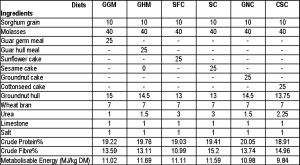 | Table 1- Ingredient proportion of experimental diets N.B, ME, CP and CF were calculated according to values and equation in Bulletin No. 1, Northern and central Sudanese animal feeds. GGM = Guar germ meal, GHM = Guar hull meal, SFC = Sunflower cake, SC = Sesame cake, GNC = Groundnut cake, CSC = Cottonseed cake |
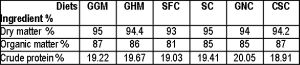 | Table 2- Chemical composition of experiment diets |
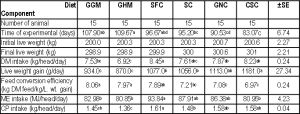 | Table 3- Feedlot performance of the experimental animal fed on diet of different protein sources N.B, figures in the same row having the same or no superscripts are not significantly different (P<0.05). GGM = Guar germ meal, GHM = Guar hull meal, SFC = Sunflower cake, SFC = Sunflower cake, SC = Sesame cake, GNC = Groundnut cake, CSC = Cotton seed cake |