


ISSN : 2231-6833
EISSN : 2231-6841



NARULA N.1*, SAREEN S.2*
1Department of Biotechnology, Mata Gujri Mahila Mahavidyalaya, Jabalpur, MP, India
2Department of Biotechnology, Mata Gujri Mahila Mahavidyalaya, Jabalpur, MP, India
* Corresponding Author : sonal_sareen2006@yahoo.com
Received : 15-04-2011 Accepted : 06-05-2011 Published : 15-12-2011
Volume : 1 Issue : 1 Pages : 12 - 15
J Soil Sci 1.1 (2011):12-15
DOI : http://dx.doi.org/10.9735/2231-6833.1.1.12-15
The soil is rich in pathogenic and non pathogenic keratinophillic fungi including dermatophytes. Most of the fungal isolates have already been reported as dermatophytes causing infections of skin, scalp, hair etc. The present work dealt with the isolation and characterization of keratinophillic fungi from different soil sources. Five different fungi were isolated from various soil sources using hair baiting technique. These fungal isolates were then identified on the basis of morphology and biochemical tests and were found to be Geomyces sp., Penicillium sp., Microsporum sp., Aspergillus sp. and Candida sp. 14 different herbs and spices were selected for the present study out of which garlic was found to be the most effective antifungal agent. Apart from garlic, ginger, turmeric, lemon, mint, neem, amla, aloe vera and ajwain were found to be effective against few fungal isolates. However, tulsi, coriander, methi, heena and green onion were found to be ineffective.
pathogenic, non pathogenic, hair baiting, keratinophilic fungi, dermatophytes, herbs, spices, antifungal agent
The keratinophilic species are able to use materials associated naturally with keratin [1] . The biggest group of organisms that can utilize keratin as the sole source of carbon and nitrogen are keratinophilic fungi. The biodiversity of keratinophillic fungal community occurs both in soils and wastewater habitats. This comprises of saprophytes, some of which are considered to be pathogenic or non pathogenic to humans and other organisms [2] . The first discovery of keratinophilic fungi from soil was by hair baiting technique, the most common method used for qualitative and quantitative, isolation of these fungi from soil. These fungi are natural colonizers of keratinic substances. Some are keratinolytic and play an important ecological role in decomposing α- keratins, the insoluble fibrous protein. Because of tight packing of hair polypeptide chains in the α- helix structures and their linkages by disulphide bonds, they are poorly biodegradable [3] . The distribution of these fungi depends on different factors one of which, of vital importance is human and or animal presence. Some of these fungi are well known Dermatophytes, and are known to cause Superficial Cutaneous infection (Dermatophytosis) of keratinized tissues (skin, hair and nails) of humans and animals. Mycotic infection is reported throughout the world and is extremely contagious [4] .
Both Dermatophytes and non- Dermatophytes can colonize and invade the keratin of skin, nails and hair [5] . The fungal morphological form that advert to these keratinaceous substrates are most probably ortho conidia and hyphal fragment in association with exfoliated corneocytes. Apart of fungi, keratin utilization has also been reported in bacteria [6] and helminthes [7] . The occurrence of Dermatophytes and other keratinophilic fungi enhances the risk of human Dermatophytosis in those regions, which could have a role in degradation of keratinous material.
Spices and herbs have been used for thousands of centuries to enhance the flavor and aroma of food. Scientific experiments have documented the antimicrobial properties of herbs and spices and their components. The antimicrobial activity varies widely depending on the type of spices and herbs, test medium and micro-organism. Some of the herbal and spice essential oils inhibitory to selected pathogenic microbes, they may provide alternative and supplements to conventional antimicrobial additives in food. The natural herbal products are known to have powerful antifungal properties [8] . In modern scenario these potent plants and herbs are being harvested by the use of biotechnology. The herbs and spices can be examined to control the growth and survival of microorganisms so that these can be used as powerful antifungal agents.
Collection of sample
10 different soil samples (rich in keratinous material) were collected in sterile polythene bags and brought to laboratories for further microbiological analysis.
The fungi were isolated by Hair Baiting technique and spread plate method on Saborauds Dextrose Agar media. In hair-baiting technique, the soil suspension was prepared in conical flask in sterile distilled water, and then short strands of sterilized human hair were introduced in the flask and observed for the fungal growth. These were transferred to SDA plate and incubated at 28°C for 5 days.
Morphological identification:
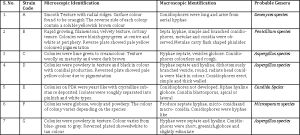
The microscopic studies were done on the basis of morphological characteristics. Slide culture technique was adopted for the identification of fungus with lactophenol cotton blue.
Biochemical identification:
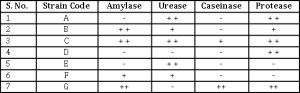
All the fungal colonies were examined for amylase production, urea hydrolysis, casein hydrolysis and protease activity.
Thermo tolerance studies
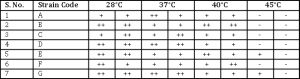
Thermotolerance of the test isolates was determined by incubating them at 28°C, 37°C, 40°C & 45°C on SDA and PDA media (supplemented with 0.05mg per ml of chloramphenicol in SDA and PDA media)
Screening for Keratinolytic activity
The isolates were screened for keratinase production based on the method of Wawrzkiewicz et al using solid mineral media. For the preparation of the media, standard keratin powder as a keratin source was added to the sterile agar medium at a final concentration of 0.06%. The agar plates were inoculated with 20 μl of fungal suspension (prepared by gently rubbing of slants in presence of 0.01% Tween 80). Keratinolytic activity of the isolates was detected as a clear zone around the colony after incubation at 25°C for 6 days. The diameter of the clear zone was measured to quantify the enzyme activity.
Comparative study of effect of natural herbs and spices:
The disk-diffusion method is used for screening the susceptibility of fungal isolates. The herbs and spices were taken separately and crushed by using pestle and mortar to a fine paste and the crude extract was taken. What man filter paper discs of 5mm diameter were dipped in each extract for 24 hours for perfect absorption.
The culture suspension was spread on SDA plats and allowed to dry for 5 mins. Then the herbal extract discs were placed on the surface of media with sterile forcep. Similar procedure was repeated for all the herbal extracts and spices. All the plates were then incubated at 28°C for 24-48 hrs.
Soil is a dynamic medium in which a large number of keratinophillic and non-keratinophillic fungi live in close association. The keratinophillic forms which are pathogenic to man and animals, colonies various keratinic substances. Several keratinophillic fungi have been tested for their keratinolytic activity by many workers [9] . A total of 5 fungi were isolated from soil samples and these were Aspergillus sp., Geomyces sp., Penicillium sp., Microsporum sp. and Candida sp.
These fungal isolates were capable of hydrolyzing starch enzymatically indicating that they require glucose for their growth. Though the amount of amylase and urea hydrolysis was different in each case. 1 fungal isolate was reported as casein positive and 4 isolates gave positive results for protease.
The results indicate that all the fungal isolates were able to grow at 28°C & 37°C but few were able to grow at 40°C showing that they are thermotolerant in nature. Those isolates which were able to grow at 45°C indicated their thermotolerant and pathogenic nature.
The results from thermo-tolerance test indicated that the fungal isolates can behave as human pathogens. Thus the effect of herbs and spices on these isolates was studied. The results showed that garlic extract can be used as an effective anti-fungal agent. The discovery of antimicrobial activities of garlic has been reported for various fungi and bacteria. Apart from garlic, ginger, lemon, mint and turmeric were found to be effective against Aspergillus sp. and Candida sp.
The keratin utilization has been reported in a wide variety of organisms including non filamentous and filamentous bacteria, water moulds and filamentous fungi. The enzymatic ability of fungi to decompose keratin has long been interpreted as key innovation in the evolution of animal dermatopathogenecity. The present work dealt with the isolation and characterization of keratinophillic fungi from different soil sources. The identification was done on the basis of morphology and biochemical tests. The study deals with effectiveness of some easily available herbs and spices on the fungal isolates. 14 different herbs and spices were selected for the study. The garlic was found to be most effective antifungal agent.
[1] Fillipelo Marcisio V., Fusconi A. and Rio S. (1994) Mycopathologia, 127, 103-115.
» CrossRef » Google Scholar » PubMed » DOAJ » CAS » Scopus
[2] De Hoog S. (1996) Mycoses, 39, 407 – 417.
» CrossRef » Google Scholar » PubMed » DOAJ » CAS » Scopus
[3] Kunert J., Kushwaha R.K.S. and Guarro J. (2000) Revista Iberoamericana De Micologia Bilbao, 77-85.
» CrossRef » Google Scholar » PubMed » DOAJ » CAS » Scopus
[4] Qaher Mandeel, Simona Nardoni and Francesca Mancianti (2009) Mycoses, Volume 54, Issue 1, 71–77.
» CrossRef » Google Scholar » PubMed » DOAJ » CAS » Scopus
[5] Deshmukh S.K., Mandeel Q.A. and Verekar S.A. (2008) Mycopathologia, Volume 165, Number 3, 143-147.
» CrossRef » Google Scholar » PubMed » DOAJ » CAS » Scopus
[6] Zaghoul T.I., AL.Bahra M., AL-Azmeh H. (1998) Appl Biochem Biotechnol, 70-72:207-13.
» CrossRef » Google Scholar » PubMed » DOAJ » CAS » Scopus
[7] Tadeusz M. (1999) Acta, Parasitol; 44;193-198.
» CrossRef » Google Scholar » PubMed » DOAJ » CAS » Scopus
[8] Ceylan Erdogan, Daniel Y.C. (2004) Journal of rapid methods and automation in Microbiology, 12:1,1-55.
» CrossRef » Google Scholar » PubMed » DOAJ » CAS » Scopus
[9] Desmukh S.K. and Agarwal S.C. (1985) Mycoses, 28: 463-466.
» CrossRef » Google Scholar » PubMed » DOAJ » CAS » Scopus
 | Table 1- identification of fungi using hair-baiting technique |
 | Table 2- BIOCHEMICAL TEST |
 | Table 3- THERMOTOLERANCE TEST |
 | Table 4- COMPARATIVE STUDY OF HERBS AND SPICES |