


ISSN : 2231-6833
EISSN : 2231-6841



BEOHAR P.A.1*, SRIVASTAVA R.K.2
1Environmental Engineering Laboratory, Hitkarini College of Engineering & Technology, Hitkarini Hills, Dumna Road, Tembhar, P.O.-Khamaria, Jabalpur, 482005, MP, India
2Environmental Research Laboratory, P.G. Department of Environmental Science, Government Model Science College (Autonomous), Centre For Excellence, Jabalpur, MP,482001, India
* Corresponding Author : Purnim78@yahoo.com
Received : 15-04-2011 Accepted : 06-05-2011 Published : 15-12-2011
Volume : 1 Issue : 1 Pages : 4 - 11
J Soil Sci 1.1 (2011):4-11
DOI : http://dx.doi.org/10.9735/2231-6833.1.1.4-11
A comparative studies was conducted between exotic and indigenous (epigeic Eisenia foetida (exotic) and anaecic species Lampito mauritii (indigenous) respectively). We use two species of earthworms for the evaluation of their efficacy in vermicomposting of poultry waste. Vermicomposting of poultry waste takes 90 days of time, resulted in significance difference between the two species in their performance and compost quality in respect to pH, Electrical conductivity, organic carbon %,Organic matter%, available nitrogen%, available phosphorus% available Potassium%, Ca, Mg and weight loss of poultry waste.
Poultry waste, Eisenia foetida, Lampito maurittii, vermicomposting
A rapidly increasing population and high rate of industrialization has increased the problem of solid waste management. The problem has further increased in cities because of shortage of the dumping sites and strict environmental legislation, so scientists are seeking for management alternatives, which should be ecofriendly, cost effective and fast. Now days we are facing major problem with Poultry waste because it is highly organic in nature, so vermicomposting has become an appropriate alternative for the safe hygienic and cost effective disposal of it. Earthworms feed on the organics and convert material into casting, which is rich in plant nutrients. The action of the earthworms in the process of vermicomposting of waste is physical and biochemical. The physical process includes substrate aeration, mixing as well as actual grinding while the biochemical process is influenced by the microbial decomposition of substrate in the intestine of the earthworms (Hand et al., 1998) Various studies have shown that vermicomposting of organic waste accelerates organic matter stabilization (Neuhauser et al., 1998; Frederickson et al., 1997)and gives chelating and phytoharmonal elements (Tomati et al., 1995) which have a higher content of microbial matter and stabilized humid substances. In India the exotic epigeic species, like Eudrilus euginae (Ashok,1994) Parionyx excavatus( Kale et al., 1982) and Eisenia foetida (Harrtenstein et al., 1978)are being used for vermicomposting. Selection of the worms depends upon the waste for vermiprocessing. Species like E. foetida (Harrtenstein et al., 1979) and E.eugineae (Kale and Bano 1988) have been used the converting organic waste into vermicompost. We have selected two species for present study because their available literature and they can survive in the climatic conditions of the Jabalpur. By the use of above two species we can solve our above 3 problems and we can evaluate their efficacy in vermicomposting of poultry waste.
In the present era we are facing 3 major problems:
1. Pollution created by the solid waste.
2. Pollution created by the fertilizers.
3. We have to change chemical based farming into organic sustainable for the quality betterment of grains as well as field area.
Collection of the Waste Material
Poultry waste is the collected from the poultry farm. As we aware through the literature on the Earthworm that for the survival and better result of composting, the pH, moisture and the organic content of the feed given to them (earthworms) are very important and the pH must be neutral or alkaline (7 to 9) but in case of poultry waste it was found that it was highly acidic (4.9 pH), where as organic content and moisture were suitable. Therefore during the inoculation of the earthworms on pure poultry waste, no response was given by the any earthworms variety and their mortality rate was very high and this was mainly because of high acidic pH. To neutralize the acidic pH of poultry waste CaCO3 was used.
The ratio of poultry waste and cow dung was taken according to dry matter weight. According to dry weight analysis, 5 different combinations of fresh poultry waste and fresh cow dung were prepared. As we know that cow dung is a great source of the microbes. That’s why we use Cow dung to reduce the time of the semidecomposition. In these combinations, CaCO3 was mixed according to the weight of the dry poultry waste.
According to dry weight analysis, 5 different combinations of fresh poultry waste and fresh cow dung were prepared.T1, T2, T3, T4 and T5 are different treatment combinations.
T-1 (4:1) (i.e.) 4 parts of poultry waste and 1 part of cow dung
T-2 (2:1) (i.e.) 2 parts of poultry waste and 1 part of cow dung
T-3 (1:1) (i.e.) 1 parts of poultry waste and 1 part of cow dung
T-4 (1:0) (i.e.) 1 parts of poultry waste and 0 part of cow dung
T-5 (0:1) (i.e.) 0 parts of poultry waste and 1 part of cow dung
For the semidecomposition of any organic waste, usually two methods are used, these are:
Pit method
Heap method
For the present study, pit method was selected because it is very safe and moisture level can easily be maintained. For semidecomposition of poultry waste and cow dung (of different combinations), five pits were prepared of size 5 ft length x 2 ft width x 5 ft depth. (5 x 2 x 5)
These five combinations were put in prepared pits and named as T1, T2, T3, T4 and T5 for decomposition and every week, pH of these combinations was measured and after 45 days, i.e. on 7th week, the desired pH value of the combination was achieved and material was semidecomposed which is easily accepted by worms.
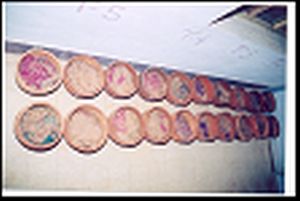
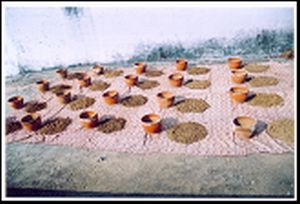
To inoculate earthworms in semidecomposed materials, 45 earthenware pots of spherical shape were taken without any hole. The experimental design was factorial and according to design, coding on pots was made. For each species of earthworm, four replicates in each treatment were taken as A1, A2 ------upto J4 And K,L,M,N,O for controls.
For the experiment 2 different varieties of earthworms were taken these are:
1. S-1 Eisenia foetida (exotic species)
2. S-2 Lampitto mauritti (indigenous species)
Now total no of earthworm species 2
Total no. of treatments 5
And total 4 replicates of all 5 combination were taken.
S1 Earthworms species - Eisenia foetida
S2 Earthworms species - Lampito mauritti
T = Treatments
T1 4:1 (poultry :cow dung)
T2 2:1 (poultry :cow dung)
T3 1:1 (poultry :cow dung)
T4 1:0 (poultry :cow dung)
T5 0:1 (poultry :cow dung)
R = Replicates
R1 Replicates
R2 Replicates
R3 Replicates
R4 Replicates
Sample codes used during analysis
For raw materials
Pure poultry waste - RM-1
Cow dung - RM-2
For semidecomposed material
Treatment T-1 - SD-1
Treatment T-2 - SD-2
Treatment T-3 - SD-3
Treatment T-4 - SD-4
Treatment T-5 - SD-5
For prepared compost
A1, A2, A3, A4,B1, B2, B3, B4,C1, C2, C3, C4 ,D1, D2, D3, D4,E1, E2, E3, E4,F1, F2, F3, F4,G1,G2,G3,G4, H1,H2,H3,H4, I1, I2, I3, I4, J1, J2, J3, J4, K, L, M, N, O.
1. pH
2. Electrical Conductivity
3. Organic Carbon %
4. Organic Matter %
5. Total Nitrogen %
6. Available Nitrogen %
7. Total phosphorus %
8. Available Phosphorus %
9. Total Potassium %
10. Available Potassium %
11. Ca
12. Mg
The above analysis was done according to the standard procedure of Jackson (1973).
1. pH and Electrical Conductivity: Potentiometric method (1:2.5 soil water suspension) by pH and EC meter.
2. Organic Carbon Content: Titrimetric determination (Wakley and Black,1934). Organic matter was derived from the organic carbon content.
3. Available Nitrogen: Alkaline potassium permanganate method (Subbiah and Asija, 1956). Total Nitrogen was derived from available Nitrogen.
4. Available Phosphorus: Olsen’s method (Olsen’s, et al. 1954). Total Phosphorus was derived from available Phosphorus.
5. Available Potassium: Ammonium Acetate Extract Method. Total Potassium was derived from available Potassium.
6. Estimation of Calcium and Magnesium: Complexometric Titration Method.
pH
In all the five combinations of compost prepared by both species, the pH value was around 8 (alkaline) as compared to pH of fresh poultry waste which was 4.9 (acidic).
Electrical Conductivity
In comparison with pure poultry waste, electrical conductivity was decreased. It was around 0.2 in all the compost prepared by both species in all five combinations.
Organic Carbon
In pure poultry waste, organic carbon was 22.52, but after vermicomposting the organic carbon decreased considerablely to around 2.0. In case of T 4 combination i.e. pure poultry waste, organic carbon of the vermicompost was 2.2 and 2.3 of S1 and S2 species respectively whereas in case of S2 species, its value was 1.726. Chowdappa et al. (1999) found the same result of decrease of organic carbon contents in their studies of recycling of organic waste.
Total % Nitrogen
Total % N also decreased considerably. It decreased from their original value of pure poultry waste. There was not noticeable difference with all combinations of the compost.
Total % Phosphorus
The value of % phosphorus of final compost between 0.03 to 0.6, which is less in comparison with pure poultry waste and it is around 1.33%.
Total % Potassium
The total % of K in all the compost was in between 0.021 to 0.4 which is less then its initial value of poultry waste.
After inoculation of different species of earthworms in various combinations, it was found that species S-I (Eisenia foetida) and species S-II (Lampito mauritti) started making vermicompost on the third day. During this period, moisture and temperature was regulated by regular watering.
After 45 days, it was found that S-I and S-II species completely converted the semidecomposed material into vermicompost and these pots were now filled with sweet smelling spongy vermicompost.
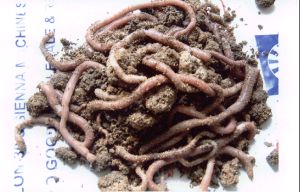
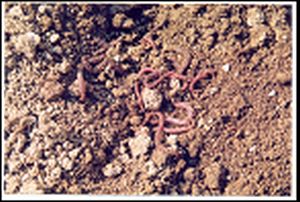
After completion of composting, earthworms were removed from the compost by drying it on a cemented floor, directly in sunlight. By this process earthworms gathered at the bottom of the compost and then bunches of earthworms were separated from the vermicompost.
After removing earthworms from the compost chemical analysis of the vermicompost was done. The result is summarized in the form of tabular form:
Thus the poultry waste (which was considered as non utilizable solid waste) can be effectively used for conversion to useful vermicompost by utilization of different earthworms species and different combination of cow dung. On the basis of the chemical analysis, the observations indicated the E.foetida to be superior in performance over L. mauritii in terms of loss of TOC, reduction in carbon to nitrogen ratio, incease in EC and TK, though E.foetida are capable of working hard to convert all the organic waste into manure, they are no significant value in modifying structure of soil. L. mauritii however are capable of both organic waste consumption as well as modifying the soil structure.
According to Dr. Radha D. Kale book “Earthworms Cinderella of Organic Forming†Page No. 62. “Any animal waste axcept the poultry droppings can be used for composting. If poultry waste has to be used for composting it should be slurry derieved fom the biogas plant.†But here in present study, pure poultry waste has been converted in to vermicompost by keeping the pH between 7 to 9 i.e. alkaline. The vermicompost prepared from pure poultry waste is superior and of good quality in comparison with vermicompost prepared from other organic waste in term of organic carbon and potassium, whereas in term of nitrogen and phosphorus it is of medium quality.
From the present study we can conclude that:
1. Pure poultry waste can be converted into useful vermicompost.
2. Total 45 days are required for the semidecompsition for all combinations.
3. Total composting time for S1 and S2 species is 45 days.
4. The best combination for S2 species that can be used to convert poultry waste into vermicompost is T2 combination (2:1)i.e. two parts of poultry waste and one part of cow dung.
5. The best combination for S1 Species i.e. Eisenia foetida is T3 combination (1:1)i.e. 1 part of poultry waste and 1 part of cow dung.
6. The best compost of S1 species i.e. Eisenia foetida was formed in T3 combination (1:1) i.e. 1 parts poultry waste and 1 part cow dung.
7. The best compost of S2 species i.e. Lampito mauritii formed in T3 combination (1:1) i.e. 1 parts poultry waste and 1 part cow dung.
8. The best compost was formed by S1 Species i.e. Eisenia foetida in T3 combination (1:1) i.e. 1 part of poultry waste and 1 part of cow dung.
9. The best species for converting T4 combination (1:0) i. e. pure poultry waste into vermicompost is S1 species i.e. Eisenia foetida and prepared compost was also of good quality.
Moisture level in the vermipit should be between 40-50%. Excess water reduces the activity of the earthworms. Worms should not injured while handling. Worms should be protected by the predators like white ants, red ants, centipedes, toads , lizards and rats etc. the harvesting and the providing of the feed mix should be attended in the time, otherwise accumulation of the vermicomposting and reproduction of the worms would be reduced.
During rainy season, temporary shelter over the pit and proper drainage around the pit should be provided to avoid water entry inside of the pit. Semidecomposed material helps faster formation of the vermicomost.
[1] Ashok K.C. (1994) state of art report on vermicomposting in India council for advancement of people action and technology (CPART) New Delhipg 60.
» CrossRef » Google Scholar » PubMed » DOAJ » CAS » Scopus
[2] Dash M.C.,Senapati B.K.,Mishra C.C. (1980)Trop.Ecol., 20,9-12.
» CrossRef » Google Scholar » PubMed » DOAJ » CAS » Scopus
[3] Frederickson J., Butt K.R., Morris R.M.,Danial C. (1997) Soil Biol. Biochem. 29 (3-4),725-730.
» CrossRef » Google Scholar » PubMed » DOAJ » CAS » Scopus
[4] Hand P., Hayes W.A., Satchell J.E., Frankland J.C.,Edwards C.A.,Neuhauser E.F. (1998) Earthworm, Waste Environ. Manage., 49-63.
» CrossRef » Google Scholar » PubMed » DOAJ » CAS » Scopus
[5] Harwood M., Sabine J.R. (1978) Proc. Z Austr Pouit stockfeed Com, Sydney, 164-171.
» CrossRef » Google Scholar » PubMed » DOAJ » CAS » Scopus
[6] Hartenstein R., Hartenstein F. (1981) Environ.Qual., 10,377-382.
» CrossRef » Google Scholar » PubMed » DOAJ » CAS » Scopus
[7] Hartenstein R., Neuhauser E.F., Kaplan D.L. (1979) Oecologia 43,329-340.
» CrossRef » Google Scholar » PubMed » DOAJ » CAS » Scopus
[8] Hennuy G., Gaspar L. (1986) Bull.Res.Agronom.Gambloux 21 (3),359-367.
» CrossRef » Google Scholar » PubMed » DOAJ » CAS » Scopus
[9] Hori M., Kondon K., Yosita T., Konsihi E., Minami S. (1974) Pharmacol. 23,1582.
» CrossRef » Google Scholar » PubMed » DOAJ » CAS » Scopus
[10] Kale R.D.,Bano K., Krishnomoorthy R.V. (1982) Pedobiologia 23, 419, 125.
» CrossRef » Google Scholar » PubMed » DOAJ » CAS » Scopus
[11] Mackenzie D. (1991) New Scientist, 31-34.
» CrossRef » Google Scholar » PubMed » DOAJ » CAS » Scopus
[12] Makarda H., Hayashi N., Yokota H., Okumura J. (1997) J.Pn. Pouft.Sci. 16,293-297.
» CrossRef » Google Scholar » PubMed » DOAJ » CAS » Scopus
[13] Neuhauser E.F., Loehr R.C., Malecki M.R. (1998) The potential of the earthworms for managing sewage sludge. In: C.A., Neuhauser, E.F.(Eds.), Earthworms in waste management and Environmental management. SPB Academic Publishing, The Hague, 9-20.
» CrossRef » Google Scholar » PubMed » DOAJ » CAS » Scopus
[14] Reynolds J.W., Reynolds W.M. (1972) Am.J.Nurs.72,1273.
» CrossRef » Google Scholar » PubMed » DOAJ » CAS » Scopus
[15] Tomati U., Galli E., Pasetti L., Volterra E. (1995) Waste manage. Res. 13,509-519.
» CrossRef » Google Scholar » PubMed » DOAJ » CAS » Scopus
[16] Yeates G.W. (1981) Am. Appl. Biol., 70, 5-188.
» CrossRef » Google Scholar » PubMed » DOAJ » CAS » Scopus
 | Fig. 1- |
 | Fig. 2- |
 | Fig. 3- |
 | Fig. 4- |
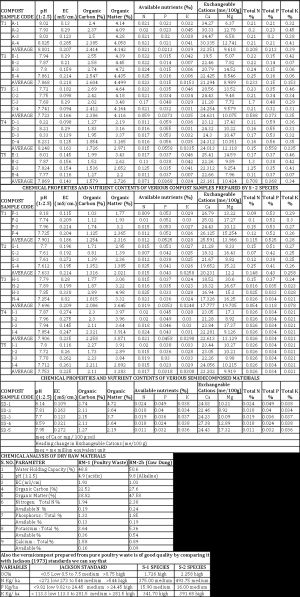 | Table 1- Chemical properties and nutrient contents of various compost samples prepared by s - 1 species |