


ISSN : 2231-6833
EISSN : 2231-6841



RAI SAPNA1*, VISHWAKARMA YAMINI2
1Department of Microbiology, Mata Gujri Mahila Mahavidyalaya, Jabalpur, MP, India
2Department of Microbiology, Mata Gujri Mahila Mahavidyalaya, Jabalpur, MP, India
* Corresponding Author : Mailsapnarai@gmail.com
Received : 15-04-2011 Accepted : 06-05-2011 Published : 15-12-2011
Volume : 1 Issue : 1 Pages : 1 - 3
J Soil Sci 1.1 (2011):1-3
DOI : http://dx.doi.org/10.9735/2231-6833.1.1.1-3
Keratins are the most abundant protein in epithelial cells of vertebrates and represent the major constituents of skin and its appendages such as nail, hair, feather, and wool. World-wide poultry processing plants produce millions of tons of feather as a waste product annually, which consist of approximately 90% keratin feathers, represent 5-7% of the total weight of mature chickens. These feathers constitute a sizable waste disposal problem. Several different approaches have been undertaken for disposing these feather wastes. In this piece of work several bacterial and fungal isolates showing potential keratinophilic activity have been isolated. The soil sample were collected from barber shop, butcher shop, slaughter house and pigeon farm of Jabalpur district. Among the bacterial isolates four strains (BS-1, BS-2, BS-3 and BS-4) showed maximum keratinase production. Effect of different environmental conditions proved that bacterial isolates produced highest amount of keratinase. The keratinase production was evident by degradation of feathers and hairs used as substrate. Characterization of keratinase was done by SDS-PAGE and low molecular weight (11-15 KD) bands were obtained. Feather is a waste considerably generated from chicken processing industry. It becomes an animal supplement as feather meal by high temperature and pressure or chemical processes. Therefore, the meal has a low nutrition value since the process destroys certain amino acids. A biological approach could be advantageous over the thermal and chemical methods since it is a friendly environment and energy conservation process resulting in its feather products could have a higher nutritional value served as a protein feed.
keratinophilic, keratinase enzyme, feather, feather degrading bacterium, keratins, keratinolytic activity, poultry wastes, wastewater
Keratins are the most abundant protein in epithelial cells of vertebrates and represent the major constituents of skin and its appendages such as nail, hair, feather, and wool. The protein chains are packed tightly either in [α-keratins] or in [β-keratins] structures, which fold into final 3-dimensional form [1-3] . Keratins are grouped into hard keratins [feathe] hair, hoof and nail] and soft keratins [skin and callus] according to sulphur content [4] . These proteins belonging to the scleropeptides group are compounds that are extremely resistant to the action of physical, chemical and biological agents. One of the main characteristics of keratins is that they have high mechanical stability and resistance to proteolytic degradation, which depends on the disulfide and hydrogen bonds, salt linkages and other crosslinkings [5-6] . Therefore, keratinous material is water insoluble and extremely resistant to degradation by common proteolytic enzymes such as trypsin, papain and pepsin [6-7] . World-wide poultry processing plants produce millions of tons of feather as a waste product annually, which consist of approximately 90% keratin feathers, represent 5-7% of the total weight of mature chickens. These feathers constitute a sizable waste disposal problem. Several different approaches have been used for disposing of feather waste including land filling, burning, natural gas production and treatment for animal feed. Most feather waste is land filled or burned which involves expense and can cause contamination of air, soil and water. A group of proteolytic enzyme which is able to hydrolyze insoluble keratins more efficiently than other proteases is called keratinases produced by some microorganisms [7-8] . Many keratinases from species of Bacillus [5-10] , fungi [11-12] and Actinomycetes [2-7] has been reported and some of them were purified and characterized.
The present study has been undertaken to evaluate the potential Keratin degrading fungi. Soil samples were collected from Barber, Chicken shop, Poultry farm and Slaughter houses of different places of Jabalpur district. Different strains of fungi and bacteria were isolated from these soil samples collected and further screened for their keratin degrading capacity. Characterization of keratinase enzyme further proved their potential of keratin degrading capacity. Soil samples with hair as waste material were collected from Barber shop (Suhagi & Gurandi) and Slaughter house (Madartekri) in Jabalpur district. Soil samples were also collected from Chicken shop (Bhaisasur Road) and Poultry farm (Gurandi) where feather was used as waste.
Serial dilution technique
NAM was prepared & autoclaved at 121° C under 15 lbs pressure for 20 min.
Serial dilution was prepared up to 10-5. 2 dilutions (10-2 & 10-4) were plated by pour plats method using liquefied NAM the plates were incubated in incubator at 30°C ± 2°C for 24-48 hrs.
Screening for keratinophilic activity
0.05 gm of feathers & 0.16 gm of hairs were weighed & autoclaved. Bacterial suspensions of selected bacterial colonies were prepared & autoclaved feathers & hairs were dipped in this suspension & placed in vials. 2 ml of autoclaved NAM was added over these feathers & hairs incubated at 30°C ± 2°C for 10 days. After 10days feathers & hairs washed and dried in sun & weighed feathers & hairs.
Characterization and identification of bacterial isolates
Among the different bacterial isolates, those exhibiting maximum keratinase activities were subjected to morphological characterization and identified using the PIB kit.
Effect of temperature on keratinase
The effect on temperature keratinase activity was, determined by the 20 μl keratinase (3mg ml 1 protein) to 1.5 phosphate buffer (100 mMol 1, pH 7.5) containing 15 mg powdered keratin and incubating at a range of temperature (26°C, 30°C, 34°C, 38°C) for 24 hrs. Peptide release was determined spectro-photometrically (600nm).
Effect of pH on keratinase
The effect on pH keratinase activity was, determined by the 20 μl keratinase (3mg ml 1 protein) to 1.5 phosphate buffer (100 mMol 1, pH 7.5) containing 15 mg powdered keratin and incubating at a range of pH (6.0, 6.5, 7.0, 7.5, 8.0, 8.5, 9.0) for 24 hrs. Peptide release was determined spectro-photometrically (600nm).
In this piece of work isolation and screening of keratinophilic bacteria was done from different soil samples. Different biochemical test was performed to identify bacterial strain, the result of nitrate test, citrate test, MR-VP test, and gelatin agar test as seen in [Table-1] indicate the BS-1, BS-2 were micrococcus and streptococcus (gram positive) and BS-3, BS-4 were gram negative. Among the bacterial strain isolated as observed in [Table-4] BS-1 and BS-2 showed good keratinophilic activity as evidenced by decreased in the feathers weight from 0.05gm, to 0.03gm., BS-3 and BS-4 showed significant keratinophilic activity. When hairs were used as substrates, keratinophilic activity was evaluated by comparison of initially weight of hairs and after 10 days of incubation. The isolated bacterial strains showed good keratinophilic activity. [Table-5] different types of isolated bacterial strain such as BS-1, BS-2, BS-3, and BS-4 showed maximum keratinase production at pH range from 7-9.
%- Percentage
0C- Celsius
&- And
Hrs- Hours
Sec- Seconds
Min- Minutes
Gm- Gram
Mg- Milligram
pH- Potential of hydrogen
ïl- Microlitre
ml- Mililitre
g/l- Gram per liter
L- Liter
BS- Bacterial strain
[1] Kim J.D. (2007) Purification and Characterization of a Keratinase from a Feather-Degrading Fungus, Aspergillus
» CrossRef » Google Scholar » PubMed » DOAJ » CAS » Scopus
[2] Esawy M.A (2007) Research Journal of Agriculture and Biological Sciences, 3[6], 808- 817.
» CrossRef » Google Scholar » PubMed » DOAJ » CAS » Scopus
[3] Krelpak L., Doucet J., Briki F. (2004) Biophysics Journal, 87, 640-647.
» CrossRef » Google Scholar » PubMed » DOAJ » CAS » Scopus
[4] Gupta R., Ramnani P. (2006) Applied Microbiology and Biotechnology, 70, 21-33.
» CrossRef » Google Scholar » PubMed » DOAJ » CAS » Scopus
[5] Korkmaz H., Hür H., Dinçer S. (2004) Annals of Microbiology, 54 [2], 201-211.
» CrossRef » Google Scholar » PubMed » DOAJ » CAS » Scopus
[6] Hoq M.M., Siddiquee K.A.Z., Kawasaki H., Seki T. (2005) Journal of Biological Sciences, 5[2], 193-200.
» CrossRef » Google Scholar » PubMed » DOAJ » CAS » Scopus
[7] Gradišar H., Friedrich J., Križaj I., Jerala R. (2005) Applied and Enviromental Microbiology, 71 [7], 3420-3426.
» CrossRef » Google Scholar » PubMed » DOAJ » CAS » Scopus
[8] Cai C., Lou B., Zheng X. (2008) Journal of Zhejiang University Science, 9[1], 60-67.
» CrossRef » Google Scholar » PubMed » DOAJ » CAS » Scopus
[9] Joshi S.G., Tejashwini M.M., Revati N., Sridevi R., Roma D. (2007) International Journal of Poultry Science, 6[9], 689-693.
» CrossRef » Google Scholar » PubMed » DOAJ » CAS » Scopus
[10] Cortezi M., Contiero J., Lima C.J.B., Lovaglio R.B., Monti R. (2008) World Journal of Agricultural Sciences, 4 [5], 648-656.
» CrossRef » Google Scholar » PubMed » DOAJ » CAS » Scopus
[11] Friedrich J., Gradišar H., Mandin D., Chaumont J.P. (1999) Letters in Applied Microbiology, 28, 127-130.
» CrossRef » Google Scholar » PubMed » DOAJ » CAS » Scopus
[12] Soomoro I.H., Kazi Y.F., Zardari M., Shar A.H. (2007) Journal of Microbiology, 24 [1], 79-80.
» CrossRef » Google Scholar » PubMed » DOAJ » CAS » Scopus
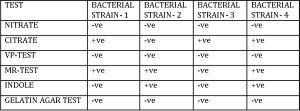 | Table 1- Biochemical test for identification of bacterial strain (1-4) |
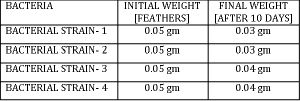 | Table 2- Different Bacterial Strains showing feather degradation after ten days of incubation |
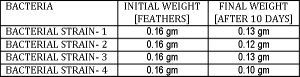 | Table 3- Different Bacterial Strains showing hair degradation after ten days of incubation |
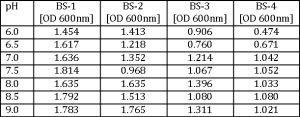 | Table 4- Effect of different pH on keratinase activity of Bacterial isolates |
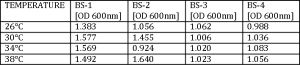 | Table 5- Effect of temperature on keratinase activity |