


ISSN : 2249-9466
EISSN : 2249-9474


DESHMUKH P.R.1, WASANKAR S.W.2*
1Computer Science Department, Sipna’s College of Engineering & Technology, Amravati, MS, India.
2Computer Science Department, Sipna’s College of Engineering & Technology, Amravati, MS, India.
* Corresponding Author : Snehal_2104@rediffmail.com
Received : 21-02-2012 Accepted : 15-03-2012 Published : 19-03-2012
Volume : 2 Issue : 1 Pages : 10 - 13
Adv Med Informat 2.1 (2012):10-13
We propose to develop an expert system that will generate Alerts and Reminders for patient in medical field. This is the era of technology, many fields like Agriculture, Education, military, Geology etc. are using huge products of Expert systems So, why Medical field lags behind??? For this reason we try do something in this medical field. Our project is motivated for Doctors, Patients, etc. The proposed system will act as an online ‘expert’ and is aiming at supporting the initiative of providing accurate information to the general public.
Expert Systems, Alerts and Reminders.
Alerts inform clinicians of changes in a person’s condition, perhaps on a monitor. Alerts could also be used to scan lab test results and send reminders or warnings. For example, a patient could be attached to an electrocardiogram (ECG) or pulse oximeter and the alert expert system could warn of changes in a patient’s condition. In less acute circumstances, it might scan laboratory test results, or drug or test orders and then send alerts or warnings-either via immediate on- feedback or through a messaging system like SMS, email. Reminder systems serve a slightly different purpose in that they are used to notify clinicians of important tasks that need to be done before an event occurs. Reminder systems are successful because they leave the physician in control and only provide feedback when the physician does not obey the rules. as the purpose of alert and reminder systems is to provide interventions to clinicians (junior and senior), explanations may only be appropriate for these user categories. Our project includes registration of patients, storing their details into the system and also computerized billing in the pharmacy and labs. Our software has the facility to give a unique id for every patient and stores the details of every patient and the staff automatically. It includes a search facility to know the current status of each room. User can search availability of a doctor and the details of a patient using the id. The main function of the system is to register and store patient details and doctor details and retrieve these details as and when required and also to manipulate these details meaningfully System input contains patient details, diagnosis details; while system output is to get these details on to the CRT screen. There is Direct Communication between patient and doctor via networking like LAN system in Hospital.
In real-time situations, an expert system attached to a monitor can warn of changes in a patient's condition. In less acute circumstances, it might scan laboratory test results or drug orders and send reminders or warnings through an e-mail system.
Patients who are not taking prescribed medications properly are incurring significant risks to their health. This is a growing problem today. Failure to take medications properly.
Is a common occurrence- 50% of people don't take their medications as prescribed.
Can keep people from getting better and sometimes CAN lead to additional health problems.
Is responsible for 10% of all hospitalizations and over 125,000 deaths annually in the cardiovascular area alone.
To help remind patients to take their medications, DSC provides an individual medication reminder service that automatically calls a subscriber and plays a recorded phone message that reminds the individual to take prescription medications. DSC can deliver these "take your pills" reminders to anyone who has access to a cell phone or simple telephone. A pre-recorded voice message (or SMS message) can be sent to either to an answering machine or to the subscriber to this service with a reminder to take a prescription medication. Simple to complex interactive voice response phone menus can be developed for touch phone response using DSC's IVR technology. For example, calls can be directed to medical personnel such as a doctor's office if the notice requires more than a simple medicine reminder.
Email patient reminder systems can be a highly effective method of practice management. Not only are patients provided appointment reminders and recall notification in a timely manner, but the savings in postage and printing can be tremendous. For many practices savings can be in the thousands of dollars each year when using online patient reminder systems. Look for online appointment systems that provide capabilities for automated email appointment confirmations. Some online appointment systems are also able to export appointments to Microsoft Outlook Express as well as their own appointment calendars. Appointment reminders by email are another useful feature. Studies have shown that email appointment reminders reduce the rate of missed appointments. Your office may still telephone patients to remind them about their upcoming appointments, but on busy days, having an automated email reminder system will be a welcome benefit. For medical-legal reasons, many practice management experts recommend an electronic trail that documents appointment confirmations and appointment reminders. Similarly, it is important that missed appointments as "No Show" or "Late Cancellation" are clearly recorded in your online appointment scheduling system. Documentation of missed appointments is evidence of patients who are not compliant Recall management by emails another important feature in a comprehensive online patient reminder system. Recall management should be customizable according to criteria that suit your office. The best online programs can organize recall by individual, type of last service and length of time from last service. Be sure that the program you use has the capability of blocking selected patients from receiving recall by email. Your email program should have a blocked list so that patients who are deceased, have moved to another city, or who have transferred their care to another physician, do not receive recall notification.
The proposed system is very easy to operate. Speed and accuracy are the main advantages of proposed system. There is no redundancy of data. The data are stored in the computer’s secondary memories like hard disk, etc. it can be easily receive and used at any time. The proposed system will easily handle all the data and the work done by the existing systems. The proposed systems eliminate the drawbacks of the existing system to a great extent and it provides tight security to data.
Alerts and reminders are among the most valuable features of clinical computing systems, because they selectively draw the attention of health care providers to new data and needed action. A large body of research demonstrates their value to the quality of patients. Credible alerts require access to timely, accurate data and for this reason reminder systems are often linked to computer-based medical record systems.However, because development of computer-based medical record systems is a prodigious task, reminder systems are not always included in automated medical record systems. One method of generating alerts is by use of an event monitor. An event monitor is an application which 'scans' electronic messages containing new clinical and administrative information sent between clinical computing systems (or from within a single system),and notifies clinicians when patterns are detected that warrant attention, by generating alerts, reminders, or by some other mechanism. database Systems Corp. (DSC) can help improve the productivity of your healthcare administration department. Our predictive dialer phone system and voice broadcasting auto dialers can call your patients with medical reminders and notifications. Our medical alert systems can broadcast thousands of messages quickly. Messages may contain specific patient information such as appointment dates and times and recommended actions such as fasting time periods be a medical appointment. Our healthcare dialer can play different messages based upon contact with an individual or an answering machine. If multiple calls are required, the phone system can likewise play different messages with escalating messages. When contact is made with an individual, your message may simply provide instructions and appointment reminders. Additionally, an option can be provided to contact someone from your medical staff by pressing a touchphone response in which case our dialer will transfer the call. Health care organizations, hospitals, doctor's offices and dental practices can improve productivity through technology from Database Systems Corp. Our automated phone system can handle incoming calls from patients and insured individuals and provide timely and accurate information to the caller. Callers can check health care programs and rates and request policy information. Existing policy holders can enter a claim number or policy account number to obtain billing and claims information. The call can also be routed to the proper organization to handle the caller's requirements. Recently, IVR systems and service have proven to be invaluable tools for clinical trials. The use of Clinical IVR data collection eliminates bias and maintains consistent patient survey results. database Systems Corp. (DSC) can help improve the productivity of your healthcare administration department. Our predictive dialer phone system and voice broadcasting auto dialers can call your patients with medical reminders and notifications. Our medical alert systems can broadcast thousands of messages quickly. Messages may contain specific patient information such as appointment dates and times and recommended actions such as fasting time periods be a medical appointment. Our healthcare dialer can play different messages based upon contact with an individual or an answering machine. If multiple calls are required, the phone system can likewise play different messages with escalating messages. When contact is made with an individual, your message may simply provide instructions and appointment reminders. Additionally, an option can be provided to contact someone from your medical staff by pressing a touchphone response in which case our dialer will transfer the call. Health care organizations, hospitals, doctor's offices and dental practices can improve productivity through technology from Database Systems Corp. Our automated phone system can handle incoming calls from patients and insured individuals and provide timely and accurate information to the caller. Callers can check health care programs and rates and request policy information. Existing policy holders can enter a claim number or policy account number to obtain billing and claims information. The call can also be routed to the proper organization to handle the caller's requirements. Recently, IVR systems and service have proven to be invaluable tools for clinical trials. The use of Clinical IVR data collection eliminates bias and maintains consistent patient survey results.
Medical Alert devices can be a home alert system, or a type of jewelry that has important medical information about you that can be use in case of emergency. If you or someone you know is a senior citizen and lives alone, you should seriously consider purchasing a Home Alert Monitoring System or some form of medical jewelry. There are many types of medical alert jewelry available today. Most of them you can purchase online at a reasonable cost.
Different types of medical alert jewelry:
Medical alert charm- Which alert medical personnel to your health problems when you are unable to speak for yourself.
Medical alert necklace- Provide user access to to emergency medical help and primary medical information of patients.
Medical ID bracelets- Having your medical condition (diagnosis) and food or drug allergies listed on your bracelets ID can actually save our life.
A small radio transmitter: with “help button†that is worn by user when activated this device send signal to consol.
A consol- connected to the user’s telephone and dials pre-selected emergency numbers or emergency response center Emergency response center: monitors users call, identify the nature of call Emergency medical alert response center- Provider based and manufacture based Provider based: usually are located in user’s local area and are operated by hospitals or social service agencies manufacture based: usually have one national center sometimes consumer who purchase systems can choose between between provider based and manufacture based center but consumer who rent system from PERS(PERSONAL EMERGENCY RESPOSE SYSTEM) manufacture usually must use its national center.
• It is fast, efficient and reliable
• Avoids data redundancy and inconsistency
• Very user-friendly
• Easy accessibility of data
• Number of personnel required is considerably less
Provides more security and integrity to data
Alerts and reminders are among the most valuable features of clinical computing systems, because they selectively draw the attention of health care providers to new data and needed action. A large body of research demonstrates their value to the quality of patient care Credible alerts require access to timely, accurate data and for this reason reminder systems are often linked to computer-based medical record systems. However, because development of computer-based medical record systems is a prodigious task, are not always included in automated medical record systems. One method of generating alerts is by use of an event monitor. An event monitor is an application which 'scans' electronic messages containing new clinical and administrative information sent between clinical computing systems (or from within a single system)and notifies clinicians when patterns are detected that warrant attention, by generating alerts, reminders, or by some other mechanism.
The proposed system is We can enhance this system by including more facilities like Email system , in patient room allotment for the admitted patients and the stock details of medicines in the pharmacy. Broadcasting through more advance jewelry for alerts and Reminder generation.
We would like to thank our Inspiration our principle Dr. Sidharth Ladhake sir, our project Guide Prof. P.R Deshmukh Sir and all teacher staffs and friends who supported us for the completion of project.
[1] Bates D.W., Leape L.L., Cullen D.J. et al. (1998) Journal of the American Medical Association, 280:1311-1360.
» CrossRef » Google Scholar » PubMed » DOAJ » CAS » Scopus
[2] Rochon P.A., Field T.S., Bates D.W. et al. (2006) Canadian Medical Association Journal; 174: 52-54.
» CrossRef » Google Scholar » PubMed » DOAJ » CAS » Scopus
[3] Pettersson M., Wihlborg J., Lövström R. et al. (2008) Studies in Health Technology and Informatics, 136. IOS Press, Amsterdam.
» CrossRef » Google Scholar » PubMed » DOAJ » CAS » Scopus
[4] Pelayo S., Leroy N., Guerlinger S. et al. (2005) Studies in health technology and informatics, 116. IOS Press, Amsterdam.
» CrossRef » Google Scholar » PubMed » DOAJ » CAS » Scopus
[5] Despont-Gros C., Müller H. and Lovis C. Evaluating user interactions with clinical information systems.
» CrossRef » Google Scholar » PubMed » DOAJ » CAS » Scopus
[6] Salomon G., Perkins D.N. and Globerson T. (1991) Educational Researcher, 20(3), 2-9.
» CrossRef » Google Scholar » PubMed » DOAJ » CAS » Scopus
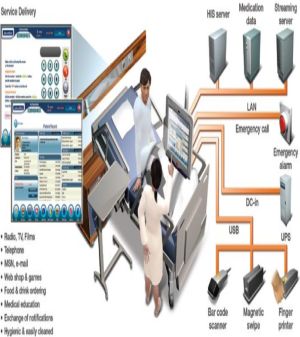 | Fig. 1- LAN connection between doctor and patient. |
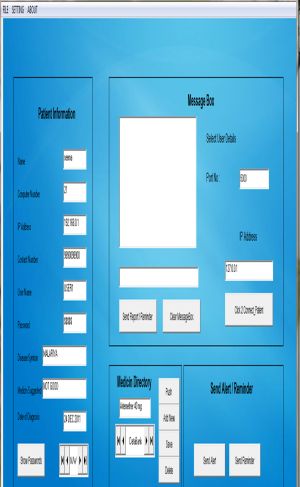 | Fig. 2- Doctor’s Window |
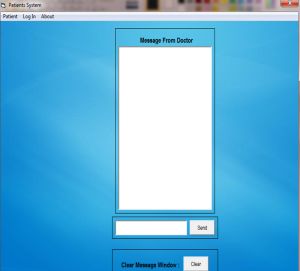 | Fig. 3- Patient’s Window |
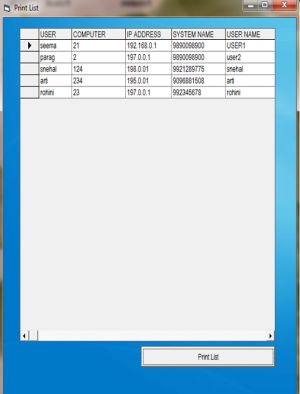 | Fig. 4- Patients Report |