


ISSN :
EISSN :



KILAMBO D.L.1*, NG’HOMA N.M.2, MTENGA D.J.3, PHIRI N.4
1Tanzania Coffee Research Institute (TaCRI) Lyamungu P.O. Box 3004, Moshi Tanzania.
2Tanzania Coffee Research Institute (TaCRI) Maruku P.O. Box 127, Bukoba Tanzania.
3Tanzania Coffee Research Institute (TaCRI) Lyamungu P.O. Box 3004, Moshi Tanzania.
4CABI International Africa Regional Centre, P.O. Box 633-00621, Nairobi Kenya.
* Corresponding Author : dkialmbo@gmail.com
Received : 21-07-2012 Accepted : 28-07-2012 Published : 09-08-2012
Volume : 1 Issue : 1 Pages : 12 - 16
World Res J Agric Biosyst Eng 1.1 (2012):12-16
Coffee wilt disease (CWD) caused by Gibberella xylarioides Heim & Saccas, is a serious production problems of Robusta coffee in Eastern and Central African countries. In Tanzania CWD was reported in 1997 in Misenyi District, Kagera region and since its appearance the disease has demonstrated its ability to spread rapidly to new areas and cause serious losses on Robusta coffee. CWD is a threat to Robusta coffee industry and livelihoods of more than 90,000 families who depend on the crop in Kagera region. Current recommendation to manage spreading of the disease is by uprooting, burning and use of copper based fungicides for stem painting to prevent landing of G. xylarioides spores. These approaches limits effective control of CWD as they are both expensive and use of copper based fungicides may lead to soils copper toxicity. Use of resistant varieties is the cheapest and reliable method for the management of CWD. Search for CWD resistance clones was initiated in April 2004, a total of 875 breeding lines from a collection of Coffea canephora germplasm were artificially inoculated with spore of G. xylarioides at a concentration of 1.3 x 10⁶, using root dipping procedures. Out of 875 breeding lines, 201 were found to completely resist CWD. In 2006, the 201 completely resistant genotypes were planted in clonal mother garden to raise planting materials for field evaluations. In addition to CWD resistant evaluation, production and cup taste of the 875 lines were assessed continuously between 2001 and 2008. Six CWD resistant Robusta lines were selected out of 201 which were also resistant to leaf rust, productivity range from 0.5 to 3.0 Kg of clean coffee per tree and cup taste described as “clean/smooth cup of natural Robustaâ€, were selected for multi - location evaluation resided in CWD hot spot areas in Kagera region. Eighteen month results have shown that the varieties are still resistant despite being established in CWD hot spot areas. The six breeding lines under evaluation are expected to be released for commercial use in the near future.
Breeding, Resistance, CWD, Tanzania.
In Tanzania coffee is an important cash crop that contributes about $ 117 million to export earning annually [1] and provides employment to 420,000 families. Out of these about 90,000 families are from Kagera region. The major varieties of coffees grown in Tanzania constitute Coffea arabica and Coffea canephora. Coffea arabica is grown in the northern and southern highlands regions while Coffea canephora is grown in the western part, mainly Kagera region.
Since its appearance in Tanzania in 1997, coffee wilt disease (CWD) has clearly demonstrated its ability to spread rapidly to almost all Robusta growing areas in Kagera Region [Fig-1] [5,13] . Losses of Robusta trees can be equated to yield produced which is approximately 162,400 Kg of clean coffee lost due to killings of 54,200 from CWD [14] . It is estimated that the disease has been causing a financial loss of approximately US $ 316,200 for over 10 years.
The disease attacks plants at all stages of growth and infected plants show 100% mortality [Fig-2] . Symptoms include wilting, defoliation and blue-black staining in the wood and under the bark [7] . On a multi-stem coffee plant, the external symptoms occur sequentially until all stems or branches are killed. Coffee berries on affected plant ripen prematurely and dry up but remain attached to branches [Fig-2] .
Current control method of CWD in Tanzania include; eradication of diseased trees and protection by stem painting as a preventive measures [23] . However these methods are expensive, impractical to implement and do not offer effective control. Host resistance is the only viable control measure. In Tanzania, search for CWD resistance was initiated in April 2004 whereby 875 lines were screened for resistance under screen house conditions. Out of 875 lines 201 were found to resist CWD. Six clones were selected for multi-locations. Progress for their performance is being highlighted in this report.
Source of Clonal Seedlings
Shoots were harvested from Robusta germplasm of Maruku, cuttings prepared and raised in propagation boxes using the method described by Nzallawahe, et al (2004) and Fernie, et al (1963). After three month rooted clones were potted ready for artificial inoculation by the spore suspension of G. xylarioides.
Fourteen isolates of G. xylarioides tested for the pathogenicity are listed in [Table-1] . Susceptible seedlings of MS1 and MS2 each 10 clonal seedlings were root dipped into spore suspension of G. xylarioides at 1.3 x 10⁶ spores per ml. Days to initial wilt symptoms and dead plants were recorded to determine the level of pathogenicity.
Artificial inoculation procedure of using root dip technique was used to assess host-resistance of selected clones. Three to six month old seedlings were removed from the potted soil and their roots cleaned with tap water, then immersed in the standard conidia suspension (1.3 x 10⁶ spores per ml) of isolate 2004/1 and removed instantly [8,9] . Seedlings were then carefully re-potted with fresh soil.
The inoculated seedlings were monitored and data recorded on survived plants (plants with no signs of wilt) for nine months (about 270 days). Percent survivors were calculated per each set of clonal variety. Survivors of the clonal seedlings are presented.
Yields were recorded from the mother trees of each variety. Ripe cherries were harvested, dried and then processed by removing the husk and parchment skin. Clean coffee of each variety was then recorded from 2000 to 2004 and average determined per tree.
Samples for liquoring were harvested from the mother trees sent to liquorers. Bean size percentage was determined by selecting beans in sizes AA, A, B and PB per sample of 100 g, weighed separately and then calculating percentage of each size per sample.
Eight varieties were established in multilocational trials in four (4) CWD hot spot areas in November 2008. Performance to assess CWD resistance of the varieties started from the month of establishment in November 2008. Scales used to assess clones were; 1=nil and 2=presence of CWD symptoms.
Pathogenicity Studies
Results on the level of pathogenicity of the 14 G. xylarioides isolates are presented in Table 1. Mean percentage of dead plants ranged 90-100% per isolate. Based on seedling death rates there is no significant differences in the level of pathogenicity among G. xylarioides isolates collected in Kagera. Isolate 2004/1 was selected to screen the clones because of its stability in culture media.
Results of Robusta clones survived after artificial inoculation of G. xylarioides using root dip technique are presented in [Fig-3] . Seedlings of commercial variety MS1 were completely whipped out at 270 day. Clones ML2, KR23, BK27, 1/62 and 13/61 had 100 100% survival after 270 days. However proportional seedlings of clones NG10, NG20 and MR10 indicated that they are good sources of resistance to CWD [Fig-3] . Artificial inoculation of G. xylarioides enabled segregation of resistant and susceptible accessions of C. canephora in Uganda [20] . Considering the nature of infection of G. xylarioides of blocking the conductive tissues [24] , resistance in this case implies host plants to produce chemicals that inhibit the growth of pathogenic fungus. Several authors have reported actions of phytoalexins to defend and ultimately inhibit the development of infection process by fungal pathogens. The species of tropical Rubiaceae have polysaccharides composition which have phytoalexins synthesized in response to fungal inducers [2-4,10,12,17] . These phytoalexins have ability to inhibit fungal infection. Genotypes which are completely resistant to CWD if they are combined with other attributes such as leaf rust resistance, productivity and cup taste, facilitate progress in breeding programme to release promising varieties to coffee growers.
Usually seedlings of a susceptible variety to CWD begin to get infection 3 month after establishment in diseased areas. Varieties under evaluation were established in CWD hot spot areas in multilocational trials in November 2008. By August 2010 different reactions to CWD infection was expected. [Table-2] shows that among the tested clones, clones KR23 and NG10 had plants with CWD infection at Kiilima. MS1 the check variety was infected in almost all the sites. As there are some plants of selected clones still surviving, it shows that careful selection of Robusta clones done in the germplasm would perform successfully under field conditions [19] .
Individual trees of selected Robusta accessions were evaluated in terms of potential to produce. Summary of records collected from 2004 to 2008 on the productivity of selected potential trees per genotypes are presented in [Fig-4] .
Clones 13/61, 1/62, KR23, NG20, NG10, MR10 and ML2 produced more than 1.5 Kg of clean coffee per tree which is double or triple of what farmers realize in their fields. Studies by Ng’homa (2005) on profitability of Robusta indicated that a farmer can break even by producing more than 1 kg per tree of Robusta. Clone MS1 a susceptible variety to CWD also produces more than 1.5 Kg of clean coffee but on the other hand is susceptible to CWD.
Additional data on production were recorded for two seasons consecutively; 2009 and 2010, results are summarized in [Table-3] . Mean separation test of least significant difference was applied to test the differences at 5% level.
Summary of results on berry clusters counted from two years old plants of selected clones established in trial sites are summarized in [Fig-5] . With the exception of selected clone KR23, the rest of selected clones produce higher number of berry clusters than MS1. This is a reflection of higher productivity of selected clones.
Growth parameters such as berry clusters (bearing nodes) were recommended by Walyaro (1983) to reflect potential on productivity of the coffee genotype.
Generally Robusta coffee is known to produce a bitter taste. Test results of the varieties to beverage assessment and their bean sizes are summarized in [Table-4] .
Beverage assessment of the tested samples of the clones indicated that the clones have beverage qualities suitable for the market [Table-3] . Typical natural Robusta coffee and natural Robusta coffee is the description of some of the samples. Moschetto, et al (1996) and Ky, etal (2001a) described presence of diversity in the cup taste within genetic groups of C. canephora in terms of aroma, acidity, body and bitterness; to range from excellent to average cup taste. The descriptive analysis of the cup taste is commonly used worldwide [11,16] .
The study shows that there are good clones of C. canephora consistently indicating resistance to CWD from the screen house to the field. The clones have also higher productivity and of accepted beverage. The clones are 13/61, BK27, MR10 and ML2. Also the pathogenicity test performed indicated that there is no pathogenic variation among G. xylarioides strains isolated from diseased Robusta coffee in Tanzania. It is expected to evaluate more accessions within Robusta germplasm to identify useful clones for breeding advancement.
We thank European Commission (EC) and Coffee Stakeholders’ for the financial support of this study. We also thank Maruku Agricultural Research Institute for the cooperation given to enable successful evaluation of these Robusta breeding lines.
[1] Anon (2009) Statistics Bank of Tanzania.
» CrossRef » Google Scholar » PubMed » DOAJ » CAS » Scopus
[2] Ahuja I., Kisen R. and Bones A.M. (2012) Trends in Plant Science, 17(2).
» CrossRef » Google Scholar » PubMed » DOAJ » CAS » Scopus
[3] Braga M.R., Pessoni R.A.B. and Dietrich S.M.C. (1998) Revista Brasileira de Fisiologia Vegetal, 10(2), 71-78.
» CrossRef » Google Scholar » PubMed » DOAJ » CAS » Scopus
[4] Braga M.R. and Dietrich S.M.C. (1998) Revista Brasileira de Fisiologia Vegetal, 10(2), 78-84.
» CrossRef » Google Scholar » PubMed » DOAJ » CAS » Scopus
[5] CAB International (2003) Final Technical Report. CABI Regional Centre, Nairobi, Kenya.
» CrossRef » Google Scholar » PubMed » DOAJ » CAS » Scopus
[6] Fernie L.M. (1963) Progress Report on Breeding: Vegetative Propagation. In: Tanganyika Coffee Board, Research Report.
» CrossRef » Google Scholar » PubMed » DOAJ » CAS » Scopus
[7] Flood J. (1996) A Study of Tracheomycosis or Vascular Wilt Disease of Coffee in Zaire. Report Presented to Zairean Coffee Organization (OZACAF).
» CrossRef » Google Scholar » PubMed » DOAJ » CAS » Scopus
[8] Girma A.S. (2004) Population and Resistance of Coffea spp. in Ethiopia. PhD Thesis.
» CrossRef » Google Scholar » PubMed » DOAJ » CAS » Scopus
[9] Hakiza G.J., Kyetere D.T. and Olal S. (2004) 20th International Conference on Coffee Science.
» CrossRef » Google Scholar » PubMed » DOAJ » CAS » Scopus
[10] Hammerschmidt R. (1999) Annual Rreview Phytopathology, 37, 285-306.
» CrossRef » Google Scholar » PubMed » DOAJ » CAS » Scopus
[11] ICO (2004) http://www.ico.org/vocab.asp.
» CrossRef » Google Scholar » PubMed » DOAJ » CAS » Scopus
[12] Keskin N. and Kunter B. (2010) Journal of Animal and Plant Science, 20(3), 197- 200.
» CrossRef » Google Scholar » PubMed » DOAJ » CAS » Scopus
[13] Kilambo D., Kaiza D. and Swai F. (1997) International Conference Centre, Kampala, Uganda.
» CrossRef » Google Scholar » PubMed » DOAJ » CAS » Scopus
[14] Kilambo D., Ng’homa N.M., Teri J.M. and Masumbuko L. (2009) Status of Coffee Wilt Disease in Tanzania. Coffee Wilt Disease, CABI.
» CrossRef » Google Scholar » PubMed » DOAJ » CAS » Scopus
[15] Ky C.L., Louarn J., Dussert S., Guyot B., Hamon S., Noirot M. (2001a) Food Chem., 75, 223-230.
» CrossRef » Google Scholar » PubMed » DOAJ » CAS » Scopus
[16] Lingle T.R. (1986) The Coffee Cupper’s Handbook- Systematic Guide to the Sensory Evaluation of Coffee’s Flavor, 2nd edition.
» CrossRef » Google Scholar » PubMed » DOAJ » CAS » Scopus
[17] Mert-Turk F. (2002) Journal of Cell and Molecular Biology, 1, 1-6.
» CrossRef » Google Scholar » PubMed » DOAJ » CAS » Scopus
[18] Moschetto D., Montagnon C., Guyort B., Perriot J.J., Leroy T. and Eskes A.B. (1996) Trop. Sc., 36, 18-31.
» CrossRef » Google Scholar » PubMed » DOAJ » CAS » Scopus
[19] Musoli P.C., Kangire A.L., Leroy T., Nabaggala A., Nakendo S., Ochugo J., Kabole C., Pande J., Cilas C., Charrier A. and Bieysse D. (2008) 22nd International Conference on Coffee Science Campinas, SP-Brazil.
» CrossRef » Google Scholar » PubMed » DOAJ » CAS » Scopus
[20] Musoli P., Olal S., Nabaggala A. and Kabole C. (2000) Screening Robusta Coffee Germplasm for Resistance Against Coffee Wilt. In: CORI-2001, Coffee Wilt Disease Research and Development in Uganda, 29.
» CrossRef » Google Scholar » PubMed » DOAJ » CAS » Scopus
[21] Ng’homa N.M. (2005) EAFCA Conference Livingstone, Zambia.
» CrossRef » Google Scholar » PubMed » DOAJ » CAS » Scopus
[22] Nzallawahe T.S., Teri J.M., Chipungahelo G.S., Kilambo D.L., Mtenga D.J., Nyange N.E., Mdemu S.Y., Mwinuka C., Temu M., Swai F., Kullaya K., Kipokola T.P. (2004) Inter. Scientific Conference on Coffee, ASIC, Bangalore.
» CrossRef » Google Scholar » PubMed » DOAJ » CAS » Scopus
[23] Phiri N. and Baker P. (2009) Coffee Wilt in Africa. Final Technical Report of the Regional Coffee Wilt Programme CABI.
» CrossRef » Google Scholar » PubMed » DOAJ » CAS » Scopus
[24] Rutherford M.A. (2006) The American Phytopathological Society, 96(6).
» CrossRef » Google Scholar » PubMed » DOAJ » CAS » Scopus
[25] Walyaro D.J.A. (1983) Considerations IB Breeding for Improved Yield and Quality in Arabica coffee (Coffea arabica L.).
» CrossRef » Google Scholar » PubMed » DOAJ » CAS » Scopus
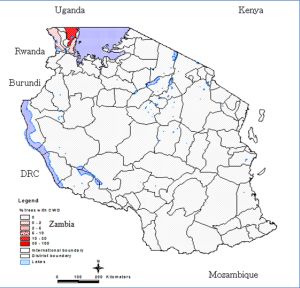 | Fig. 1- Map of Tanzania showing areas infected by Gibberella xylarioides. |
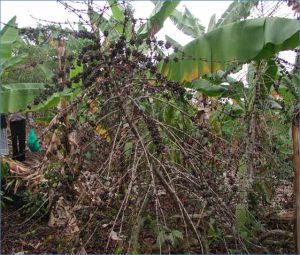 | Fig. 2- Robusta tree infected by Gibberella xylarioides. |
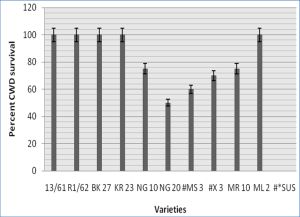 | Fig. 3- Robusta varieties survived artificial inoculation with G. xylarioides after 270 days. Key-£50% survivors considered good sources for CWD resistance # and/ or *Commercial Robusta varieties |
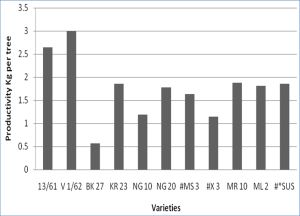 | Fig. 4- Mean productivity of Robusta varieties tested for their resistance to CWD for five years. Key- # and/ or *commercial Robusta clones |
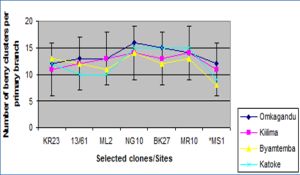 | Fig. 5- Performance of selected Robusta clones on the number of berry clusters per primary branches. |
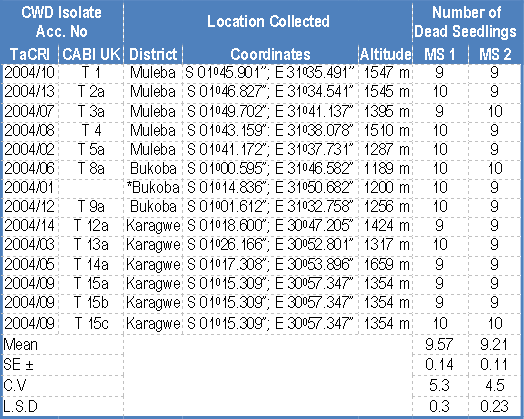 | Table 1- Pathogenicity test results of Giberella xylarioides on MS 1 and MS 2. |
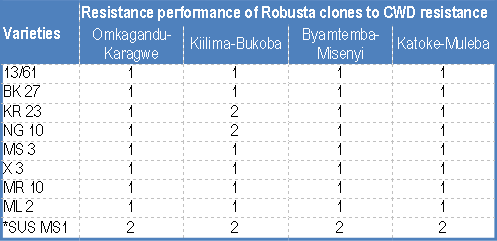 | Table 2- Performance of the Clones to CWD Resistance in the Four Multilocational Trial Sites. |
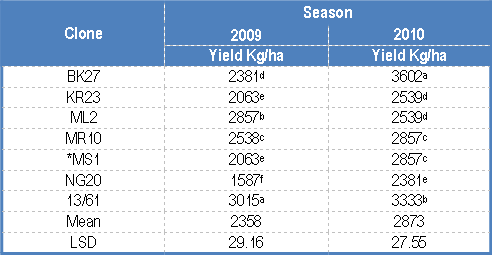 | Table 3- Mean yields of selected clones in 2009 and 2010. Key-*= control, Figures followed by same letters are not significantly different |
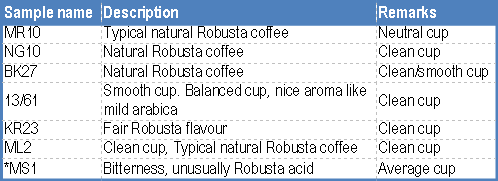 | Table 4- Summary of the beverage assessment of four selected Robusta clones 2010. Key: *Control |