


ISSN : 2278-9847
EISSN : 2278-9855



MEENAKUMARI T.1*, SHEKHAR M.2
1Department of Zoology, B.V. Bhomaraddy College of UG and PG Bidar- 590 014, Karnataka, India.
2Department of Biotechnology, Bangalore University, Bangalore- 560 056, Karnataka, India.
* Corresponding Author : meena862@yahoo.in
Received : 12-06-2012 Accepted : 19-07-2012 Published : 23-07-2012
Volume : 1 Issue : 1 Pages : 14 - 16
World Res J Agr Biotechnol 1.1 (2012):14-16
An experiment was conducted to determine the effect of vermicompost and other fertilizers on growth, yield and fruit quality of tomato in the field condition. The field trails were conducted using different fertilizers having equal concentration of nutrients to determine their impact on different growth parameters of tomato plants. Six types of experimental plots were prepared whereT1 was kept as control and five others were treated by different category of fertilizers (T2-Chemical fertilizers, T3-Farm Yard Manure (FYM), T4-Vermicompost, T5 and T6- FYM supplemented with chemical fertilizers and vermicompost supplemented with chemical fertilizer respectively).The treatment plots (T6) showed 73% better yield of fruits than control, Besides, vermicompost supplemented with N.P.K treated plots (T5) displayed better results with regard to fresh weight of leaves, dry weight of leaves, dry weight of fruits, number of branches and number of fruits per plant from other fertilizers treated plants.
Vermicopost, growth, Chemical fertilizers, Tomato plant.
The ability of some earthworm to consume and breakdown a wide range of organic residues such as sewage sludge, animal wastes, crop residues and industrial refuse is well known. The use of organic amendments such as traditional thermophilic composts has been recognized generally as an effective means for improving soil aggregation structure and fertility increasing microbial diversity and populations improving the moisture holding capacity of soil (CEC) and increasing crop yields.
The green revolution in India promoted the indiscriminate use of chemical fertilizer and pesticides to obtain a better crop yield. In course of time, the tropical soil after receiving such chemicals turned unproductive due to lack of proper amendments of organic matters [11] . The best alternative of the present day’s environmental degradation is to make proper use of the available unutilized organic biodegradable wastes in order to convert them into compost within a short period. Vermicompost could be used as an excellent soil amendment for main fields and nursery beds and has been reported to be useful in raising nursery species plants. In nature, some time plants follow altered growth patterns such as negative geotropism of roots, stem elongation and dwarfing, shortening of vegetative phase, enhancement of leaf area, photosynthetic rate, flowering and fruiting by matured plants. Edwards (1988) reported that vermicompost could promote early and vigorous growth of seedlings. Vermicompost has found to effectively enhance the root formation, elongation of stem and production of biomass, vegetables, ornamental plants etc. [2,3,8,10,11] . Ghosh et al. (1999) observed that integration of vermicompost with inorganic fertilizers tended to increase the yield of crops viz- potato, rape seed, mulberry and marigold over other traditional composts. The application of vermicompost rendered better performance in respect of all round growth of mulberry plants in the lateritic soil of South West Bengal [5] . The nutrient level, especially the (macro or micro-nutrients) were found to be always higher than the compost derived from other methods [10] . One of the unique features of vermicompost is that during the process of conversion of various organic wastes by earthworms, many of the nutrients are changed to their available forms in order to make them easily utilizable by plants. Therefore, vermicomposts have higher level of available nutrients like nitrate or ammonium nitrogen, exchangeable phosphorous and soluble potassium, calcium and magnesium derived from the wastes [4] . The paper has attempted to evaluate comparative efficacies of vermicompost developed by indigenous method on tomato plants.
The effect of vermicompost in comparison to other organic and chemical fertilizers was tested on gotya variety tomato plants (Lycopersicon esculentum) through randomized block design method [12] . All total 96 seedlings having 21 days time were sown in the field prepared following standard method of agronomy. The field trial experiments were undertaken in the university study site during November 2010 to March 2011. The air temperature during the experiment period varied from 18°C (December, 2005) to 26°C (March, 2006). Prior to this experimental study, nutrient status of different fertilizers and soil characteristics of study site were estimated [Table-1] .
Before introduction of vermicompost as fertilizer, only nitrogen content of different fertilizers Farm Yard Manure (FYM) and chemical was estimated. Amount of nitrogen present in vermicompost was considered as standard and on the basis of that, the dose of other fertilizers (FYM and chemical fertilizers –urea, single super phosphate, murated potash) were determined and applied to tomato plants in the same ratio [Table-2] .
Effects of these fertilizers on the average yield of the tomato fruits were recorded. All total six treatments were made (T1- Control; T2-Chemical fertilizers; T3-FYM; T4-Vermicompost; T5-FYM supplemented with chemical fertilizers and T6-Vermicompost supplemented with chemical fertilizers) and each treatment was with four replicates.
The effect of these different fertilizers showed significant increase of the fresh weight of leaves, dry weight of leaves, dry weight of fruits, number of branches, number of fruits and yields in terms of fruit production in all the treatments in comparison to controlled one [Table-3] . The yield of vermicompost treated plants was found to be 28,665 Kg/hectare, which was 47% more than the plants in control plots and was very nearer to inorganic fertilizer treated plants (Kg/hectare). This result was statistically significant at 1% level. It was also observed that the plants treated with vermicompost supplemented with Chemical fertilizers displayed (T6) better results than the plants treated separately with vermicompost (T4), chemical fertilizers (T2), FYM (T3) and FYM supplemented with chemical fertilizers (T5) treated plants [Table-3] . In this field trial experiment, it was observed that the plants treated with vermicompost supplemented with chemical fertilizers (T6) displayed better results than the plants treated separately with vermicompost (T4), chemical fertilizer (T2), FYM (T3) and FYM supplemented with chemical fertilizers (T5) treated plants.
Plant’s response to vermicompost showed much better results than any other commercial potting or rooting media. Vermicompost can also influence a number of physical, biological and chemical processes of soil which have their bearings on plant’s growth. In the present research, it was found that only organic fertilizer treated tomato plants (T3 and T4) showed more branching than chemical fertilizer treated plants (T2), but overall stem lengths were higher in chemically treated plants (T2). An interesting result was that organic fertilizer supplemented with chemical fertilizer treated plants (T5 and T6) exhibited better results than the plants treated separately with different fertilizers treated plants (T2-inorganic, T3- FYM and T4-vermicompost) [Table-3] . It has been reported that N.P.K of organic manure require more time for their utilization by plants because of slow releasing of N.P.K. Many hybrid varieties have very high demand for the nutrients. These high demands for chemical fertilizer meets nutrients whereas organic manure initially form conducive environment with regard to physical parameters of soil which promote better root growth and other vegetative growth. It is assured that other factors, such as the presence of beneficial microorganisms or biologically active plant growth influencing substances such as phytohormone are released by beneficial microorganisms present in the vermicompost rich soil [6,13] . Root initiation, increased root biomass, enhanced plant growth and development and sometimes, altera-tions in plant morphology are among the most frequently claimed effects of vermicompost treatment [13] . Stem elongation, dwarfing and early flowering have been found to be because of the hormone effect in a wide variety of plants and in a number of physiological situations, stem elongation is promoted (or inhibited ) by endogenous phytohormones, a class of growthregulating substances which inhibited stem elongation without affecting leaf or flower development (dwarfing agents). Plant and crop physiologists, microbiologists and agronomists agree that plant growth and development are strictly dependent on biological fertility factors. Earthworms stimulate microbial activities and metabolism and also influence microbial populations. As a consequence more available nutrients and microbial metabolites are released into the soil [13] .
[1] Allen S.E., Grinshed H.M., Parkinson J.A. and Quarnty C. (1974) Chemical analysis of ecological materials, New York, 138.
» CrossRef » Google Scholar » PubMed » DOAJ » CAS » Scopus
[2] Atiyeh R.M., Subler S., Edwards C.A. and Metzger J. (1999) Pedobiologia, 43, 724-728.
» CrossRef » Google Scholar » PubMed » DOAJ » CAS » Scopus
[3] Bano K., Kale R.D., Satyavathi G.P. (1993) IV National Symposium Soil, Biology, Ecology, 165-168.
» CrossRef » Google Scholar » PubMed » DOAJ » CAS » Scopus
[4] Buchanan M.A., Russelli E. and Block S.D. (1988) Earthworms in Environmental and waste Management, The Netherlands, 231-9.
» CrossRef » Google Scholar » PubMed » DOAJ » CAS » Scopus
[5] Chakraborty B., Chandra A.K., Chakraborty S.K. (2008) J. Environ. Sociobiol., 5(2), 221-226.
» CrossRef » Google Scholar » PubMed » DOAJ » CAS » Scopus
[6] Edwards C.A. (1998) Earthworm ecology, Boca Raton, Florida, 327-354.
» CrossRef » Google Scholar » PubMed » DOAJ » CAS » Scopus
[7] Ghosh M., Chottopadhya G.N., Baral K., Munsi P.S. (1999) Proceding of the Seminar on Agrotechnology and Environment, 64-68.
» CrossRef » Google Scholar » PubMed » DOAJ » CAS » Scopus
[8] Grappelli A., Tomati U. and Galli E. (1985) Hortic. Sci., 20(5), 874-876.
» CrossRef » Google Scholar » PubMed » DOAJ » CAS » Scopus
[9] Jackson M.L. (1967) Spectrometric determination of phosphorous in soil and plant materials with ascorbic acid, Soil Sci., 109, 214-220.
» CrossRef » Google Scholar » PubMed » DOAJ » CAS » Scopus
[10] Kale R.D. (1998) Proceding National Seminer Org. Waste Utiliz Vermicomp Part B: verms and vermicomposting. Burla, Orissa, 151-156.
» CrossRef » Google Scholar » PubMed » DOAJ » CAS » Scopus
[11] Kale R.D., Bano K., Sreenivasa M.N. and Bagyaraj D.J. (1987) South Indian Hortic., 35, 433- 437.
» CrossRef » Google Scholar » PubMed » DOAJ » CAS » Scopus
[12] Panse V.G. and Sukhatma P.V. (1967) Acta Zoologica Fennica, 196, 11-94.
» CrossRef » Google Scholar » PubMed » DOAJ » CAS » Scopus
[13] Tomati U., Grapppelli A. and Galli E. (1988) Biol. Fertil. Soils., 5, 288-294.
» CrossRef » Google Scholar » PubMed » DOAJ » CAS » Scopus
[14] Walky A. and Black T.A. (1934) Soil Science., 37, 250-260.
» CrossRef » Google Scholar » PubMed » DOAJ » CAS » Scopus
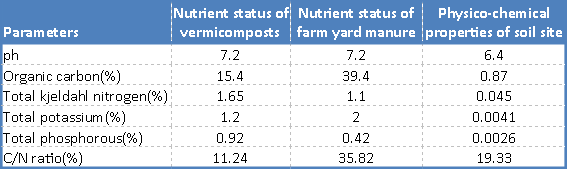 | Table 1- Nutrients status of different fertilizers and soil characteristics of tomato planted study sites. |
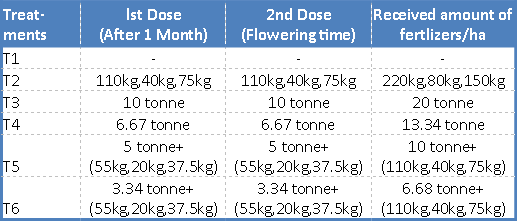 | Table 2- Standardization of dose of different fertilizers based on nutrient status. T1= (Control); T2= (Chemical that is -N.P.K); T3= (Farm yard manure); T4= (Vermicompost); T5=(50% farm yard manure + 50 % Chemical fertilizers that is NPK) and T6= (5 0% Vermicompost + 50% Chemical fertilizers that is NPK). |
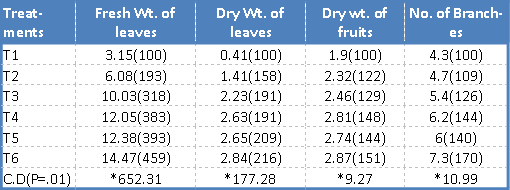 | Table 3- Effect of different fertilizers on different vegetative parameters and yield of tomato crop. T1= (Control); T2= (Chemical that is N.P.K); T3= (farm yard manure); T4= (Vermicompost); T5=(50% farm yard manure + 50 % Chemical fertilizers that is NPK) and T6= (5 0% Vermicompost + 50 % Chemical fertilizers that is NPK). |